15 Years of Ministry of Sound
World Wide · 10.10.2006
By Александр Баулин
Not so long ago a rather significant and impressive anniversary was celebrated – Britain's best-known club, Ministry of Sound, turned a full 15 years old. The celebration ran two nights straight. Invited as distinguished guests were CJ Mackintosh, Marc Hughes, Jazzy M, Mark Knight, Steve Angello, Justin Berkman (co-founder of Ministry of Sound) and one of the pioneers of the British electronic scene – Danny Rampling. The venue's official website reports on the wild atmosphere that reigned within its walls, when over the course of the party the attendees got to return to the very roots and relive all the best moments of the club's life and hear all the immortalized hits... It's no longer a secret that a Russian Ministry of Sound will soon open in Moscow, so the question — "what is this brand really today and what should we expect from it?" — is more than relevant.
The famous club opened in the south of London, in the small neighborhood of Elephant & Castle, on the site of an abandoned bus depot. Its founder was James Palumbo, son of the property developer Lord Peter Palumbo. He was inspired by American clubs and decided to try his luck back home. The place was grimy, but exactly in the spirit of the hangars and abandoned warehouses so typical for holding dance parties in the early 90s. Across the River Thames, opposite Tower Bridge and next to the Dracula museum, the club sat in a dark brick building. Going down a long staircase, you found yourself in a spacious round hall, from which you could then reach the chill-out zones and restrooms.
The first DJ to play at the very first party at Ministry was Jazzy M. Interestingly, the club officially opened only in 1992, and until then it hosted underground nighttime parties, but thanks to them and the rumors those events generated, on the day it stepped out of the shadows the club was literally packed. Such popularity allowed it, in that same year of 1992, to set off on its first club tour. In 1994 Ministry launched Friday techno parties in Ibiza, and three years after that it ran its first tour to China, titled "Slow Boat to China".
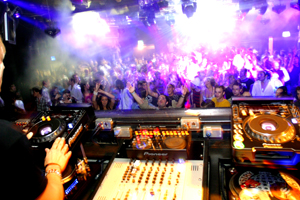
What's interesting is that, literally from its first days, the venue adopts as its policy a refusal to sell alcohol at the bar. This fact, along with its geographical remoteness from the center and its extremely powerful audio system, which the club can still boast to this day, set it apart from its competitors. And all of it taken together constantly drew large numbers of music fans to it. Today the club consists of two big dancefloors and a Sony PlayStation zone; what immediately catches the eye are four sound rigs – one of the club's main assets – as well as decent lighting and a few lasers, and an entrance ticket costs around 20 pounds. As for booze, it is, of course, sold there and was sold before, but Ministry's ideologues nonetheless insist on their concept of "no to alcohol, all attention to the music". Either they turn a blind eye to the sale of spirits, or they stubbornly deceive their guests with such statements. After all, any nightclub's income comes in large part precisely from these drinks...

It would hardly be an exaggeration to say that Ministry of Sound was one of the key clubs where house music as such took shape, and it had a great influence on shaping English club life in the form we know it now. House music always held a special place at the club — sometimes it was even called the "House of House". There is also the other, dark side of this matter known: the absence of a proper bar and cocktail menu at the club pushed many guests toward another extreme – drugs, or heavy drinking before and after parties – and in the end, for many, the club came to be nicknamed "Misery", which means "suffering"... But let's not belittle the club's considerable merits. Saturday night here has long been the traditional time for house parties ("Saturday Sessions") featuring the most relevant and talented DJs and musicians. So that these words don't come across as merely an advertising slogan, it's worth noting that Ministry of Sound is still the only club in London to have such DJs as Pete Tong, Deep Dish, Sander Kleinenberg, DJ Sneak, Smokin Jo, Nic Fanciulli, Yousef, Mark Knight and Steve Angello on exclusive residency. On Fridays you can hear completely different music there. For a year now, on that night the club has been playing an eclectic mix of Drum&Bass and Hip Hop at the "Switch" parties. In 1993 the Ministry of Sound label came into being, and its first release was a mix by Tony Humphries. Six years later, thanks to ATB's breakout hit "9pm Till I Come", the label reached the coveted number-one chart spot for the first time. And in 2004 Eric Prydz, with his hit "Call on Me", repeated this success, even managing to stay at the top for 16 weeks. Around the same time Smoove Records, controlled by the label, was born. In January 2006 Ministry bought the famous Hed Kandi label from Guardian Media Group and plans to develop it in every way. One can, however, say with confidence about the label that today it is no less famous than the club, and a new generation of partygoers often learns of it before its older brother. Here is just an incomplete list of the best-known compilations released on Ministry: Chillout Sessions, Clubber's Guide, Club Nation, Club Nation America, Dance Nation, Funky House Sessions, Hard NRG, Jungle Rewind, The Annual, Trance Nation, Trance Nation America.
9 years ago Ministry of Sound Radio first came into being, broadcasting David Morales's live sets from the club. However, in December 2002 it shut down, surviving only in its Internet version. But, to the delight of all the brand's fans, this summer they once again got the chance to catch this radio on the Sky Digital EPG satellite.
In March 2002 the club opens its first branch abroad – in Bangkok, Thailand, though it no longer operates today. On the other hand, in 2003 another franchised Ministry of Sound appears in Taipei, Taiwan, still open to visitors to this day. Last year Ministry of Sound – Red Sea threw open its doors in Egypt, and in the town of Harrogate, in the county of Yorkshire, the alcohol-serving MoS Mini Bar opened. And finally, on December 16, yet another new club begins operating, this time in Singapore.
Even this cursory overview is probably enough to assert that the brand's current position can be characterized as nothing other than steadily developing. Incidentally, its 2004 earnings allowed its owner to make it into the ranks of the 300 wealthiest citizens of Great Britain according to the Sunday Times, with an annual income of 136 million pounds sterling.
What awaits us here in Moscow isn't yet entirely clear. The wait, however, won't be long – from the information already available, it's known that Ministry of Sound will open in the capital, on Savvinskaya Embankment, before the end of this year. And one would like to believe that it will become for us what it once became for the residents of foggy Albion.