Arduino – Homemade Hi-Tech
Техника · 06.01.2009
By Максим - The Lizard - Милютенко
Probably each of us has already wondered why modern computers, with their unlimited capabilities, are still controlled only by a mouse (or trackpad) or a keyboard. Indeed, you couldn't call these interfaces anything but archaic. Why can't we use our natural movements and other properties of our body to interact with technology?
Physical Computing – that's the name of this technological field, and over the last few years it has been approaching our everyday life in seven-league strides. Not long ago such developments required the joint efforts of the best scientists and a powerful technological base. Cutting-edge engineering ideas could be embodied in devices only by other engineers, and for "creatives" – artists, musicians, designers – they remained completely inaccessible. But now a new platform has appeared that allows prototypes of such devices to be created with minimal preparation – Arduino.
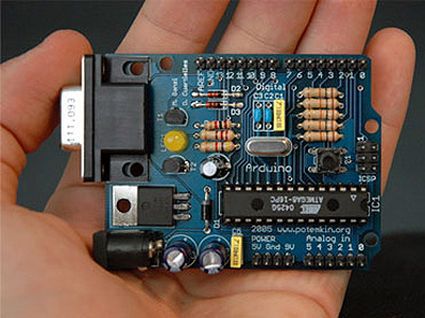
Arduino is a small town in Italy where a group of students and professors devised the software-and-hardware platform of the same name for the simplified development of new electronic devices. In essence, it's a microcontroller placed on a small board that understands signals from various sensors (input) and is capable of controlling other devices (output). Examples of input signals can be simple switches – a button or a photocell – or sensors – accelerometers, sensors for pressure, temperature, brightness, humidity and so on. Outputs can be digital (for example, USB) or analog (servomechanisms, electric motors, light bulbs, dimmers – anything that works with voltage). The board exchanges data with a computer on which special software is installed. Arduino boards have already gone on sale, and all the engineering and programming documentation is posted in open access.
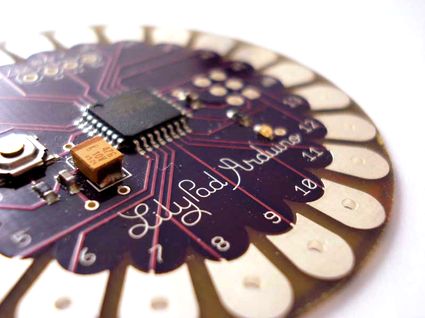
In effect, Arduino is becoming for physical computing the very same thing that Flash became for animation and web design. In essence, a democratization has begun in the field of electronic device-building. Enthusiasts rushed to explore the possibilities of the new platform. It all started with art installations. For example, they created a "talking" model of a stomach, which you can step into, touch one or another of its plush parts and hear a corresponding rumble or gurgle.

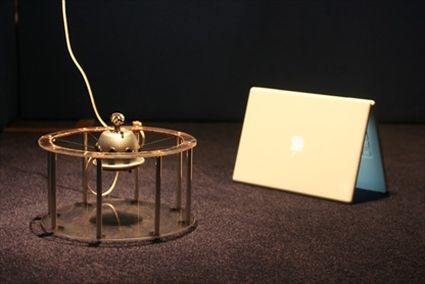
In Malmö, Norway, the lighting of a bridge changes depending on where and how hard pedestrians tread on it. A group led by Miles Thorogood studied the behaviour of Australian magpies and modelled their population using objects hung on a tree: microsculptures equipped with speakers emit changing sounds, depending on the sway of the wind or the approach of people. German developers made a new musical instrument out of bicycle pumps, and American ones – out of a ball suspended from a metal ring by elastic threads.
By the way, the fact that Arduino finds a lively response among musicians and inventors of musical instruments is entirely logical. A traditional musical instrument has always become an extension of the musician's body, a part of it – anyone who has tried to play the guitar knows this. Electronic instruments have until now required purely intellectual control – by means of a computer keyboard and mouse. Now, however, a new generation of improvisation will become possible, a sort of "physical jam session" with a synthesizer.
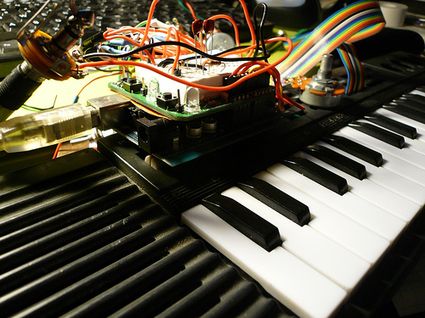
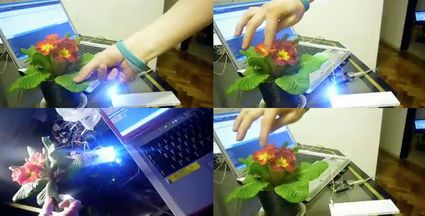
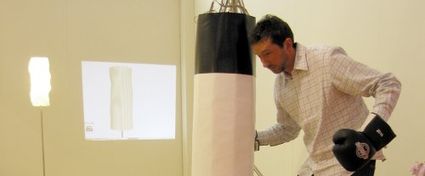
But more "useful" devices are being tested too. A special belt analyzes which direction its wearer is moving in, and with the help of vibrators hints where north is. Special sneakers beep if your gait becomes orthopedically unsound. A club door opens only if you kiss the entrance door. A smart chair automatically adjusts itself so that you don't slouch on it. A houseplant connected to an Arduino board sends an SMS with the text "please water me," and having received the needed portion of moisture (also via an SMS message that switches on a watering can), it graciously thanks its owner. Clothing designers weren't forgotten either: special LEDs sewn into clothes blink or change colour depending on the movements of the wrist. And Austrian specialists hung sensors all over a punching bag; by striking the bag, you can alter its original cylindrical shape, and then, based on the shape of the crumpled cylinder, a unique lamp is manufactured.
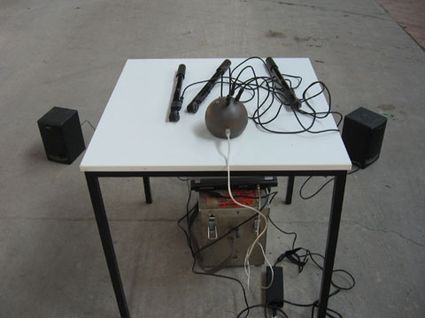
One of the very promising areas of application for physical computing in everyday life is the "smart home." Indeed, isn't it strange that thousand-dollar designer lamps still use a penny toggle switch with "on" and "off" functions? And yet now you can change the colour, brightness and anything else depending on where the master of the house is, and even on his mood. A simple programme that turns music on in the room a person has entered, and turns it off in the other rooms, has also already been developed using Arduino.
Of course, this technology is still only developing – otherwise such products would already be on the shelves under world-famous brands. Some products, for example the iPhone, already use physical computing: the built-in motion sensor is used in games and other applications. Unified standards have not yet been adopted, and for now Arduino engineers are forced to send each other photographs to explain modifications to one board or another. As with the Flash application, a bit of programmers' work is still required to make, say, an unusual musical instrument on the basis of physical computing. But the advantages of the open platform are obvious, and news of ever more applications arrives literally by the minute.
Have no doubt, soon Arduino will be working in our living rooms, kitchens, studies and gyms, and instead of "Lego" the kids will be tinkering with sensors, a laptop and an Arduino board.