Auto-translated by 44100Hz.
Read the Russian original →
B-Voice & KillaHertz
Интервью · 03.01.2009
By Дмитрий Гримм
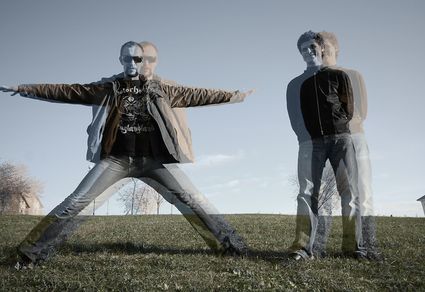
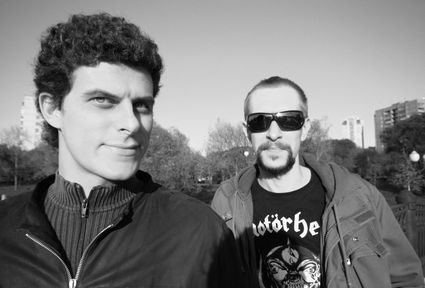
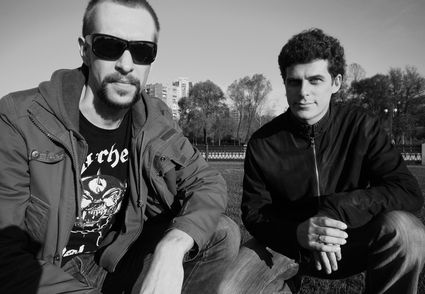
Quite recently, the well-known Moscow techno duo B-Voice & Khz released a recording of a live performance on the domestic label National Techno, the presentation of which was a great success at the club 'Gorod'. In an interview with 44100Hz, Vasily Konstantinovsky (B-Voice) and Egor 'Killahertz' Sukharev talked about how their joint work is developing and evolving, where the boundaries of the musicians' authority lie within the B-Voice & Khz project, who influenced their personal development and much more...
44100Hz: How did it come about that you started making electronic music?
B-Voice:
Once, around '95–96, I came to the club 'Ptyuch', where I danced for 14 hours. And only at the end of the party did I wonder why the music didn't stop, and what kind of alchemy with records was going on there… After that something clicked inside, and that's how, in fact, I caught fire to become a DJ. Some time later I was offered to do an arrangement for Dmitry Malikov. I came to the studio to discuss the details, and there were three sets of speakers, a huge mixing desk, synthesizers I'd only seen in magazines. I knew absolutely nothing about the process of making remixes and arrangements, but I said that of course I'd work day and night. Teaming up with Dima Feelgood, who by that time already understood the production process very well, we started writing something.
44100Hz: Egor?
KHz:
At the institute where I studied there was one guy who made breakbeat in trackers (a type of computer program for creating musical compositions – ed.) no worse than Prodigy. For me that was a very powerful musical shock. Then I took up drum'n'bass, but not very successfully. I wanted to make electronic music, but my technical knowledge, however, was rather scant; my tastes gradually changed – I listened to one thing but wanted to create something completely different… In the end it all led to what there is now – a computer, monitors and a couple of drum machines.
44100Hz: Egor, is it true that you used to work in government structures?
KHz:
Yes, I worked in the State Duma for 6.5 years. It was such a routine, which I gave up in favour of music, and I don't regret it at all; besides, I started getting enough sleep. Now there's no need to go to work, because other, more pleasant, sources of income have appeared.
44100Hz: Let's talk about your music – what is it like now and where is it heading?
B-Voice:
Everything was and is very spontaneous. Sometimes we want some kind of super-deep stuff with live instruments, sometimes, on the contrary, dancefloor bangers. It all depends, for instance, on the events we're going to play at. Sometimes you subconsciously think about it while working on another track. Right now I want to do house music, Egor – something else. Before, we did everything more or less together – fifty-fifty..
44100Hz: What do you mean?
KHz:
There's no division of who wants to work on what. It heavily depends on the weather, the mood, how busy Vasya or I am. It's our shared occupation regardless of the degree of participation.
44100Hz: Are there any zones of authority? For example, mastering is Egor's domain, and building the track is Vasya's?
KHz:
Of course there are. There's the zone by the sofa – that's my zone, and there my authority reigns. I brought in the second set of speakers and I practically don't get up off the sofa; everything I need is right there: the Xbox and the ashtray. And there's the desk – and there Vasya's authority reigns.
B-Voice:
When I'm writing something, Egor is preparing for his video performances. And vice versa – I'm gathering records for a set, and Egor is writing.
44100Hz: How long ago did this way of working appear?
KHz:
About a couple of months ago. We never agreed on anything specific, there are no constraints. Everything goes as it goes.
44100Hz: During live performances, how does the division work?
B-Voice:
Before, we used to take along a pile of all sorts of gear, drum machines, effects, and tried somehow to manage it all. Now we limit ourselves to two computers. I handle building the track, Egor – the effects and sequences, but we can always swap everything around. We try to experiment and surprise ourselves.
44100Hz: What motivates you to create music?
B-Voice:
Sometimes the desire to convey your state, to express yourself; sometimes a craving for experiments. Egor also has video, whereas I got to know the whole world through my ears and only in adulthood did I 'see the light' – I started getting into visuals, cinema and so on.
KHz:
Sometimes because I'm bored, sometimes because I'm sad, sometimes because I'm cheerful. I can't name any specific reasons for this occupation.
44100Hz: When inspiration comes, you mean?
KHz:
I don't really believe in inspiration... Problems in communication, inadequacy, talent, inspiration – what pushes you to write music? – it's very strange to talk about this.
44100Hz: A disc with your live performance recently came out on the label National Techno. Why did you decide to collaborate with them rather than start your own label?
KHz:
We don't have free time that we could devote to a label, and it's very good that there are people who deal with this, especially ones who are kindred spirits, friends.
44100Hz: Egor, on the cover of the disc you're bearded – is the beard real or fake?
KHz:
It's mine. Grew it myself; too lazy to shave – you wake up in the morning and there's nothing to do, wonderful!
44100Hz: What do you think of the label National Techno, what are your expectations from the collaboration?
B-Voice:
They've only just started developing and have already achieved certain results and some recognition, even though there have been very few releases. I think everything here is serious.
44100Hz: Can you name musicians you find appealing?
B-Voice:
I can single out an interesting character from Odessa, Technique; the project De:Se – who moved to Piter from Stavropol; Krasnodar's Modul, Roma Korablev. My latest revelation is a mate from Rotterdam, Joachim, founder of the label Sound Architecture. He makes jazzy music, full of groove and mood, which you can play in a club and listen to at home. Also the Berlin crew Bar 25 – I can't recall all the names, they're all very different and interesting... Freund der Familie, Skinnerbox, Dop.
KHz:
I really like the project ZimaLeto from Alma-Ata; they make a kind of shamanic music, urban hypnosis. Also the project akkord-i-on – strange glitch with a processed accordion.
44100Hz: What do you think about the conflict between media such as vinyl and digital?
B-Voice:
The fear of losing vinyl has gradually passed. When digital appeared, everyone reacted very jealously to it, like a house cat to a dog brought in off the street. Now it's all calmed down; vinyl won't disappear, both will coexist, and everyone will simply decide for themselves what's more convenient and necessary for them.
44100Hz: Are there events or people who influenced or changed you?
B-Voice:
Henry Miller. Long ago, I was riding a train to Kharkov, read the first 50 pages of his book and asked myself: 'How can one live like that?' And then it drew me in, and I started looking at the same things differently. Kubikov influenced me musically... he was the first to get released in the West. Once we carried his first synthesizer home to him, a blue Yamaha CS-1x. We came home, played on it, not understanding at all what it was or what it was for, and a couple of years later his tracks come out on famous German labels. That definitely served as an example.
KHz:
In childhood – my parents. And also jazz on records at my uncle's in Dnepropetrovsk, older schoolkids with 'Elektronika' tape recorders round the neighbourhood, extracurricular calligraphy classes, the cats Vaflya and Marusya.
Photographs: Feodor Miller
