Berlin Air
World Wide · 14.12.2010
By Александра Беркович
Berlin is a very unusual European capital. But we won't tell you about the city's history, its restaurants or its club life — we'll tell you about its people…
The three people we spoke with in this city are unlike one another, yet they have something in common. In Berlin they breathe easily. And it is a city that has become their own.
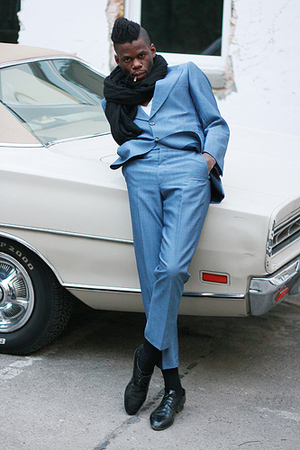
A year and a half.
It could have been Hong Kong, for example, but it just so happened to be Berlin. I came here for the first time about 6 years ago, and I was wildly taken with the city and the atmosphere. In Paris it became unbearable — something happened to Paris. It got very boring there; people there only want to do something "about themselves", it doesn't matter exactly what, as long as it glorifies them. So I thought: "well now, what about other cities? Los Angeles, say, or Berlin?" — and I chose Berlin.
It's funny — on the one hand, Berlin is incredibly cool, because a mass of creative people from all over the world is concentrated here right now, but on the other hand, you yourself become just one of many, everyone around is doing the same thing — every second person is a writer, an artist, a composer. Moving to Berlin greatly influenced me and my work. I play music live, and when that happens, the atmosphere and the audience listening are very important — all of it has an effect and becomes part of it, and so my work has changed a great deal.
I actually go to a language school here and study German; it's very different from French and English, and I want to become part of what's going on around me, because the language, of course, creates a certain barrier, but when you start learning it, you realize what a wonderful language it is — so neat, precise and rich.
For me it's EasyJet. It really is happening, and I like it. Thanks to it, I'm here.
Right now we're putting out a new album, and I write a lot — almost every day I write several songs; I've already accumulated several hundred songs of finished material.
Hmm... I wake up early, I love reading, almost every day I read a book. I love real literature — among the Russians, for instance, I really like Sorokin, I've already read 5 or 6 of his books. I also love to cook, I almost never eat in restaurants; for me it's like music, like a live performance — I mix all the cuisines, all the ingredients and seasonings, it's a rush. So, an ideal day is to wake up, read a book, cook some food, eat well, make love — very simple things, you know, that's actually how I live! In the evening you can go out somewhere, dance your heart out, come home and write a song, something like that.
Oh yes, it happens here all the time — so many completely different and interesting events. Practically everywhere, in every venue, there are excellent sound systems, so it all depends on the promo group organizing the event. On different days, in the same place, there can be techno, reggae or classical. There are lots of truly professional people, plus lots of enthusiasts doing their own thing.
East, of course. Something's always happening here. I live in the eastern part of Kreuzberg, practically in East Berlin.
By bicycle. Even in winter. In winter it's refreshing, it clears your head! The city's mood is completely different in winter, a different atmosphere; I even like it more than summer — there are few people on the streets, everything's frozen, as if on pause, a little sad and melancholic, simple and transparent... I like it! And I'm not afraid of the cold.
I'd love to visit Moscow! And Los Angeles too; I've been to New York, I have lots of friends there, but Los Angeles I've only heard about — there are lots of different people there, everyone's open to any experiment, lots of music, lots going on. The only downside of Los Angeles is the absence of winter.
Oh, it's a waste of time, seriously. I simply don't have time for it. I already told you I love reading, I read a book a day. Just imagine how much that takes. And a mobile and social networks are sheer procrastination. It's just not for me. Nonetheless, I communicate with people perfectly well — I have email, and that's enough! Here we are, we met and we're getting along wonderfully. It's like driving a car versus walking, you understand? I just walk, that's all.
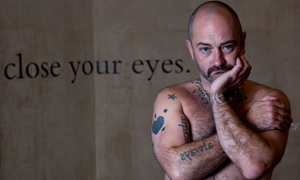
Love! Love drives me to many things: back in the day I moved to New York because I was in love with a girl from New York, but alas, it didn't work out between us, and I decided to go back to Glasgow; on the way I stopped off briefly in Manchester — a big project was being prepared there, which I'd been invited to take part in — and I fell in love!
I could have ended up in Tel Aviv — my girlfriend is Israeli, but she lives in Berlin, so you could say I got lucky. I love Berlin very much; in fact I'd already lived in Berlin before — in 1997 — but as it happened, I left.
I can't live in East Berlin. Back then, in the nineties, I lived in Charlottenburg, and now we live in Kreuzberg. I recently watched that film — "The Lives of Others". It's a very beautiful, wonderfully made film, but when you walk around Prenzlauer Berg after that film, you of course look at everything differently.
It's inexpensive here, and at the same time the quality of life is high — I probably shouldn't say this, because we don't want a whole crowd of people to rush to Berlin.
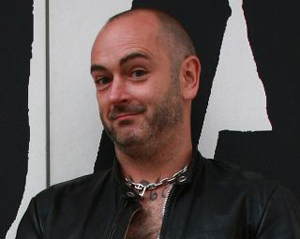
I don't go out to party very often at all — at one time I overdid it with the partying — but in Berlin I love it like nowhere else, because here relationships between people are simple, everyone supports one another, a warm atmosphere. Berlin is ruled by some strange, wild energy that arose from this "east-west" standoff. Everything is passionate and passively-calm at the same time. The people and the space are open — I missed that in New York, for example. In Berlin there's physically a lot of space, and I think that affects the city's atmosphere. At the same time, it's a very liveable city — I ride to work on a bicycle every day.
In Berlin there's none of that fetish of the artist that exists in London and New York; here they won't put you on the covers of glossy magazines. In London, in New York, and in Berlin there's simply an incredible number of artists, and so I don't think it's a matter of numbers, but simply of a different attitude to life and creativity. In Berlin I have no gallery, for example, and I'm happy! No contracts, no obligations. In general there are no obligations in Berlin — that's what's nice.
I'm absolutely happy to have broken away from Britain. Just imagine: I speak with my girlfriend in English, she speaks with our daughter in Hebrew, our nanny is Portuguese, not a word of English, so I speak with her in French, and she speaks with our daughter in Portuguese, and from time to time in German; sometimes a Russian woman comes to clean for us, and she sings in Russian while she works. That would never have happened to me in London or Glasgow, and I love it, and I love that my daughter is growing up in such a multinational context.
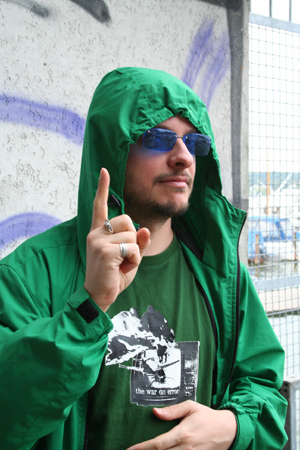
Depends how you count — you could say since 2001, or since 1984. The first time I came to East Berlin was in 1984, the Orwell year, incidentally, and it was probably the most Orwellian city at the time. My mother and I came out of the Ostbahnhof station, right there where the East Side Gallery is now, got into a taxi and drove along the wall...
The Wall is the kind of object that to this day defines the whole city to a certain degree. You can interpret and perceive it in different ways. I saw it back then, in the flesh, and naturally it broke my brain forever. Like everyone who saw it and lived through it, most people can't forget it. It's such a psychedelically-real thing, such a fantastical border, beyond which a completely different world begins.
A strange thing happened to me: in 2004, exactly 20 years after my first visit, one night I accidentally got on the wrong bus, got absorbed in reading and rode off to the completely opposite end of the city — and ended up on exactly the street where I had lived in 1984, in the then still utterly unshakeable Soviet Berlin. It was quite a trip for me when I suddenly realized it. For some reason, on some mystical level, I'm certain that Berlin is exactly the place where I need to be right now. And not only me — I'd recommend it to many.
Berlin now is like New York in the 80s-90s. It's the centre of the world, a centre of bohemia, creativity, freedom. The secret, the reason for this special atmosphere that has taken hold here, is this: West Berlin was a special zone of the FRG, with a special status — those who came here from West Germany were exempt from military service. People were lured here. All the pacifists gravitated here. There was a preferential tax status — you could avoid taxes. Newcomers were given housing, some funds; the city was pumped full of money. In general, economic laws didn't apply here. Here you could do nothing, or do something in a very relaxed way. It was a symbol of the Western world, a kind of VDNKh of the Western world — everyone was supposed to know that it was very cool here.
And in the East, correspondingly, there was no economy either, because what economy was there — a planned one. The sausages were very tasty, but otherwise it was a total mess. When everything went belly-up — it went belly-up not only in the East, but in the West too, because the special status vanished and the flows of money dried up. And in the end the East sort of rose in living standards and everything else, while the West sagged. And a kind of middle level, a balance, was established. Had it not been the capital, at that moment Berlin would have turned into ruins. There's no big business here, no manufacturing, with a few small exceptions. But the state is forced to support the capital, and so life here doesn't stop.
Fewer people live in Berlin now than before reunification. Besides those who fled from East Berlin to the West, a huge number of people left West Berlin — for example, the American, British and French troops that were stationed in West Berlin. What's happening here is a countertrend to the rest of the economic world; this city exists outside economic logic. And there are positive aspects to that. It gives all sorts of creative processes the chance to develop without economic pressure. It's an interesting space outside the systems. And now this attracts a large number of people; a new cycle has begun. If in the 90s it was very revolutionary and alternative — a kind of punk movement — now it's people with MacBooks. But it's still a very creative atmosphere.
What's more, the city's population growth comes mainly from foreigners — Germans leave, and young creative people from other places arrive. A clerk won't come here to build a career in a bank, but a person will come to, say, form his own band. And from a business point of view that probably gives little, but from a creative point of view it bears fruit. Take, for example, the band BONAPARTE — it's led by a Swiss guy, the band formed in Barcelona, and now they're based in Berlin.
You get the impression that life here is so easy that all those crowds of creative people in Berlin do nothing and nothing truly vivid happens... That's not so — in fact, within the creative milieu the competition here is very fierce. A dual situation has formed here — everyone is very friendly and nice, a kind of brotherhood, but at the slightest hope of success they'll walk right over you. Because everyone, one way or another, wants success, whether its material manifestations or a media rise. There are, of course, countersystem artists who don't seek success as such and create for the sake of "art". A vivid representative of that current is Aljoscha Rompe, the man who led the band Feeling B — the coolest alternative band of the GDR, out of which Rammstein subsequently emerged. He was a man who embodied absolute alternativeness to everything — a squatter, a punk, a citizen of Switzerland who returned to the GDR of his own accord. Some cultural phenomenon or other is constantly appearing in Berlin. Take, for example, today's hero of Berlin — Alexander Marcus.
I now write in German, at least I try to, I take part in German poetry readings. German isn't my native language, I don't have a perfect command of it, but nonetheless over several years I've accumulated enough German-language material for a whole book. I've performed at poetry slams and even won, in 2007, the international competition of the Berlin Literature Festival.
In my work I try to adapt Russian absurdist poetry to the German language, while conveying a cross-linguistic message.
I feel like a stranger among my own. Even in Russia I always felt like a stranger, and when I came here that feeling simply became normal — here it really is so. Today poetry flourishes in Berlin — stage poetry, poetic performance; there's just an incredible poetic blossoming here — a huge movement, poetry slams gather several thousand spectators, and the winners become media figures. And that's just one strand in poetry; there's also a strand like literary performance, for which there isn't even a term in Russian yet — it's like a rock band, only everyone in it is a writer, creating texts that are genuinely interesting to listen to. It's a kind of literary reading, but delivered very powerfully. It's a real, major cultural phenomenon.
My dream is to write a book like that in prose, in German — it could be a novel or a series of stories reflecting my experience of infiltration. I feel like a kind of Superman in reverse — as we know, Superman flew to Earth from a dead planet; likewise I flew to Berlin from the dead planet of the Soviet Union, only Superman possessed superpowers, whereas I possess something more like super-weaknesses. And this book will be executed in the form of an official diary, a report to one's superiors on the progress of the operation, so to speak. For conceptual reasons this text must be written in German.
There are many foreigners here who write in German — Russians, Serbs, Turks, Italians. The German language is unexpectedly becoming an international language that unites all these diasporas. Even though it seems so conservative and doesn't like anything foreign.
It's the "PANDA not-only-Russian theatre". PANDA stands for Poetry Art Network Dream Action. Officially PANDA has existed since January 2010 and is located in the Kulturbrauerei. Working on Panda together with me are Pyotr Goryev and several enthusiast-activists. We combine musical, poetic and art-performance projects with a human-rights, oppositional flavour.
Among our latest projects is an action called ARA — the Anti-Fascist Russian Action in support of the Khimki hostages, the anti-fascists, as well as a signature-gathering action in solidarity with Oleg Mavromatti, a Russian actionist artist whom Bulgaria may extradite to Russia, where a prison term awaits him for one of his performances.
We try to invite to our theatre not only Russian oppositionists but also representatives of other nations — we've formed a great connection with Lithuania, many musical and poetic projects come and perform at our theatre, and there are plans to invite representatives of the Iranian diaspora. On top of everything, we organize the biggest poetry slam outside Russia.
I'm a supporter of globalization! I believe that all the remnants of socialism should be swept away, all the communists should be sent to Nepal, and West Berlin should be restored, walled off and funded. Joke.