Damian Lazarus. Rise and walk
Интервью · 27.02.2006
By Филипп Миронов
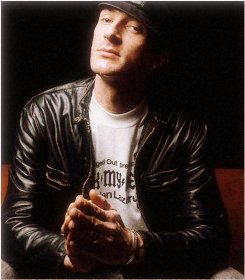
London DJ Damian Lazarus is a puppeteer, an eminence grise and an all-powerful vizier serving one shah-in-shah after another. Cranking out his mixes, he drives the evolution of music on this planet.
In 2001 the former music editor of the cult magazine Dazed&Confused - who counted interviews with Mathieu Kassovitz and Gizmo from The Muppet Show as the main events of his journalistic career - found himself at the freshly minted label City Rockers. Lazarus had dabbled in management work at London record companies before, but at City Rockers the whole policy of the label was concentrated in his hands. Thanks to Damian, the label released the record "Kittenz & Thee Glitz" by the half-forgotten second-tier Chicago producer Felix Stallings. And a year later it also put out the vinyl "Sunglasses By Night" by the then-unknown Canadian upstart Tiga and the Finn Jori Hulkkonen (Zyntherius). Indeed, these two works, together with Miss Kittin's "First Album" reissued in America, marked a watershed in musical time. Just as historiographers hold that the 20th century began not with the calendar year 1900 but with the assassination of Franz Ferdinand and the World War, so in music the new century arrived in 2002, when the double vinyl compilation "City Rockers Present Futurism" - an interim summation of Damian Lazarus's directorship - was released. Everything that came before it - Detroit techno, gloomy disco-house, Scottish deep-house, Belgian hardcore and the band "Ivanushki" - was left in the past forever.
The call caught Damian during his lunch break.
Are you somewhere near the "Crosstown Rebels" office right now?
Yes, your call caught me right on the way back to the office. We're working hard right now - a ton of releases are coming up, and I always try to stay on top of what's happening at my label. I pay maximum attention to every detail.
Okay. Let's start from the very beginning. Tell me who your family is, how you got into music, where you studied, what influenced you?
Ha. This is a bit like a job interview.
Well, these are the usual questions.
The usual ones? All right. I was born into a not very musical family, but thank God my parents supported me when I announced I was going to make a career in music. It actually started with journalism - I was good with words and I had that research drive that helped me structure articles properly. Then I met a man who worked at London Records, who offered me the post of consultant to the A&R director. Together with him we left London and founded City Rockers. Under the new label we started a party called Bodyrockers, where I first tried my hand as a DJ. I played there warming up for Soulwax, FC Kahuna and Erol Alkan. One day a friend of mine complimented me, saying I played great and why didn't I play full-time. At the same time I signed and released a bunch of great musicians on City Rockers. But after the twenty-third single, because of several wrong business decisions made in my name by third parties, I had to leave City Rockers and found my own company Crosstown Rebels.
And what state is City Rockers in now?
They still exist, but now they've almost completely reoriented toward rock bands. Well, they have a more or less noticeable band, The Sunshine Underground - they put out a record literally a couple of weeks ago.
So City Rockers is still a cool label?
No, because I don't work there anymore.
Damian, your surname Lazarus - is it Greek?
Nah, I'm not Greek, I'm Jewish, but it's not a Jewish surname at all. My ancestors come from Holland, there are some relatives in Austria too, but the Lazaruses have been living in London for three... actually, four generations now.
Tell us about your journalistic career.
I started out working at Touch magazine - a kind of urban, hip-hop-adjacent publication. I also wrote for a magazine devoted to jazz, funk, jungle and drum'n'bass. Then I became a junior editor at Dazed&Confused, where I worked from '93 to '96. For D&C I interviewed Chuck D of Public Enemy, the singer India, who collaborated with Masters At Work, and Mathieu Kassovitz. And I was also responsible for all the music content in the magazine.
Are you a self-taught journalist?
No, I trained as a newspaper columnist, but I never actually worked at newspapers. So you could say I taught myself the finer points of glossy writing.
Are you writing anywhere now?
Only on my blog at www.damianlazarus.com.
How did your musical tastes develop? Starting with long-haired rockers?
My first real love in music was hip-hop and electro in the 80s. I have to say I've always loved pop music and I don't give it up even now. And the serious music-buff stuff began with a passion for British soul, funk and what are usually called rare grooves. From there I moved into experimental art - into the psychedelic rock of the late 60s, into some utterly outrageous acid jazz things. From there I rushed into jungle and hardcore - the 90s had just arrived. Then came house and techno, but my passions for rock and indie music kept rolling back periodically. So, as you can see, I have fairly broad tastes. And right now I like a lot of things - from neo-folk to abstract hip-hop, the White Stripes and the Magic Numbers. If we're talking about my DJ reference points, I play experimental underground techno and house of the same kind.
Don't you think that the professional DJ and the music-buff DJ are two completely different musical genres?
Yes. The fact that at one time I was involved in such disparate styles as acid rock and hardcore lets me experiment in my sets, combining together completely unrelated tracks. I greatly respect musicians who can hold one style (techno, for example) for three hours, but it's always more interesting for me to go beyond one chosen genre. That is, I too sometimes play techno sets, while taking the listeners beyond its boundaries.
You released Felix Da Housecat's album "Kittenz & Thee Glitz", as well as Tiga's vinyl "Sunglasses By Night". Tell me, do you feel that you tossed that electro pebble into the sea of music? Do you feel that the ripples from it are still spreading?
No (giggles). My contribution is that I dug up excellent artists, and the media turned it into a trend.
Well, you won't argue that electro turned out to be a very media-friendly phenomenon?
Yes, but at that moment we all needed a bomb like that. Electronic music had reached its limit back then. It seemed that after IDM you couldn't come up with anything more complex and cleverly convoluted. And a certain fakeness, the phoniness of electro - was undoubtedly what was needed. That's exactly what interested the media. The era of club postmodernism had arrived, irony had crept into dance music. The only thing I regret is that we didn't patent this new direction.
But Gigolo did...
Yes, but they relied almost entirely on the domestic market - on Germany. Whereas City Rockers were more interested in international distribution.
You yourself say you play underground music, and many rightly consider you the most important underground DJ. What meaning do you put into the concept of "underground"? Is the term still relevant?
You have to be different from others. Not follow fashion. And not look at those authors who are stuck on the idea of innovation. Not count on a wild reaction from the crowd. I realize that my sets are uneven, that it's impossible to hold an audience in one and the same state throughout the whole evening. I believe you must not pander to the audience, you must not always give it what it expects. I have a firm conviction that only people who know something about me and roughly understand what music I play should come to Damian Lazarus's sets. You have to have a certain courage to treat the public that way.
Do you remember what Miss Kittin sang? "I don't want to be underground..." Do you think it's possible to remain underground while denying its values - courage, difference, honesty?
You're right that there's a discrepancy: many characters who insisted on their underground-ness, their chosen-ness, turned into the most commercially successful DJs. But you know, it seems to me they deserved it, having stayed for quite a long time on the sidelines, in the shadow of those who don't actually deserve fame and wealth. They woke up with a feeling of love for music, with a desire to create, unlike those who met with their managers in the morning and discussed sponsorship packages for upcoming tours.
So you think it's possible to remain underground and be rich?
Yes. The main thing is not to strive for wealth and fame.
Can you name the most underground people in London?
The Chapman brothers. Then the guy who made "24/7" - Shane Meadows. Richard James - Aphex Twin.
And Erol Alkan and the NagNagNag guys...
Nope, they're not underground.
Marc Almond.
Well, he was, but I haven't heard anything interesting from him in the last 20 years.
Do you know that he spends most of his time in Moscow gay clubs and even recorded an album of duets with Russian artists?
Oh! Really?!
Can you give your prediction about the next big style? What about Lindstrom and disco-norsk?
I like their sound. So soulful and melodic. Emotionally it's very close to me, but Norwegian disco is hardly going to become a defining trend. I think the style that City Rockers is pushing will grow steadily and confidently. Our British style, dubstep, has pretty good popularity-growth figures - it's a form of grime, very bass-heavy. Listen to a guy named Skream. But I'm absolutely certain about the potential of my label's music.
2Many DJs define their style as "fucked up contemporary music". Are you ready to sign off on that formulation?
No. I do other things. They're heading toward rock, indie music, doing bastard pop. That's not bad either, but it's better suited to wedding parties.
Or to a prom... How many times have you been to Russia?
Only once. Last year. "Propaganda" is a great club with tasty food, and I was struck by how quickly they folded up the tables and turned from a restaurant into a disco. In just 5 minutes. They dimmed the lamps, let out the smoke, cleared the tables, and hop - a club. I'm not too sure about the club where I'm going to play. What's it like?
It's "Mio". Also a rather pleasant place. You could say you got lucky with the venues. Please, tell us about the CD "The Other Side Of London" that you made for TimeOut London magazine?
Well, it really is the other side - of both me and London. Something like a laidback compilation. It consists of beautiful slow tracks. It just came out in England, and there'll probably be an international release soon. We're now making a new compilation together with Matthew Styles - my label manager. Now that will be a manifesto of a work - pure underground.
Saturday, March 11, 23:00, Mio