Auto-translated by 44100Hz.
Read the Russian original →
Doctor — Scissors for Peace. An Interview with Dr Scissors
Интервью · 07.12.2004
By Nasty
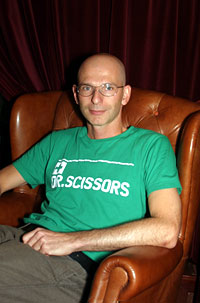
A few minutes before the party at Sobachka kicked off, we caught the "doctor" tuning the sound. When we offered to grab a beer, have a bite and talk, we got a yes — and right away we ordered dark beer, shrimp, and an interview with the techno-music surgeon Dr. Scissors.
44100:
What are we drinking?
Dr: Warsteiner
44100: Your real name?
Dr: Pino Grzubovsky (our ears heard it as Pino Grzhubovski =)
44100: How many times have you been to Moscow?
Dr: This is my ninth time.
44100: What are your impressions?
Dr: The first time was in 1997, I played at the Hermitage Garden at some art project. It was a fashion show, and specially for it I recorded a program — the sounds of the city, of the Moscow metro. After the event I was introduced to Anton Kubikov and we went together to his show on Radio Stantsiya. I played my music live on air and, judging by the pager messages and the phone calls thanking us, everyone loved it. I also managed to play at A-Club and at the Jazz Cafe back then. That was right during the economic crisis. The city looked very strange, the shops weren't working, nobody knew what price to sell goods at. My friends from Moscow — Kirill Preobrazhensky and others — invited me to stay out of town, and the whole time I was the main source of funding for everyone, buying food and drink, because I was the only one with dollars. That was my first time in Moscow. But, on the other hand, what stayed in my memory was the warmth and breadth of the Russian soul.
The next time was in 2000, and by then everything was new — a lot of new buildings had appeared, everything was blooming and smelling sweet. Since then Moscow hasn't changed for me.
44100: Tell me, why Dr? Are you a doctor? A specialist?
Dr: In a sense — yes. When I started making music solo in 1995. Back then it was more in the dub-electronica style. At my shows I played one big 80-minute mix and cut the music in real time with virtual scissors, like a surgeon.
44100: Hmm... Then tell me, as a doctor — does the behaviour of patients on dancefloors differ a lot from country to country?
Dr: No, there's practically no difference now. In Moscow the parties are just like, say, in Germany or Japan. The real difference is only between different cities in Russia. Once I played in some small town at a club that was not techno at all. There were two people on the dancefloor and I didn't understand what it was all for...
I really enjoyed playing on the Rynda; there were similar parties on the water in Frankfurt. In Europe the era of underground parties is over now, and everything has become more professional, the approach to organization has turned commercial. In '95-'97 everything was like it is with you now — huge venues, semi-legal parties in strange places. And now in Frankfurt there are only two places you could call techno clubs — U6311 and one more club that Sven Vath opened about two months ago, called Cocoon Club. Which, by the way, is one of the best techno clubs in my opinion. Sven Vath gathered everything best he had seen in various venues around the world in one place.
44100: Tell me, what did they call you as a child?
Dr: For 20 years now they've called me Pino — that's my alias in a way. My real name is Axel, which in Swedish means "keeper of peace".
44100: Do you feel that way?
Dr: Yes. When I walk down the street and see some injustice being done to someone — I always step in! But in general my sense of being a "keeper of peace" has a lot to do with politics, but that's another conversation.
44100: Why not — let's have it now!
Dr: I feel an acute need to protest against wars. And politically — I have a lot to say. For example, in Germany you can skip the army and go to the Red Cross instead. So I served in the Red Cross and helped people.
44100: Yes, you really are a peacemaker...
Dr: I even have a track called "Total war in space" and its idea is that all people on earth realized that fighting is pointless. If the rulers can't stop, they'll have to board spaceships and go fight each other in space among the asteroids. And after the events in Beslan I genuinely cried! The problem is that until we try to stop terrorism, it won't stop on its own.
44100: Can music stop terrorism?
Dr: Music can't stop terrorism, but it can be a message capable of making people think.
44100: And what music shaped your views?
Dr: When I started making music, and that was about 25 years ago, it was Genesis. I also listened to Logic System, Tangerine Dream and the Recoshet project. That music had a huge influence on me. I also really liked the collaborations between Jean Michel Jarre and Tangerine Dream.
44100: And who do you like now?
Dr: DJs like Cari Lekebusch, Adam Beyer, Chris Liebing...
44100: Do you know the story about how Chris Liebing was supposed to play at a party in Moscow together with DJ Fascist? Shortly before the party a rumour went around in Germany, from certain promoters in Russia, that Chris would be performing at a party of the ultra-right, and he didn't come...
Dr: Yeah, I heard about that, it's typical, sounds like Russian promoters. (laughs)
44100: But you did play at the same event as Fascist — how do you find his music and Russian DJs in general?
Dr: We played at different times at the same open-air, and I never caught his set. In general I like DJ Phono, Anton Kubikov, Strelok, and I really like the Scsi-9 project.
44100: Do you do anything besides music?
Dr: Only music. It takes up all my time. I have a lot of different projects. For example, two of my friends — Turks — play a stringed instrument called the "zas". With them we're recording a very interesting project. Playing the zas is very dynamic, you could say around 160 beats per minute, but the overall rhythm of the piece is around 110 beats per minute. It comes out interesting..
Another project is with my friend, an arts professor. We have a joint multimedia installation called "Transformation of Energies". The essence of the project is the interaction of digital music and visual images with an analogue essence. You can find out more about this project at www.r111.org.
44100: What development do you see for a creative person, what is the potential progress for a DJ?
Dr: Every DJ must eventually write music. Until you have your own tracks, nobody in the world knows you, nobody needs you.
44100: Any wishes for your listeners?
Dr: No war on Earth. All the words in my sets today will be in Russian, so listen to my messages in my music!
Dr: Warsteiner
44100: Your real name?
Dr: Pino Grzubovsky (our ears heard it as Pino Grzhubovski =)
44100: How many times have you been to Moscow?
Dr: This is my ninth time.
44100: What are your impressions?
Dr: The first time was in 1997, I played at the Hermitage Garden at some art project. It was a fashion show, and specially for it I recorded a program — the sounds of the city, of the Moscow metro. After the event I was introduced to Anton Kubikov and we went together to his show on Radio Stantsiya. I played my music live on air and, judging by the pager messages and the phone calls thanking us, everyone loved it. I also managed to play at A-Club and at the Jazz Cafe back then. That was right during the economic crisis. The city looked very strange, the shops weren't working, nobody knew what price to sell goods at. My friends from Moscow — Kirill Preobrazhensky and others — invited me to stay out of town, and the whole time I was the main source of funding for everyone, buying food and drink, because I was the only one with dollars. That was my first time in Moscow. But, on the other hand, what stayed in my memory was the warmth and breadth of the Russian soul.
The next time was in 2000, and by then everything was new — a lot of new buildings had appeared, everything was blooming and smelling sweet. Since then Moscow hasn't changed for me.
44100: Tell me, why Dr? Are you a doctor? A specialist?
Dr: In a sense — yes. When I started making music solo in 1995. Back then it was more in the dub-electronica style. At my shows I played one big 80-minute mix and cut the music in real time with virtual scissors, like a surgeon.
44100: Hmm... Then tell me, as a doctor — does the behaviour of patients on dancefloors differ a lot from country to country?
Dr: No, there's practically no difference now. In Moscow the parties are just like, say, in Germany or Japan. The real difference is only between different cities in Russia. Once I played in some small town at a club that was not techno at all. There were two people on the dancefloor and I didn't understand what it was all for...
I really enjoyed playing on the Rynda; there were similar parties on the water in Frankfurt. In Europe the era of underground parties is over now, and everything has become more professional, the approach to organization has turned commercial. In '95-'97 everything was like it is with you now — huge venues, semi-legal parties in strange places. And now in Frankfurt there are only two places you could call techno clubs — U6311 and one more club that Sven Vath opened about two months ago, called Cocoon Club. Which, by the way, is one of the best techno clubs in my opinion. Sven Vath gathered everything best he had seen in various venues around the world in one place.
44100: Tell me, what did they call you as a child?
Dr: For 20 years now they've called me Pino — that's my alias in a way. My real name is Axel, which in Swedish means "keeper of peace".
44100: Do you feel that way?
Dr: Yes. When I walk down the street and see some injustice being done to someone — I always step in! But in general my sense of being a "keeper of peace" has a lot to do with politics, but that's another conversation.
44100: Why not — let's have it now!
Dr: I feel an acute need to protest against wars. And politically — I have a lot to say. For example, in Germany you can skip the army and go to the Red Cross instead. So I served in the Red Cross and helped people.
44100: Yes, you really are a peacemaker...
Dr: I even have a track called "Total war in space" and its idea is that all people on earth realized that fighting is pointless. If the rulers can't stop, they'll have to board spaceships and go fight each other in space among the asteroids. And after the events in Beslan I genuinely cried! The problem is that until we try to stop terrorism, it won't stop on its own.
44100: Can music stop terrorism?
Dr: Music can't stop terrorism, but it can be a message capable of making people think.
44100: And what music shaped your views?
Dr: When I started making music, and that was about 25 years ago, it was Genesis. I also listened to Logic System, Tangerine Dream and the Recoshet project. That music had a huge influence on me. I also really liked the collaborations between Jean Michel Jarre and Tangerine Dream.
44100: And who do you like now?
Dr: DJs like Cari Lekebusch, Adam Beyer, Chris Liebing...
44100: Do you know the story about how Chris Liebing was supposed to play at a party in Moscow together with DJ Fascist? Shortly before the party a rumour went around in Germany, from certain promoters in Russia, that Chris would be performing at a party of the ultra-right, and he didn't come...
Dr: Yeah, I heard about that, it's typical, sounds like Russian promoters. (laughs)
44100: But you did play at the same event as Fascist — how do you find his music and Russian DJs in general?
Dr: We played at different times at the same open-air, and I never caught his set. In general I like DJ Phono, Anton Kubikov, Strelok, and I really like the Scsi-9 project.
44100: Do you do anything besides music?
Dr: Only music. It takes up all my time. I have a lot of different projects. For example, two of my friends — Turks — play a stringed instrument called the "zas". With them we're recording a very interesting project. Playing the zas is very dynamic, you could say around 160 beats per minute, but the overall rhythm of the piece is around 110 beats per minute. It comes out interesting..
Another project is with my friend, an arts professor. We have a joint multimedia installation called "Transformation of Energies". The essence of the project is the interaction of digital music and visual images with an analogue essence. You can find out more about this project at www.r111.org.
44100: What development do you see for a creative person, what is the potential progress for a DJ?
Dr: Every DJ must eventually write music. Until you have your own tracks, nobody in the world knows you, nobody needs you.
44100: Any wishes for your listeners?
Dr: No war on Earth. All the words in my sets today will be in Russian, so listen to my messages in my music!
