Electroshock. Part Four
Чтиво · 22.09.2006
By 44100Hz
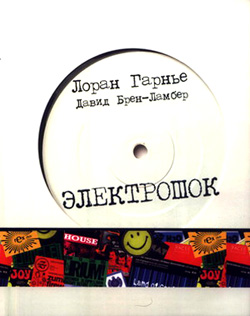
Not long ago the publishing house "Fluid" released the book "Electrochoc" by the legendary French DJ and musician Laurent Garnier. 44100Hz is publishing excerpts from this gripping history of electronic music. The narrative begins with the tenth chapter of the book "Electrochoc". Playlists of the tracks mentioned in the book can be found on the site pedrobroadcast.
The first to play live were LFO and Orbital (this happened back in the early 90s), then Underworld, Prodigy, Chemical Brothers and, finally, Daft Punk followed in their footsteps. Realizing that the future belonged to live electronica, I decided it was time for me to start a stage career of my own. I was held back by a lack of confidence in my own abilities. After all, writing music shut away in your studio is one thing, and playing that music on stage, and together with professional instrumentalists at that, is quite another. I shared my doubts with Eric Morand and received the following instruction: "Forget your hang-ups and get down to it immediately!".
Around that same time I met the drummer Daniel Bechet – the son of the famous Sidney Bechet. We began rehearsing together, and I immediately understood that my compositions catastrophically lacked space for live instruments. It took about six months to "tune" the album. When the work was finished, I sent the reworked tracks to Daniel, and also to Karine Laborde – a classical violinist from Bordeaux who was likewise interested in collaborating with an electronic musician. Now all that remained was to assemble a touring team. Christian Paulet, who by then had become my manager, introduced me to one of the most respected French sound engineers, Didier Lubin, nicknamed Loulou, who in his time had done the sound for the Rex. Having secured Loulou's agreement, I invited to my team the founders of the dance troupe "White Nights", Ulrich and KKO, and two technicians: Laurent Deflore and the former technical administrator of the Rex, Fred Kikemel.
Thanks to Karine's connections, we got the use of the "400" concert hall in Bordeaux for rehearsals. It was here that all the members of our team met one another.
The rehearsals lasted three days, and then the touring began, which was to stretch out over a full year and a half. Having tried out our program on the audiences of European festivals, we set off to conquer the French cities: Lyon, Marseille, Bordeaux, Rouen, Lille, Dijon... During the concerts my task was to distribute the roles among the musicians and, from behind my console, to control the rhythmic parts formed out of short loops and sequences, thereby setting the direction for the entire track. I was pleased with how the tour was going. The audiences greeted us warmly, and the atmosphere within the team itself reminded me of a summer camp holiday.
Six months after the start of the tour I learned that my album "30" had been nominated for the "Victoires de la Musique" in a category new to that award, "electronic music". It turned out that shortly before this Eric Morand had, without my knowledge, contacted the organizing committee of the "Victoires de la Musique" and suggested they listen to "30". The album passed the preliminary selection, and I, without having applied any effort to it, found myself in the finals.
The awarding of the winners was to take place at the legendary concert hall "Olympia". Each of the five finalists was told to prepare some composition and, on the eve of the ceremony, to do a soundcheck and rehearsal at the "Olympia". Anyone who wished could make use of the symphony orchestra hired by the organizers. We decided that we'd play "Acid Eiffel".
And so, on 19 February 1998, Daniel, Karine and I set off for the "Olympia". We came in through the service entrance and, finding ourselves backstage, asked one of the technicians how to find the administrator. "So you're these techno musicians! – we heard in reply. – If you want my opinion, your music is complete garbage". And it began... Each of the technicians considered it his duty to fire off some nasty little joke at us. At that very same time my wife, sitting in the hall awaiting the start of the rehearsal, was forced to listen to the endless lamentations of the "Olympia" staff: "What a disgrace!", "What have we come to?!", "Who let them in here?!" and so on. This continued until our sound engineer Loulou – a man who enjoys enormous authority among his colleagues – appeared backstage. "And how did you end up here?" – the technicians asked. "I work with Garnier", – Loulou answered. The technicians were surprised. Then one of them recognized Daniel Bechet and asked him the same question. "And I play with Garnier", – answered Daniel. The technicians were completely bewildered. "It must be terribly unpleasant to play music like that, no?" – they sympathized. "Are you kidding?! Quite the opposite! – Daniel laughed. – It's such a blast! We draw six thousand people per show, can you imagine?!". The technicians were left standing with their mouths open... In general, you can understand these people, I thought. They've most likely never really heard techno and know about it only from newspaper articles and television programs, so it's quite natural that they're outraged by the intrusion of this music into the temple of French chanson, where Edith Piaf and Jacques Brel once performed.
When it was our turn to rehearse, Karine handed out the score of "Acid Eiffel" to the orchestra. "Is that all?! – the musicians were astonished. – Why, any schoolboy could play this!". But it wasn't so simple: as soon as we started playing, it turned out that the strings kept falling out of rhythm. Karine took up her violin and stood facing the musicians. That helped, but not for long, and soon the orchestra was again in complete disarray. We had to stop. "Well, so what's the matter? You said this was as easy as pie! – Karine wondered. – I don't understand, what's so difficult about a syncopation?!". When the rehearsal ended, we politely thanked the technicians and musicians and left the hall.
The next evening I put on a suit and set off for the "Olympia" again. That same night I was due to play in Ghent at the I Love Techno festival, and the organizers of the "Victoires de la Musique", meeting me halfway, put the "electronic music" category at the start of the ceremony. The ceremony itself went by for me as if in fast-forward. "30" was declared the winner, I went up on stage, said that I dedicated this victory to all techno musicians, we played "Acid Eiffel", I jumped into my techno-mobile and set a course for Belgium.
At the Franco-Belgian border I was stopped by a police car. I mentally prepared myself for an unpleasant conversation, but the friendly, smiling policemen explained to me that they'd been sent by the I Love Techno promoter Peter Decuypere and that they were obliged to escort me all the way to Ghent. I never thought I'd one day arrive at my own performance escorted by a police car, with the flashing lights on at that! Backstage another surprise awaited me: champagne and a stack of notes with congratulations. And when I – still in my suit, since I hadn't had time to change – came out on stage, I was met with a genuine ovation. Touched and happy, I stood behind the turntables, and six thousand people immediately broke into dance. That's how I celebrated my Musical victory.
My success at the "Victoires de la Musique" allowed F Communications to establish relationships with many interesting people who, until recently, would hardly have taken some independent electronic label seriously. But this success also had a flip side. The excessive attention of the press turned me, in the eyes of the wider public, into a kind of authorized representative of techno in France, which, of course, did not correspond to reality. The most galling thing was that the journalists, instead of taking an interest in my work, bombarded me with questions about the role of drugs in techno culture and about the notorious French Touch - a movement to which, by the way, neither I nor F Com had ever counted ourselves. The situation was becoming unbearable, and when talk started in the techno crowd that "Garnier has sold out completely", I felt I had to dot the i's, and I released my new maxi-single "Dangerous Drive" in a tiny run of three hundred copies, whereas by the laws of show business I should have flooded every record shop in the country with it, having first slapped on it a sticker reading "from the winner of the Victoires de la Musique".
Meanwhile my "live" tour of Europe continued. In the summer of 1998 I received an invitation from the organizers of the famous festival in Montreux. To play at Montreux without a single jazz composition in my repertoire would have been disrespectful to the audience, so as soon as inspiration visited me (and this happened in Ireland), I composed a jazz piece which, without further ado, I called "Jazzy Track". A couple of days before the festival I met the saxophonist Finn Martin, we found our groove, and during the concert we performed an improvisation on the theme of "Jazzy Track" together.
While I was roaming around Europe, the French house movement continued to grow stronger and develop. In September 1998, at the initiative of the public organization Technopol, the first Techno Parade took place in Paris. Interestingly, the idea for this event had occurred to the Technopol activists considerably earlier, but they resolved to begin serious negotiations with the authorities on the day when Jack Lang publicly declared that Paris ought to have an analogue of the Berlin Love Parade. Having secured the support of various electronic artists and labels, including F Communications, the "Technopol people" set about doing educational work among the representatives of the Ministry of the Interior, the Ministry of Culture, the gendarmerie and the Anti-Drug Department, explaining to them what techno culture is and what an important place street parades occupy in it. In parallel with this, they worked on the Society for the Protection of Copyright in the hope of obtaining for the DJ the official status of a creative worker. In words all the officials were sincere admirers of youth culture in general and of techno in particular, but as soon as it came to concrete cooperation, the classic bureaucratic games began, with muddled answers and non-committal promises. The matter was moved off dead center thanks to that same Jack Lang, who managed to persuade the prefecture to support the Technopol project. And although many disagreements remained between Technopol and the officials, it was clear that now nothing and no one could any longer stop techno music from seizing the streets of the French capital. And its museums along with them, since the organizers decided to time a whole series of events devoted to electronic culture to coincide with the parade, including the exhibitions Sonic Process and Global Techno at the Pompidou Centre.
The first Paris Techno Parade took place on 19 September. On the colorful trucks that set off from the Place Denfert-Rochereau heading for the Place de la Nation, one could observe the whole cream of the French electronic scene. The musicians of F Communications, together with the Rex team, rode through the streets on a vehicle christened the "Scouts' Truck" and decorated with all sorts of lush greenery. It was a warm Saturday. The city rejoiced in the sun and the music. Whole families with small children greeted us from the balconies of the houses. When our cortege solemnly rolled into the Place de la Bastille, I couldn't restrain myself and shouted into the microphone: "It's happened! Techno has taken the Bastille!". We were happy. This parade meant for us the successful conclusion of a struggle, begun ten years earlier, for granting techno music French citizenship.
At the final point, the Place de la Nation, the cortege arrived at the beginning of the evening. In the square a stage awaited us, set up specially for the closing party of the Techno Parade, in which, among others, Carl Cox, Manu le Malin, Jack de Marseille and the group Kojak were to take part. By agreement with the city authorities the party was to finish at exactly midnight. Before the stage an enormous crowd had gathered, in which there were both hardened ravers and ordinary onlookers who'd found themselves at a techno party for the first time in their lives. Everyone was in a benevolent mood. Nothing foreshadowed trouble.
The disturbances began with the onset of darkness, when a gang of provocateurs turned up in the Place de la Nation. The hooligans harassed the girls, picked on the peacefully dancing ravers – in short, by every means they sought a pretext for a fight. I was performing last of all. When I came out on stage, a ghastly picture presented itself to my gaze: groups of aggressive thugs scattered across the whole square were beating up defenceless teenagers and blocking the way of the Red Cross medics who were trying to give first aid to the injured. Realizing that things were taking a serious turn, the organizers told me to wrap it up. I began frantically gathering my records, watching as thousands of people, shoving one another, tried to break out of this hell. My heart bled: at the last Berlin Love Parade, in which over a million ravers took part, not a single serious incident was recorded, and in Paris some two hundred scumbags managed to ruin the celebration for fifty thousand people!
By the moment I finished gathering my discs, the Techno Parade team had managed to safely leave the "sinking ship". I found myself behind the stage in the company of the American producer Lenny Dee and five other equally slow-moving guys. A few metres from us dozens of rioters were smashing car windows and breaking up sound equipment. To count on slipping past them unnoticed with forty kilograms of vinyl under our arms was foolish. So we sat behind the stage, cringing with fear and trying with all our might not to attract attention. Finally one of our companions in misfortune, unable to bear it, got up and said he'd try to bring his car around. We stayed to wait. An hour and a half later our saviour returned, we climbed into his car and a few minutes later were already far from the Place de la Nation.
Public opinion, to which techno artists were now presented not as inveterate marginals but as quite successful young people, began to favour dance culture, and this sooner or later was bound to lead to the commercialization of the French electronic scene. The temptation of easy money (the majors distinguished themselves by their ability to juggle sums with a great many zeros elegantly and casually) was too great, and many DJs and musicians could not resist it. As for me, I firmly decided that I would remain aloof from this fuss and concentrate on new creative tasks.