What does Mexico bring to mind for you? Chili, tequila, sombreros, hot-blooded Latinos? Well, this country has many more interesting things and events. To begin with, Mexico is part of North America, on a par with the USA and Canada. There are a huge number of pyramids left behind by the Maya and the Aztecs. Mexico stands out for having the greatest diversity of animal and plant life. Perhaps only in Mexico is there a Day of the Dead, when people sing and dance on the graves of their relatives. Of course, Mexico is famous for its delicious food (fajitas, quesadillas, enchiladas, tacos), and recently musical Guinness records were set here: the world's largest ensemble of folk singers and musicians (mariachi), comprising 549 people, performed in the Mexican city of Guadalajara. In addition, on 29 August of this year around 14,000 residents of Mexico took part in a mass performance of the «living dead» dance from Michael Jackson's famous clip for the song «Thriller,» after which this event was also entered into the Guinness Book of Records.
Getting to the main point… Mexico, of course, does have nightlife. Techno and house are played here, as everywhere in the world – you'll meet hipsters too. Every month there are concerts by major electronic musicians here, and the young crowd knows how to have a good time.
Our conversation with the creator of the Mexican music-and-technology festival Mutek – Damián Romero – went far beyond the festival itself. Damián, being a friendly and cheerful person, shared his secrets and also told us about the mysterious nightlife of Mexico City…
44100Hz
: Hi, Damián! You're a seasoned DJ, and also the general director of Imeca music, so you know Mexico City's nightlife like no one else. What are your favourite clubs?
D.R.
: Hi! Unfortunately, I don't have any favourite clubs in Mexico City.
44100Hz
: Then let's name the best of what's out there…
D.R.
: Hmm… I think Pasaje America.
44100Hz
: Yes, I'd agree with you. In my view, it's the only club that's interesting in terms of music.
D.R.
: Maybe also the club Pasagüero, but only thanks to its long history. It's a very old concert venue in Mexico City with eclectic music and lots of space. Then all those techno clubs, which I don't much like, but they exist. There's Rioma, A.M. (which is also an after-hours) and a new little club, Leonor. (Note that in 2009 Mexico introduced a new law requiring all nightspots to close by 3 a.m. So finding a proper after-hours is practically impossible, except for illegal places.) In the same category is the Imperial club – a rock venue where DJ sets and concerts by electronic musicians often take place.
44100Hz
: I'm familiar with these places. But honestly, having spent a year in Mexico, I still haven't found a place where I'd want to spend my weekend. There's always some serious drawback, whether it's the people, the music, the design…
D.R.
: I agree with you. To be honest, the «cool guys» don't go to these clubs. I mean artists, painters, musicians, writers. Maybe they occasionally drop in for a good concert at Pasaje America, but no more than that. The reason is simple: I, for one, find it unpleasant when I come to, say, A.M. or Rioma and run into fat, sweaty dealers and prostitutes.
44100Hz
: Agreed, not much fun there… Tell us your standard Friday or Saturday route. You leave the office, and then…?
D.R.
: My standard route… I think it's very simple. Bearing in mind that I'm 34. We go to dinner at one of the restaurants in the Roma or Condesa colonia (Mexico City is divided into colonias, a kind of large district). I really love a little New York–style restaurant, El Malayo. If it's just for drinks, we go to various «cantinas» (Mexican bars where people usually drink beer and tequila with light snacks). One of the most famous is the cantina La Covadonga. Or, if you want to try mezcal (Mexican moonshine made from agave sap), go to La Botica Mezcalería. If you fancy something glamorous, you can drink and dine at the Condesa D.F. hotel. It's very nice there… elegant, I'd say.
All these places are located very close to one another. The Condesa and Roma districts are popular precisely thanks to their restaurants, bars and clubs.
After dinner, if I'm not playing at some club, we gather at friends' homes and keep the party going in a calm atmosphere. Of course, sometimes our calm spills over into a proper booze-up and we end up at a nightclub… But it's all decent and relaxed (laughs).
44100Hz
: As far as I know, besides DJing you run the electronic music festival Mutek-Mexico, which appeared in 2003, three years after the Montreal original was created. Tell us, what inspired you to this idea?
D.R.
: I remember, back in 2002, DJ Mike Shannon came to visit me. From there he invited me to Quebec for the Mutek music festival, where I first met the organizers and landed right in the thick of things. I was shocked by the fresh, innovative approach to running an event. I left the first Mutek of my life full of inspiration and ambitious ideas.
At that moment the international book fair was taking place in Guadalajara, and it was within its framework that we decided to hold the first event. At first, based on an exchange of Canadian and Mexican musicians, we organized parties and conferences. From Guadalajara we moved on to Mexico City, and then to Tijuana. The result was stunning – and we set about preparing a full-fledged festival.
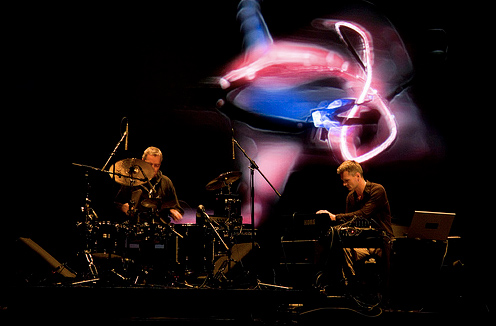
2003 and 2004 were a time of hard work, of creating the project, the image and the core concept of Mutek-Mexico. During the preparations, one-off concerts and DJ sets went on around the country. And in 2005 we finally fired off a full four-day festival that rocked the Mexican capital for a long time. The headliners then were: Isolée, Krikor, Lucien n' Luciano, Matthew Dear, Monolake, Pier Bucci, Robert Henke and others.
44100Hz
: Besides Mexico, Mutek takes place all over Latin America: Argentina, Chile, Brazil, Colombia… Are you familiar with this part of the Canadian festival?
D.R.
: To begin with, in those countries Mutek happens as one-off parties, not as a full-fledged festival. The Festival Mutek with a capital letter exists only in Quebec and Mexico.
The story, in general, is this: the director of Canadian Mutek, Alain Mongeau, initially wanted to make Mutek-Montreal, Mutek-Berlin and Mutek-Chile. He's connected to Chile through his childhood and many friends; he even speaks Spanish like a Chilean. I remember all the fuss about putting on a Chilean Mutek… But, as time showed, something didn't come together, things didn't work as planned, and the only worthy successor turned out to be Mexico.
44100Hz
: Tell me, how different is the Mexican festival from the Canadian one?
D.R.
: A hundred percent. Mutek-Canada builds its concert programme 50/50 – half top DJs and half musicians nobody knows. It's interesting, I share this approach, but I still always try to distinguish our programmes. For Mutek Mexico, as for me, eclecticism and experimentation are important. We come up with a lot ourselves and in this respect we don't depend on Montreal, but we undoubtedly always interact and exchange experience.
Probably we shouldn't overlook the difference that Montreal is in Canada and Mexico City is in Mexico. These are different worlds. Montreal is a city with a population of 2 million; Mexico City is one of the biggest megalopolises in the world, with a population of 19 million. In a provincial atmosphere such events work better, people live for the festival, they grab their bicycles and ride under the sun from one venue to another, they meet musicians in the streets, they dance in cafes, music is everywhere.
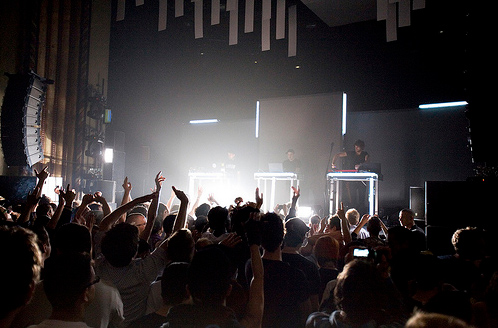
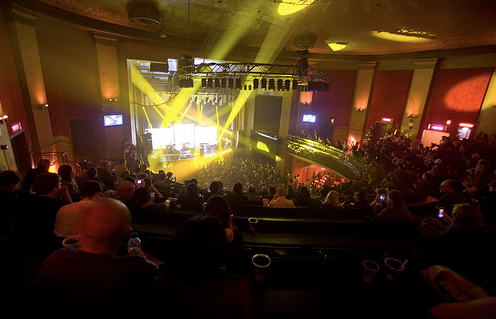
What happens in Mexico City? First, it's chaos, millions of cars, streets, houses, streams of people… Second, building coherent festival venues here is almost unreal; the space is so vast that getting from one club to another takes great effort. On the other hand, the energy of a festival in a big city is completely different – thousands of fans can flock to a good event. I'd say Mutek in Mexico City is, above all, extreme…
44100Hz
: Recently I was discussing Mutek with my friend, a DJ from Switzerland. He played at the Canadian festival for three years. According to him, something special happens in Montreal: besides the concerts, DJ sets, lectures and theatrical performances, a very warm and friendly atmosphere hangs in the air. After their sets, all the musicians head off to a barbecue, to the cinema or on country outings. Almost everyone who comes spends more than a week in Montreal (even though the event itself lasts five days). What happens in Mexico City? How does the festival atmosphere transform in a huge megalopolis?
D.R.
: The difference is enormous. In Mexico City we run into the problem of scheduling time. People live at a frantic pace; for them, getting out to a festival, relaxing and focusing on rest is practically impossible. After a six-hour event it's hard to find a «living» person, everyone burns out very quickly and there's neither the strength nor the point in continuing the next day (because of work, errands, fatigue, distance).
We need the atmosphere of a small town, we need fresh air, nature, we need a place where you can catch your breath after dancing and set off with renewed energy to enlightening lectures.
44100Hz
: Which of the artists you've brought over are you most proud of?
D.R.
: I think Ryoji Ikeda. Robert Henke's concert was also stunning. Everyone, of course, went crazy over the sets by Luciano and Richie Hawtin. In 2008 musicians from Raster-Noton came. One of my favourites is the Isolée concert, and of course the Warp Records showcase.
44100Hz
: Have you never invited Underworld?
D.R.
: Underworld is mainstream, and bands like that have no business at the Mutek-Mexico festival.
44100Hz
: So you never invite popular DJs and musicians? Sónar, for example, always singles out one main concert from among its experimental performances.
D.R.
: Sónar today is a powerful, immense commercial event. I'm a proponent of more closed, more intimate events. I wouldn't do an event for more than 2,000 people, and that's very important to me. I, for one, really dislike the feeling of being in a crowd of thousands of stoned people, the way it is at Sónar. For me, communication with people and the uniqueness of what's happening are fundamental.
44100Hz
: In 2009, Mutek-Mexico was split into a series of separate parties, many of which will take place in the state of Guanajuato. I'm curious why, out of 7 events, only 2 will be in the capital? Though the question is a bit rhetorical, since you already spoke about the ideal atmosphere of small towns…
D.R.
: It all goes much deeper here. This year I want to concentrate all my energy on preparing the 2010 festival (a landmark date in Mexico – 200 years of the country's independence and the 100th anniversary of the Mexican Revolution), and in connection with this we decided to limit ourselves to separate concerts that together will make up a full festival programme. Among this year's guests: Circlesquare, Akufen, Murcof vs Geodezik, Modeselektor vs Pfadfinderei and others.
Besides, I think you've heard about the large-scale arts festival in Mexico – Cervantino, which takes place precisely in the city of Guanajuato. Every year Cervantino invites different cities to take part, and in 2009 it will be Quebec. Given that Quebec is very proud of its Mutek, and we are the official representatives in Mexico, Cervantino invited us to participate.
44100Hz
: Which Mexican electronic artists can you single out? In Russia, for example, Murcof is popular among fans of intelligent electronica.
D.R.
: Murcof isn't popular here. He's an electronic musician influenced by classical music. He'd hardly be able to fill a club with fans in Mexico. The only group that reached the international level long ago is Nortec Collective (by the way, Murcof was part of Nortec Collective for a while. All the members are from Tijuana).
Apart from these guys, people are unlikely to go and listen to any of their compatriots. We even have a word for it – «malinchista,» which denotes Mexicans who give preference to foreigners.
44100Hz
: I think «malinchistas» can be found in every country. See you at the Mutek party!