A Guide to Amsterdam
Танцпол · 05.11.2007
By Юля Чай

The Kingdom of the Netherlands is a colorfully populated country with strong musical traditions. Club life here bubbles like tar in the sun. Take the Amsterdam Dance Event alone, where in three days as many events happen as don't happen in a whole month in Moscow and Petersburg combined; and judging by such natives of the country as Tiesto and Paul Van Dyk, a musical instinct and a sense of rhythm are absorbed here with mother's milk. At the same time, when you first find yourself in Amsterdam, you run into such a number of temptations that there's usually no time left for the clubs. Our guide will come in handy for those who, on a trip to the capital of Holland, don't intend merely to admire the tulips, eat cheese, ride a bicycle and indulge in other — entirely legal, we'll note — pleasures.
Getting there:
Getting a visa isn't difficult: you book a hotel or hostel, come to the consulate, receive it and book your route. At your service is a whole range of budget airlines where, with a bit of will and quickness, you can buy plane tickets for a very laughable amount of money. But you need to book them in advance. For residents of Petersburg it's more convenient to travel on a Finnish Schengen visa via Helsinki or Tampere.
www.blue1.fi
www.airberlin.com
www.germanwings.com
www.ryanair.com

The oldest and most famous club in Amsterdam, with a capacity of more than 2,000 people, opened in 1986. It's hard to imagine how many bright, euphoric moments hundreds of thousands of its visitors have lived through in that time. Today at Escape you can easily meet both young people with inspired eyes and no-longer-young ladies in lime green dancing with laser pointers. Some are chasing Holland's club legend No. 1 and first-rate techno; others, it seems, started going to Escape as little girls and still can't give up this pastime. The dress code is officially defined as "fashionable party-dressed", but in essence the club is soaked through with the good old spirit of rave. Those wishing to be especially valued guests can, for 235 euros, get the "Escape VIP package", which includes skip-the-line entry for 4 people, a table, a bottle of the strong stuff of your choice and a certain quantity of lighter drinks.
Since 2007 the club has opened three additional spaces: Escape Lounge, Escape Studio Cafe, Escape Deluxe. Those worn out by incessant clubbing will be particularly taken with the Lounge space, where instead of a ceiling there's a solid LED screen. It is both the main entertainment here and the only source of light, shifting its color accents through the night. Escape Deluxe means a separate entrance and a different musical policy (hip-hop, r&b, urban dance, latin). Despite the capacity — be prepared to run into a queue at the door.

An indoor space with a total area of 2,400 sq m, part of whose interior resembles a Shanti grown to a grand scale — for the most part nothing other than… a huge sandbox. It hosts beach-sport competitions and the most current events in Amsterdam today. At The Sand (with rackets by day, with glasses by night) you can spend days on end, until you're deported over an expired visa. Now and then the gentlemen from Cocoon drop by with their signature parties (and the representatives of the most expensive club in the history of electronic music surely know a thing or two about club venues); the world's best DJ according to DJ Mag magazine's ranking, Armin Van Buuren, plays here, and events of varied styles but equally intriguing atmosphere take place. Entry, depending on the scale of the party, will run from 10 to 30 euros. If you've decided to make a club tour of Amsterdam by bicycle, be careful. Despite their incredible number in the city, cases of these iron steeds being stolen are no rarer for it.
Just add water:
Students at the Dutch Helicon Vocational Institute have created an unusual powder. Van Elderen and four of his coursemates at the Helicon Vocational Institute came up with the idea of creating powdered alcohol as part of the work on their diploma assignment. You only have to add liquid to it and a glass of a 3% alcoholic drink of pure water appears on your table. "Booz2Go" (as the invention was named) is a 20-gram sachet costing 1–1.5 euros. In color and taste the finished drink resembles lemonade. The powder can hardly be called a drink, so even minors can buy it without hindrance.

The largest concert venue (calling it a club somehow doesn't come easily to the tongue) in Amsterdam opened in 2001. 3,000 square meters, a capacity of 5,500 people, 7,000 parking spaces. Ladies and gentlemen, allow me to introduce — the Heineken Music Hall. Actually, the Music Hall isn't quite in Amsterdam, but in the district of Ouderkerk aan den Amstel to the southeast of the city, not far from the main football stadium Amsterdam Arena, which nurtured the Ajax team, and right by the Gein metro station (convenient to reach from Central Station). If you've come by metro, don't forget that the last train from Gein into the city leaves at 0:10; most likely you'll make it out in time, since the Music Hall mainly holds evening concerts, but it's not out of the question that you'll be swept off here to an afterparty or a late-night performance. See to it in advance how to get back to your home hostel in time. In the Music Hall's upcoming program is a hotchpotch of Kaiser Chiefs, Arcade Fire, Mika, Rihanna, Underworld and Tiesto.

In 2007 the club Panama marks the sixth "anniversary" of its leisurely existence — a cultural establishment five minutes from Central Station. In the latest word of club fashion, the venue is built right into the building of a former warehouse/factory. The reclaimed-land district and the embankment where it stands are called nothing other than the Amsterdam Manhattan by the locals. It may not be as convenient to make your way here as to the red-light district, but it's worth it. For more than a hundred years the machinery of this imposing building, where Panama is now located, supplied electricity to the countless mechanisms of the adjacent port. Now, though, everything going on in this building charges with energy the seasoned party-goers who flock to Amsterdam's port center from all over the world. Panama is known not only for dancing. Besides the club, there is a theatre and a restaurant here, and live musical performances take place regularly. In addition, you can grab a bite in the café-restaurant with its huge terrace. You may have thought that an older and calmer crowd rests here — let the list of names that have already made their mark at Panama dispel your misconception: Deep Dish - Sander Kleinenberg - Tiësto - Erick Morillo - Sasha - John Digweed - X press 2 - Frankie Knuckles - Timo Maas - James Holden - Danny Howells - Armin van Buuren - Todd Terry - Joey Negro - Josh Wink - Ron Carrol - Erick E - Carl Craig - Dave Angel - Michel de Hey - Dave Clarke - Dave Seaman - Armand van Helden. And there's more to come!

Another club venue, striking in its scale and technical capacity, ready to take up to 3,000 people at once. Power Zone is a club with a telling name. The basis of the musical format here is loud, stadium-scale commercial house and techno, but live performances are no rarity either. The crowd is uniformly groomed and polished. The interior flourishes are modest, but the minimalism of the design pays off handsomely during a party thanks to audio-visual flourishes and special event-themed decoration. At your service are a cocktail bar and a special bar for champagne lovers. A hungry party-goer can treat themselves, right in the club, to Chinese food in boxes (wok), which is provided at Power Zone by YumiFood. On fine days the club's visitors relax on cushions on the open terrace overlooking the canal. And some even come to the club on their own boat, motorboat or river VIP taxi, which is happy to deliver guests straight from the hotel or from any other point in Amsterdam. The main condition — the presence of water.
Enjoyed it? As you leave the club, remember that in Holland it's sometimes customary to leave small change as a tip for the door staff. If you didn't blow it all on Chinese food, leave a few jingling coins and rest assured that next time they'll not only let you in without trouble but also say hello.
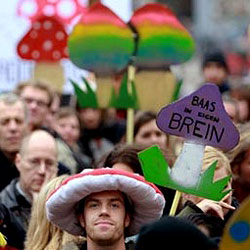
The mushroom strike:
On 27 October in Amsterdam several hundred people came out onto the main square to voice their disagreement with the government's plans to ban hallucinogenic mushrooms. Some of the protesters were dressed in headgear resembling fly-agaric caps. The idea of banning the sale of hallucinogens occurred to the government as a result of the growing number of accidents among tourists who had taken these hallucinogens. The mushroom sellers, however, insist that the dire situations are caused by mixing them with alcohol and other drugs. According to RIA Novosti, at the call of the site "Save the Mushrooms!", around 30 thousand emails were sent to the cabinet of ministers or to the parliamentary factions of political parties with an appeal to protect the mushrooms.

For anyone who has despaired of finding a small, cozy club in our guide to Amsterdam's clubs and was about to head off again to their favorite coffeeshop, we hasten to tell you about the club Jimmy Woo and several other relatively intimate establishments. But bear in mind: the smaller the venue, the harder it is to get in. The number of people out for a good time in Amsterdam is large, and the locals need somewhere to go too.
So then, Jimmy Woo is a Chinese-style club with its own legend. It was built on the order of a Chinese mafioso. The mafioso, of course, like Pilot Jao Da, turned out to be a mythical figure, but the venue is nonetheless made with more than a taste for the expensive, almost gangster way of life. The design was handled by the glamour-obsessed company B.INC., for whom nothing beats Swarovski crystals. The result — Chinese lamps, sofas of no small price, a dance floor of 100 square meters with lighting and hundreds of little lights, a black bar counter and a smoking room. Circle "Jimmy Woo" in red pen right on your monitor screen if you appreciate hip-hop and r'n'b. In the event that you don't manage to get into Jimmy Woo, stride confidently to the nearby (really very close) club Zebra.
A venue of a similar level but with a more flexible musical policy, so that the crowd, carried by hormones and pheromones, migrates from one place to another all through the night.

The club Sinners in Heaven, named after the 1924 American film and called by the locals simply Sinners, is as off-limits to the random guest as a sinner is to heaven. Popular among VIPs and famous Amsterdammers, the venue has a worldwide reputation as an extremely exclusive place. What's all the fuss about? The house parties "Lollipop" held with the support of Chupa Chups, the electro days — "Lust!", r'n'b on Thursdays, disco on Fridays — 'Thank God It's Friday' — and the other recurring events dazzle neither with big names nor with a unique concept. And yet, they say, at Sinners there reigns an inimitable atmosphere comparable to no other place in the city. It's as if this place were catnip to models, TV-series stars, players of the Ajax football team (how could it be without them) and other celebrities. Club members have first right of entry, so if you're still drawn to this sweet little spot and you don't lose hope of getting inside, come early (before midnight entry is free) to stand out the queue, dress festively-provocatively and be graciously friendly. And then, hallelujah, your patience will be rewarded with carefree dancing in the plush-and-mirrored interior. And if, closer to morning, you discover that you've lost your passport, phone or head in one of the bars of one of the three dance floors, be sure — once you've slept it off — to check the club's website in the Lost&Found section. And let that be a lesson to you.
Cheap and cheerful:
www.couchsurfing.com, www.hospitalityclub.com — users of these sites all over the world are just waiting for you to invite yourself over for the night. You register, find your destination city, browse the profiles of participating townsfolk, pick the ones most to your liking and ask to stay. They take no money for their hospitality, but they're always glad of gifts. Bring along some matryoshkas or traditional Russian food. If modesty won't let you invite yourself in with the locals, book a hostel, of which there are masses here. One of the most pleasant — MeetingPoint — is equally conveniently located both in relation to Central Station and to the city's most happening district. The windows of almost all the rooms look straight out onto the canal; there's a foosball table, hot breakfasts and the most comfortable plastic sofa in Amsterdam.

Taking the proud name of its founding country, the club Club NL was once the first lounge club in Holland and set off a whole wave of openings across the country of similar establishments meant not for dancing but for hedonistic contemplation. After four years of existence its creators decided to reprofile it into a fashionable — but still danceable — venue. The club is now 7 years old, yet the main bet here is still placed not on the names of the artists brought in but on a diligently updated cocktail list. The local cocktails — whether they glow in unnatural colors or have something unidentified, resembling an olive, floating in them — are guaranteed to make an excellent start to the night and may perhaps help you formulate your still hazy plans more clearly. The musical cocktail is served mainly by the residents, but guests do look in on occasion too: Trentemoller, Ricardo Villalobos, Rui Da Silva. The club is in the very heart of Amsterdam, so even if you don't feel like lingering here for long, you can easily stroll to another establishment.

Located in the red-light district, this two-level club is aimed above all at an active gay audience, but gladly welcomes many others within its walls too. What goes on here in the dark room nobody knows, but many can guess.
Every Thursday, Saturday and Sunday, mind-blowing strip shows are laid before the audience's eyes. A menacing lighting system throws the off-guard dancers into a whirlpool of dance — at the mercy of the lords of the DJ booth. The musical format is declared to be "hardcore". Extra color is added by the friendly, athletically built bartenders.
With touching pride the club releases its own music compilations and presents various "special" events, all of them, in one way or another, steeped in gay aesthetics.