Goa is a beautiful childhood dream. An interview with DJ Gavrila.
Интервью · 24.03.2002
By 44100Hz
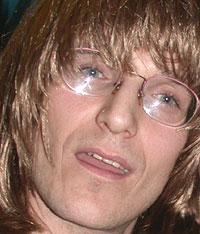
My real name is Gabriel. Gavrila is a nickname my auntie came up with in St. Petersburg back in early childhood. She paraphrased the famous lines about my name from Ilf and Petrov's novel. In the original it's "Gavrila was an exemplary husband," and the Moscow version is "Gavrila served as a disc jockey, a disc jockey Gavrila was." The name has stuck with me ever since. I've been into music for as long as I can remember. Thanks, probably, to my dad, who still has a big collection of vinyl records — an anthology of world jazz. It all started with me listening to my dad's records; when I set the needle down on the record, I got an indescribable thrill from it. All the more so because I was forbidden to use the turntables when my parents weren't home, so I did it in secret, wiping my own fingerprints off the lid of the player afterwards.
Somewhere around the 7th or 8th grade I started practising as a DJ — I played from reel-to-reel tape recorders at discos for the upperclassmen. Even back then my hits were Donna Summer and the slow numbers from "Led Zeppelin." Maybe the fact that I was born in Cuba and spent all my earliest childhood years there means that, with my father's blood and my mother's milk, some "black" rhythms and "black" "soul" entered me. It all somehow mixed together inside me. Then came a fascination with the St. Petersburg rock club. All my friends from my youth are St. Petersburg rock musicians and actors. I myself have worked a lot in film since childhood. My first role, at the age of 12, was the son of the great maestro in the film "Niccolò Paganini," and my last was in the picture "Gladiatrix." Artists, musicians and other creative people are still my circle, my creative family, you could say.
The first time I encountered psychedelic music was during trips abroad to Italy and England. When I got into real nightclubs, I tried stimulants for the first time. It was the very dawn of American house, somewhere around '87–'88. I was struck by how, through mixing, adding or removing some sound, you could get a progressive melody that "hooks" you on a physiological and psychological level, makes your legs dance. You can spend the whole night that way without getting tired, without any "slow numbers" and couples' dances. And the DJ doesn't yell anything into the microphone, doesn't say anything, doesn't announce anything. That pleasantly surprised me after all the get-togethers at the Leningrad and Moscow — at the time not yet "parties" but rather discos. At those, the DJs constantly shouted something into the mic, and played one slow track and then two fast ones. The arrival of electronic dance music undoubtedly broke all these stereotypes and turned dancing into exactly the kind of "jumping" it resembles at the moment. Which is precisely what we all moved away from at the very earliest stage of humankind's development — when we beat tambourines and drums, held hands, jumped around bonfires. And that was the only rest after the hunt. What is already laid into us by nature from the start is rhythm, vibrations.
Goa and the psychedelic sound somehow immediately became for me the embodiment of everything best. In short, it "cracked me open." Because non-psychedelic directions in music, honestly, interest me little. And I think that, for example, that same jazzman Miles Davis, or those same rock musicians "Led Zeppelin," "The Doors," "Grateful Dead," and of course "Pink Floyd," anyone at all who worked seriously with sound — it's all psychedelic music. It doesn't matter that it later turned into electronic music; it all began precisely with that. What matters is the idea, not its sonic embodiment. DJs became the continuation of the musicians' idea. They are the ones who keep them afloat, carry them further, multiply them, propagate them.
When I lived in England — this was in the early '90s — I dived very deep into the London music world, since I was in love both with the English language and with the whole of English culture in general. I got to meet, right away, the monsters of the "vinyl" and "party" movement of that time. You could say those were my years of schooling in immigration.
Then I brought all of that back with me to Russia; at the time it was just the very heyday of the parties on the Fontanka, in the so-called club "Fontanka 145." Or rather, it was simply a squat where people kindred in spirit, who didn't yet know the word "rave," gathered. They threw free parties, for themselves. Lyokha Haas, Misha Vorontsov (DJ Mikha Voron), Zhenya Groove, your humble servant — we're all monsters and veterans of those days. This was somewhere around '91, '92.
Then the club "Tunnel" appeared, which became a home for all of us. Techno music found its place precisely there, and found its audience too. I did, of course, try to bring elements of trance in there, because I had already started going to India with my wife and a narrow circle of friends. Back then I believed that the less I spread the word about it, the longer I, like a Messiah, could preserve Goa exactly in the form in which I'd seen it. Naturally, that was nonsense! If not me, then someone else would have done it. But I liked being in such a romantic frame of mind. I considered Goa my second secret home, a magical fairy tale into which I could plunge once a year. And then put on a mysterious face when someone asked. I liked all of it very much. Gradually more and more people started travelling there from St. Petersburg and Moscow.
Completely by chance, in London, at one of the parties, an "open air" thrown by an English sound system called "Pagan" at the time, put on by Mark Allen — now a well-known musician, the DJ of the group "Quirke." They did a series of out-of-town parties for the summer solstice. Suddenly, toward morning, at dawn, I saw people of a strange appearance, in strange clothes, climbing out of all the trucks, tents, sleeping bags and bushes, united by one thing — a certain glint, a strange light in their eyes, all-loving and a little mysterious. I was, of course, myself in an altered state of consciousness at the time and asked: "So, guys, what's going on with you — did you all eat something bad?" To which they answered that what they'd eaten was exactly the "right" thing, that they'd had a very hearty breakfast. And what united them was that they all travel to Goa, where, as I understood at that moment, there was a kind of hippie colony for ragamuffins from all over the planet. That thought lodged deep in my head. I imagined pictures of what it all might look like. In the end I saved up money — huge amounts at the time — for tickets and everything else, and my wife and I jumped on a plane, flew into Delhi, not even knowing where Goa was, not suspecting that it was still a two-day journey away from us. It seemed to us it was somewhere just outside the city, some little beach. It turned out — no.
With great adventures we made our way to the coast, the two of us, without any guides, with no information whatsoever. And fate led us out along a path straight to a party. We found ourselves at a party in the middle of the night. People could tell, of course, that we were new, a little frightened, not quite understanding what was going on around us. But everyone treated us very kindly, very warmly. Right away we felt that these were absolutely kindred spirits, who didn't care who you were or what language you spoke. One of the main unwritten rules of Goa is that no one has the right to keep someone else from resting and blissing out, in the good sense of the word.
And so we began a wonderful life on the coast in a big family of psychedelic hippies and neo-travellers, as they're called now, new-age travellers. People who move around the planet following the weather and the music festivals. And everyone does what they know how to do. Someone cooks food, someone makes clothes with their own hands, someone does music, paints pictures. The one who is simply in a state of bliss has every right to that too. Everyone occupies their own ecological niche, coexists coolly together — on the beach, and in the jungle, and in the sea, and by day and by night. The Indian land is so strong in energy, in its cultural and musical traditions, that Goa trance absorbed all of that right away. All the early Goa trance was saturated with melodies and harmonies borrowed from Indian music.
Trance came out of techno music. The fathers of the trance movement are the Germans, and not the Goans or the English at all. There was techno that included various intellectual directions, out of which came music with a detached mood — more sentimental, more contemplative, complex. It got the name "trance," thanks to the state a person experiences while listening to this music. Apparently it (that state) appealed to those very psychedelic-hippie-musicians, and Goa became the testing ground where this music was tried out. It suited the place, the time, the weather, the open sky, the high stars, the warm air, the bare earth under bare feet. All the more so because in Goa there had always been parties with psychedelic music.
When trance gradually came back to the continent with a powerful Indian coating, it scattered across the countries. In each country it took on some tint of its own. And it turned into psychedelic trance — without the Goa sound, more urban, with a sonic cacophony, using the most modern electronic instruments. At the same time some old analogue synthesizers instantly became a real "fashion" in trance music and an object of the hunt for devoted musicians. Eclecticism, the combining of everything at once, can easily be heard in trance; it has breakbeat, and echoes of reggae, and guitar samples of rock groups, and fragments from science-fiction or cult films. All of this took on its own cultural colouring, became a way of life and thought for many who plunged into this wave headfirst. Including me.
One can also note Israeli trance, a direction I call "childish." It's more accessible, festive-looking, dazzling, more ecstatic, less contemplative, less complex, but very high-quality in its sonic execution. The studios are very expensive, having at their disposal all the very latest achievements of sound technology. And the Israelis themselves have always been far from the last people in the music world. In this direction one can hear a big influence of Jewish folk music. Apparently, because Russians have always been heavily intermingled with this nation, Israeli trance appealed to many here, especially, probably, to those people who aren't so demanding or particular in their attachments to trance. Personally, I'm not a great supporter of this direction, since as luck would have it life pushed me toward deeper experiences. But any quality music has a right to exist, and Israeli trance is very high-quality music. You could say it's the pop music of trance, and pop culture is always the driving force. If only the underground existed — some alternative experimental music — people could go crazy. Everything is good in moderation.
Before trance, any cutting-edge music of those years played there: in the '70s — art rock, in the '80s — new age, and so on, the music that traces its roots all the way back to "Woodstock." The first settlers in Goa were all people of exactly that generation. There had always been parties there; another thing is that they went differently. Reggae music could be played there, early experimental ambient, that same "Kraftwerk," Klaus Schulze and many others. Gradually all this music was displaced by contemporary directions, one of which became trance. It came like a huge wave and washed over everyone, united everyone, was instantly liked by old and young alike. On the dance floor you could see both a four-year-old boy and a sixty-year-old grey-haired grandpa, who would just as well tap his heel, raising red Indian dust into the air.
As a DJ, I did all kinds of music before trance. I played house, and acid, and techno, and the last thing before trance was English acid house, which I still adore. Many Moscow DJs keep this style going even now, which I like a lot. I absolutely can't stomach ordinary, traditional "girly" club house, the "snot" kind. I can't listen to it at all; it puts me to sleep, makes me bored. I'd rather go and listen to some young trip-hop DJs; I'd even listen to rappers with great pleasure — by the way, my love for rap was killed off by our domestic rappers.
Trance music seemed to me the fastest-changing of them all. In it, in my view, some radical leap forward happens almost every six months.
At times it's hard to put modern psychedelic trance on the same shelf as the Goa trance of previous years. It seems like they're absolutely different things.
And the main thing, my very favourite, is the "open-air party." Big cities have driven trance under roofs and confined it within walls. Originally this music was meant to be listened to in open space. The worldwide festival movement is very rich in events and numbers several dozen festivals a year, taking place one after another all over the world. For example, in Germany, in June, July and August alone, around 15 major festivals take place, which are quite well known and draw 20–30 thousand people. Spirit Zone, Woof Experience, Antaris. In England — Tribal Gathering, Return to the Source, plus Ibiza, Boom Festival in Portugal, winter in Goa, Australia with Byron Bay, Mexico, Brazil, Thailand, Japan, and so on. In short, from May to October trance parties take place in Europe almost every weekend, and then the festival movement moves to resort countries, thanks to the weather and the cheapness of organizing open-air events. Wherever it's cheaper to do it, that, of course, is where they'll do it.
India became a Mecca for everyone who doesn't want to spend big money on a holiday. The cheapness is a big plus that can't be ignored. Ibiza, for example, is more expensive, and nevertheless the very same thing goes on there, just at a slightly more polished, bohemian level. If Ibiza has a club scene, then Goa's is more of a street one.
Despite the fact that trance predominates in Goa, you can hear the most varied electronic music there, since the people who gather are varied too, with their own tastes and preferences. In Goa you can wind up at a drummers' "session" or at a live reggae concert; you can also, riding a motorcycle past some garden, hear hardcore, and everyone who is in the same kind of mood will go there and rave. Everyone who feels like it entertains the others — that's the main occupation in the free time between "doing nothing."
Goa is a beautiful childhood dream, where everyone plays with toys, tries to stay in their childhood as long as possible, in that kind of illusory, imaginary world, full of colours, the aromas of incense and fruit.
As many people, so many opinions and concepts. People gather to be with nature, music, their own kind. To realize their creative talents precisely on Indian soil, which is strong in traditions, and that helps creative people do what they do. Many musicians have settled in Goa, moved their expensive studios there. There are several such studios; one or two of them are located not even in Goa but in northern India, up high in the mountains, where people reject the urban European world. As Roerich did in his time — he went off to the Himalayas to write his books and paint his pictures. Apparently it's easier there, and more ideas come into your head, fewer factors that irritate you and keep you from creating.
Officially I can't recall any such labels, but there are certain groupings that have formed over many years precisely in India. The French from "Parvati Records" are based in Goa.
In general, music doesn't necessarily have to be born there; it has to appear in the head of a person who is somehow connected with "there." Nonetheless, it can happen anywhere.
Over the past few years the connection between Russia and Goa has grown stronger, if you can put it that way. It all happened naturally, as it was bound to.
Foreign DJs whom we befriended during our trips to India started coming here. Everyone remembers who were the first — our friends and partners, the musicians from "JMS," the musicians from "Return to the Source." Musicians from all over the world have already been to Russia. The more promoter blocs got organized in Moscow and St. Petersburg, the more opportunities appeared to invite foreigners so that their performances paid off. Russian musicians began to travel. A figure like Den Kozlov (In-Resonance Voice) currently lives in England, writes music, releases it. The group "Parasense" tours and releases records abroad splendidly. And I travel the world a great deal.
Almost all the main domestic trance DJs have probably already been to Goa — KT-15, Mega-Mist, Sasha Fly, Thomas 303, Lyokha Renik, Roma Anatolich, Zheltok, the Shiva groups. Even my old friend Borya Spider, though he's not a trance DJ, went to Goa this year and liked it very much. Going forward, I think the trend will hold, and more and more people will travel there, exchange experience, thoughts, creative potential.
Abroad there's an established market, and to them we're still savages all the same. This stereotype, imposed by the times of the "cold war," is still present, and it needs to be destroyed. And no matter how much we shout that Russian DJs are the best — even though it's true, our DJs really are very strong — it has to be proven. Even if one person believed it, he then has to convince his audience of it in order to bring in a Russian foreigner. Luck, good fortune, sociability and personal contacts also play a not-unimportant role here. From the start, you have to be likeable as a musician, as a creative individual, so that people want to hear you. Because over there they have plenty of their own "cuties" too, who also need something to eat.
The audience has changed a lot now; it's gotten much younger, really 10–15 years younger. I practically no longer see on the dance floor the faces I started out with, though, of course, I know perfectly well where they are and what they're doing. They still love this music, and many of them have settled in Goa. Having come to love it all so much that they've actually made it their second home, and maybe even their first. Among the characters everyone knows is Timur Mamedov, aka the legendary DJ XP VooDoo.
Of course, it's good that young people come to the parties, listen to the music, dance. The main thing is that these young people also take some kind of interest, that they still try to understand what's going on, rather than just dumbly waving their arms and jumping around with eyes bulging from low-grade amphetamines.
With confidence, now that many years of both my abuse and my complete abstinence have passed — the absolute extreme phases — I can say that with your own desire and the ability to tune yourself in, trance music can perfectly replace any drugs. During the "jumping," by the way, a huge amount of endorphins is released; they are a magnificent stimulant. You can also do extreme sports to this music in parallel, for example. A former "junkie" and "drunk," and nowadays I don't drink, don't smoke, don't use. There you go!
It's inevitable, of course, but more and more people are moving away from it and coming to a healthy way of life. You could say that for many it passes like a step in their own development. Read Terence McKenna and the other figures who gave their lives to study and somehow classify substances. There's nothing bad about it, but nothing especially good either, of course. Everything is good in moderation — that's probably the only thing that can be said on this account. Having tried it once, it stays in you afterwards for your whole life. The rest is already a matter of your imagination, your subconscious, your subtle matters, your feelings. You can get along perfectly well without it. There are very many such people, and they feel perfectly fine.
It's the same stereotype as the one about my beloved city on the Neva. Every time the police stop me in Moscow to check my residence permit or my train ticket, once they find out I'm from St. Petersburg, the next phrase is usually: "Oooh! Where are the drugs?"
The same kind of stereotype exists regarding Goa — that it's some sort of drug Mecca. In response to that I can suggest you drop by New York or Amsterdam; things are far more serious there than in Goa, where there is a lot of fruit, beaches, motorcycles and other activities. Some people even go there to "kick the habit." Heavy heroin addicts became healthy little fellows before my eyes. So you must not, under any circumstances, declare that this is some kind of Indian drug capital.
And, say, smoking hashish has always been inseparable from their religion in Indian culture, as the scriptures, traditions and customs testify to us. The use of hard drugs came there with civilization, with white people.
A lot of nastiness, by the way, came to India with the whites. India used to not know plastic and polyethylene, didn't know cigarette filters, or what galvanized tin was. Why am I saying all this? Because all of it — tin cans, "butts" with synthetic filters, plastic bags that need many thousands of years to decompose — was brought to India by Europeans. The Indian land is now littered with all of it. And just a few decades ago the tableware in India was made of palm leaf; cigarettes in India were called "bidis" and looked like a rolled-up tobacco leaf. Instead of plastic for packaging they always used newspaper, which they simply tied with a string. That is, all those materials that quickly rot, decompose and become organic waste, which in no way kills the Indian land.
Synthetic drugs can be called that very same waste, which in exactly the same way kills not only the Indian land but the Indian consciousness too.
But hashish, marijuana or some other wild-growing "substances" have always and everywhere been beside man, grown by Mother Nature. Not for nothing. But so that we, in a kind of symbiosis, could be friends, help each other and somehow use it for the good of humankind. And not so as to become its slave.
Promoters, without calling me or arranging things with me in advance, announce me at their events. And often at several parties in different places at the same time. At first I got really angry about it, cursed, but now I'm already thinking about creating my own clones, so as to earn — contrary to the saying — all the money in the world, like "Laskovy May."
I'm very glad I've stayed afloat until now, though I consider that quite deserved. I'm glad I'm not reaching for the stars, that I didn't go into pop culture, though the temptation is very great, but the line is very fine. I'm glad that I have the chance to travel a lot around the country and the world. I recently got back from Japan, where together with "Parasense" we played a super party in Yokohama. Before that there were trips to the Czech Republic, Hungary, Portugal; I often go to Ukraine, India, St. Petersburg and Moscow. The geography of my movements is quite extensive. True, there's absolutely no time to deal with organizational matters, so many offers and projects often end up without due attention. I'm a busy family man; I have a whole horde of kids growing up, and that takes a lot of time.
Asses! I have one word, and a very simple one — asses! And I'd like this to be conveyed to the readers exactly as I said it. They think that playing from DATs is "cool" and vinyl is "lame." This comes from a complete misunderstanding of the situation. Let's start with "A," if we don't understand what "B," "C," "D" are…
What is a DAT for? I'll explain, for the asses and for those who are interested. In the case where your contacts include musicians with unreleased material, when you have access to the primary source and can record their music in the format in which they made it, you need a DAT medium, as the only medium that can copy, one-to-one, the original, studio sound of the music. Plus, if you play in Goa, no vinyl will withstand the heat and the dust. In the city it's a different matter.
A compact disc is 44 kilohertz, and a DAT is 48 kilohertz — the quality in which the master copy comes out from under the wing of the computer at proper studios. If you're such a lucky one that you have access to the studio of musicians who give you their track to play, then that's exactly why you play this track from a DAT, so as not to drop the level of quality it was created in. And all these MiniDiscs and burned blanks naturally kill the sound. People use it because "when there's no fish, even a crayfish is fish," or simply because there's no other option. I think it's better to spend money on vinyl, to learn to mix and play like normal DJs. Rather than chasing fashion and buying yourself expensive DATs. What's the point of playing off a DAT a collection you originally assembled by copying from MP3s onto MiniDisc? That shouldn't exist at all on a big sound system; it grates on the ear. Now, unfortunately, 75% of Russian DJs do exactly that. And I want to tell them that it's very bad. They themselves apparently don't understand that they're thereby spoiling the sound and the sensations from it. Different sources and formats are needed in order to use different music, not to dumbly destroy everything with MP3s. And then to gather it all onto a DAT because that's fashionable — it's utter idiocy. If a DJ plays vinyl, he is by no means backward or unfashionable. He's a beauty! He spends his own money on expensive records, keeps them unscratched, makes real mixes. In every respect he'll be much closer and more pleasant to me than any Vasya Petechkin with two MiniDiscs, full bags of low-quality copies and a not-yet-dried green snot on his nose.
In St. Petersburg things with trance are quite good, but very few parties take place. Trance is also developing quite actively in Tallinn. There are some manifestations in Kharkov, Kazan, Crimea, a bit along the Volga.
Use fewer low-quality drugs, listen more to the music, to yourself, to the world around you and to nature. I'd like promoters to stop staging an unhealthy competition over gathering as many people as possible at the entrance. It's better to try to bring it back to the format of quality parties; then people will come on their own. Bom Shankar!