Goa Syndrome
Чтиво · 20.02.2007
By 44100Hz
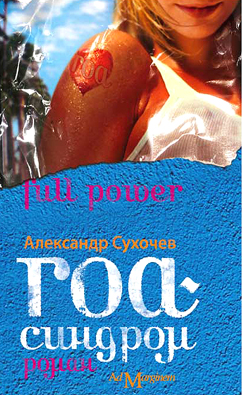
44100Hz publishes the 10th chapter of the novel:
Barely keeping up with his own feet, Bolt, in the company of Yura and Mahindra, was tumbling down the steep little steps, away from the tourist-packed club. Broken beats of music still carried through the trees, occasionally interrupted by the tireless MC, but they were growing quieter and quieter — up at the car park nothing could be heard anymore. Bolt squeezed between the tightly parked cars behind Yura and Mahindra, who did it with acrobatic virtuosity, while the tail of the little snake was brought up by the taxi driver, tirelessly offering his services to take them to the best places, in his own opinion.
— Taxi!.. "Mambo", "Tito's", — he repeated like incantations until the guys came out at the long rows of motorcycles and scooters.
— No taxi! — Yura stopped abruptly and turned around, Mahindra crashed into him by inertia, Bolt reacted but didn't manage to stop in time — the taxi driver, owing to a national peculiarity, didn't even react to the abrupt halt but kept walking, repeating his incantations. Bumping into Bolt, he gave a push to him, to Mahindra and to the already-off-balance, enormous Yura. The latter flailed his arms absurdly, loudly repeated once more: — No taxi, — collapsed onto a scooter and, together with it, onto the neighbouring motorcycle. Three bodies fell on top of him, and everyone froze, watching the two-wheelers fall one after another, like dominoes. Last stood a chromed "Enfield". When the wave of falling machines reached it, it seemed to Bolt that the powerful motorcycle stoically took on the weight of the mopeds leaning against it — it tilted slightly to the side, and its kickstand half-sank into the red dust. But the "Enfield" held firm.
Sergei shook the taxi driver off himself and got to his feet, holding out his hands to Mahindra and Yura — who readily grabbed both and gave a sharp tug. Bolt's feet came off the ground, and a moment later he was on top of Mahindra again.
The taxi driver laughed loudly, hissed something in Konkani and went off to his own people — he had something to tell, killing time while waiting for customers. Bolt looked at the back dissolving into the darkness and shifted his gaze to the "Enfield".
Neither Yura nor Mahindra even had time to grasp what had happened. Bolt jumped up and ran to where the toppled "dominoes" ended — the motorcycle's kickstand had, after all, given way and folded, the "Enfield" fell too and began slowly sliding down the slope of the steep hill on whose edge it had stood. Sergei grabbed the rear wheel with both hands, trying to hold the motorcycle back, but it was too heavy — dragging Bolt along with it, it kept sliding through the red dust. The last thing Mahindra and Yura saw in this scene was Bolt's eyes, astonished at his own helplessness.
After a few seconds of clatter somewhere below, silence fell. It was unclear just how far below it was, but the understanding that Bolt, at least, had to be pulled out of there came quickly. Yura and Mahindra ran to the edge of the hill — Sergei had come to a stop lower down, some twenty metres away; his feet had caught on tree roots creeping along the ground, and his hands were gripping the motorcycle's rear wheel tightly.
— Seryoga, are you alive? — Yura carefully began descending the slope; Mahindra tried to follow him but thought better of it, slipping after the first step.
— Alive! — shouted Bolt. — Get me out of here, my legs are tangled up.
After a few minutes of struggling, Yura and Bolt, covered in red dust, climbed up to the car park; Mahindra had found her "Honda" in the heap of toppled machines and was trying to pull it out from under the pile-up.
— We've got to clear off, — Yura lifted the scooter, sat on it and switched on the ignition; Mahindra sat behind.
— And how am I going to ride? — Sergei saw no room for himself on the small seat.
— With us, get on, — Mahindra shifted over and, pressing herself tightly against Yura, freed up a little space.
Bolt wedged himself between the spare wheel bolted on at the back and Mahindra, and Yura set off, paying no attention to the car-park guards who were approaching them fast and loudly.
Miraculously dodging their arms spread out in all directions, Yura rode out through the club's gates and stepped on the gas. The wind blocked Bolt's ears, it was unreally cold in just a T-shirt, and, trying to shout over the moped and over himself, he yelled to Mahindra:
— Do we still have far to go?!!
— Where?!!
Bolt was taken aback and, to be sure, shouted:
— Where are we even going?!!
— First to "Manches", we'll have a smoke there, and then — to "Paradiso"!!
— And what's "Manches"?!!
— When we get there, I'll tell you!!!
It seemed to Bolt that Yura was tearing along at enormous speed, taking the bends the way the great motorcyclists do at motocross events — until this moment Bolt had only seen such things on live broadcasts from Indianapolis on RTR-Sport.
The "Delfinchik" was kicking in stronger and stronger; the road ahead no longer doubled in his eyes but, like the tentacles of an octopus, spread out in smooth lines between the palm trees. Bolt understood perfectly well that Yura had the same picture before his eyes, and marvelled at his ability to keep threading the moped between the thick tree trunks.
— Around this bend will be "Manches", — Mahindra pointed at the fast-approaching junction, blocked off by iron police barriers and by the police themselves.
On the bend Yura didn't even let go of the accelerator; his trouser leg touched the ground and raised a little column of dust, the scooter tilted menacingly, Bolt caught a policeman with his elbow, the policeman shoved his whistle into his mouth but never managed to blow it — the trio vanished into the darkness in a matter of seconds.
A hundred metres on, Yura stopped abruptly beside a café built out of bamboo poles.
— This is "Manches", which in slang translates as "the munchies after a smoke", — Mahindra hopped off and walked confidently towards the entrance.
Half of the plastic tables were occupied by Israelis, each of them absorbed in some task, but nobody was eating — only preparing: someone was cleaning a chillum, someone was lighting a new one, someone was crumbling hashish into a mixing bowl, someone was packing, someone was lighting up again; the fans struggled to disperse the clouds of smoke, but managed.
The waiter quickly brought the menu and was about to leave, but Yura, who had already got everything ready to roll a joint, stopped him and ordered three teas.
— Only tea? — the waiter wasn't surprised; orders like this had their own separate page in the menu.
— Yes, — Yura began breaking it up, hashish falling in little pieces from under his fingers into a half of a coconut polished to a shine. Then he took out a cigarette and passed it over the flame of the lighter until the paper blackened.
— And why do you do that? — Bolt didn't understand why the cigarette had to be ruined.
— It's so the tobacco dries out, it's easier to roll that way, — Yura didn't even look up from the process, ran his tongue along to the filter, tore off the wetted paper and tipped the tobacco in with the hashish. From a small notepad he tore off a sheet and rolled it into a little tube.
— And what's that? — there were no notes in the notepad, and Bolt realised this was another trick to make rolling a joint easier, but what exactly it was for he couldn't work out. In principle, he couldn't understand at all how his thought process was constructed at that moment; for an instant he zoned out, but, realising that he wouldn't be able to sort out this complicated question without outside help anyway, he refocused his attention on the process of rolling the joint.
— It's a filter, — deftly fishing a sheet of rolling paper out of the little packet, Yurik placed the rolled tube on its edge and tipped out the mixture, distributing it evenly along the whole length. Then, the way conjurers hide their passes with their hands under blue cloth, he lowered his hands under the table, forcing Bolt to dive head-first down there too — Yura's fingers transformed the blank into a finished joint; he ran his tongue along the sticky strip and, tucking in the paper at the end of the joint, passed it to Bolt under the table. — Spark it up! And don't tell me you don't smoke.
Without lifting his head, Bolt found the lighter by feel and lit up.
— Come out, there's no need to hide here, — Mahindra laughed when Bolt banged his head on the edge of the table.
The waiter brought three tall glass tumblers of boiling water and, separately, three tea bags on a saucer.
The joint went around the circle; the Israelis approvingly raised their chillums and said: "Bom!"
— That's it, enough, I can't take any more, — Bolt handed the joint to Mahindra and for the first time asked her name.
— Masha... — she took a deep drag, held the smoke in her lungs and, on the exhale, continued, — ...but Mahindra is more familiar.
— And why's that?
— No idea. Do you think it matters?
— Not really, — what Bolt was actually interested in was something else entirely. — Guys, so what is the Goan syndrome?
— You know, people here divide into two types, — Yura took a drag. — The first are the ones who don't like anything. You could stand an elephant on its ears for them and paint its balls pink — they'll still be spitting, because, for instance, there's a cow wandering on the beach. The second are the ones who don't give a damn about the dirt by the roadsides and those same cows on the beaches; they get a kick out of the palms, the sun, the sea…
— And what's the Goan syndrome got to do with it?
— Everyone here finds what they're looking for. That's exactly what the Goan syndrome is, — Yura put out the small remnant of the joint and, finishing his tea, suggested they get going.
The second time, the policeman past whom the guys again went tearing managed not only to shove the whistle into his mouth but also to blow a portion of air into it, but the whistle only reached Bolt's back, not even disturbing Yura — he kept riding, utterly ignoring the cop's wish to stop them.
At the car park by "Paradiso" there were about five times more machines parked than by "Kabana"; a huge neon sign lit up the space in front of the club and the small queue at the entrance. Over the few minutes while Yura parked the scooter and the three of them walked to the iron turnstile through which people got inside, they were offered around fifteen kinds of drugs, guaranteed to be nothing less than "good quality" and "full power".
Mahindra passed through freely, Yura handed the cashier two hundred, and they stamped a huge blue mark on his wrist; they didn't fuss over Bolt for long either and slapped a blue circle right onto his palm.
— Well then, tourist, onto the dancefloor? — Yura smirked, watching the muscles working in Sergei's jaw.
— Yeah, — he didn't even need to go anywhere, a dense beat carried up from below, and that was enough to set Bolt dancing. — Got any gum?
— We'll buy some inside.
Steep steps descended in a semicircle into the grotto; right beyond them an area packed with people opened up before Bolt's eyes. Their clothes glowed under the ultraviolet in the colours of the solutions that usually stand behind glass in a chemistry classroom. A sample of the colour of the DJ's dreadlocks would normally be kept locked away in a flask and sealed by the chemistry teacher, along with her personal signature on a strip of paper stuck to it.
Memories of the school classroom carried Bolt's thoughts back to Russia — only a week had passed, but this week had either flown by like a single instant or stretched out into a line as long as a lifetime. It was hard to make sense of; very strange metamorphoses happened to time here. Sometimes it bounced like a ping-pong ball between the paddles of Chinese table-tennis players, sometimes it stretched out like those cat's balls his grandmother was always telling Seryozha about.
Right now there was no time at all. There was space, there were many people dancing in it, there were walls painted with fluorescent colours enclosing that space on three sides, there was the roaring ocean on the fourth. There was music that had filled that space at the speed of that same ping-pong ball, there were thoughts leaping even faster through his head, but all of it existed on the far side of time. For this Bolt was not ready — he was used to nine — off to work, one — a break, dinner — around seven, and a film on ORT — twenty to eleven. And here it had all collapsed, as if at a snap of the fingers in the air. Snap — and it was gone, time had vanished.
Bolt felt discomfort, whether from the unfamiliar sensations or from the fact that the music had changed — in the DJ's place there now stood a skinny, Japanese-looking boy in big horn-rimmed glasses. He took absolutely no interest in what was happening on the dancefloor and, absorbed like a three-year-old with a "Lego" set, fiddled with the mixing desk. Listening to it was unpleasant — and not only for Bolt: together with most of the people, he went down another flight of steps to a level below.
To call what Sergei saw by any single word was impossible — for some it was an eatery, for some a smoking den, for some a bedroom, but on the whole for everyone it was a hangout.
"There it is! — thought Bolt. — People from all over the world in one place, under one sky, with one music. Just as it should be!"
He stopped, admiring the flickering flames of the kerosene burners; people in bright clothes sat around them in circles, hashish smoke and the steam of hot tea rose into the air, there was a smell of omelette and fried bread, and the noise of waves breaking on the rocks was louder than the paralysing music above.
— Move, motherfucker!!! — someone gave Bolt a painful shove in the shoulder, clearing a passage; he even registered that he'd been treated rudely, he even clenched his fists and even drew back his arm, but...
..."This isn't Korolyov, after all!" — flashed like lightning through Sergei's head, and he lowered his hands. "This is Goa!" — and he was filled with love for everyone passing by him.
Mahindra and Yura, seeing Bolt, waved to him, and he moved towards them, carefully weaving among the shoes arranged by the mats.
— Hi, sit with us, — some bearded guy in a colourful lungi, with a green pen case around his neck, shifted over, freeing up a spot next to Masha. Bolt took off his shoes and lowered himself onto the straw mat.
— Want some tea? — Sergei saw Mahindra's enormous pupils; back in Manches they'd been much smaller... Well, if the tea gets you even higher, then...
— Why not? — Bolt turned his head this way and that. — We need to call the waiter, order.
— My name's Vasya, — the guy in the colourful lungi held out his hand, then pointed at an old Indian woman who looked more like a gypsy, and began explaining: — There are no waiters here; those women over there by the primus stoves are called chai-mamas — besides tea, they've got cigarettes, water and eggs fried with onion.
— And gum? — Bolt caught himself having tirelessly chewed his own tongue and ground his teeth for the last few hours.
— Gum you can get from those lads over there, — dirty youngsters in ragged clothes darted tirelessly among the chai-mamas, taking orders and passing them on to where they were needed. — They've also got hashish, and that guy over there, — Vasya pointed with his finger at a nimble barefoot lad who didn't stop for a single moment, moving from one group of people to another, never idle, in short, — well, he's got excellent pink crystals today. I recommend giving them a try.
— Crystals?
To be continued. The book "Goa Syndrome"
goes on sale in early March 2007.