Gorod. One Year in the New Place
Интервью · 05.10.2005
By niQue
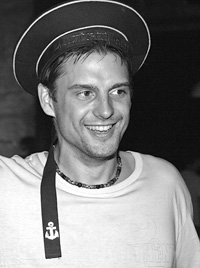
"A city is a unity of the dissimilar", said the wise Aristotle. The legendary club Gorod is celebrating its anniversary in a new location. Over this time the club has become a stage for the most varied events. Gorod's art director Kolya Boodoo talks about what has been achieved and looks into the future.
Such thoughts did occur. But there was a certain understanding that in the future, if we opened another club, it would no longer be called Gorod. Back then it seemed very important that Gorod should remain in people's memory as what it had been on Shmitovsky. When we opened the new club a year and a half later, we came up with nothing smarter than to call it Gorod. I suppose time changes one's notions of what is "very important".
Of course there were. The new club was supposed to be within the Garden Ring. To be big, beautiful, with the best sound and light. And without a "commercial" lease. Dreams are a beauty unconstrained by reality. In practice we had to work from the space and the conditions available. The new Gorod didn't turn out perfect.
It lacks nothing. It's we who lack things. Money, for instance. A lot has changed since we started out. And the absence of any starting capital dictates its own terms. For now even this situation suits us. It's a matter of the gap between "the desired" and "the real".
Sometimes. But probably less often than at other clubs. It just doesn't quite work out. Working with sponsors takes some special character trait, or something. Because of that we have to run at a loss on our guest bookings. The only one that supports our events and puts up with our temperament is Bacardi. For which we thank them.
I think location isn't all that important. The old Gorod didn't draw a thousand people every single night. In 2000 Dubrovsky and Zhenya Zotov, the people who created Gorod, set off what seemed at the time like an endless rave. But circumstances and various external and internal factors led to only 100 people coming to the club by the time I joined in 2001. The floors were shut at three in the morning. Later, from 2002 up until the closure, the count ran into the thousands again. Location is one of many factors. And if fewer people come to us now than went to the old Gorod, it's not about the address, it's about us.
It did, of course. The old Gorod stood on the grounds of a factory. A big parking lot, a distance from residential buildings. We really miss that now. People out on the street in front of the club mean the police, complaints from residents. A paid re-entry fee helps a little — there are fewer people outside the club — but it still doesn't get rid of the problems.
The team. We've gotten better. More experience means more rational action. Efficiency is growing. Costs are being optimized. Of course, over time downsides appear too — your eye gets "worn in", enthusiasm drops. You can no longer work quite so selflessly. I'd say personal entropy is on the rise. But that doesn't matter. There are still more pluses than minuses.
There are actually a lot of us. Dubrovsky is the club's permanent leader. Zhenya Zotov, whose work I'm carrying on here. Cowboy and Mitrofan — the club survived its hardest times thanks to them. Misha Spirit, Vasya Magic B, Sergey Sergeev, Anton Kubikov — my and the club's musical teachers. And Anton Kubikov, I suppose, will never tire of buying us needles and slipmats. Thanks to Volodya Trapeznikov, Gorod's best events became possible — Laurent Garnier, Sven Väth, Richie Hawtin. Nyura is me two years ago, only prettier. Kiriloff is my karma, the one who led me into club culture and stays with me to this day. Lyosha 44100 — I'd rather tell you about Lyosha in an interview for some other outlet. The DJs who, despite their status, played the club for free in really hard times can also, to some extent, be counted as investors... Garrison and Marychev are our unseen companions. Natasha Rostova... You can't name them all. Our name is Legion.
Many performed, but only some are truly memorable. Among the DJ sets: John Selway and Electric Indigo — for the music; Kana — for the contrast with my notion of Eastern reserve; Oxia and Dash&Dry — for their uncompromising attitude; Richie Hawtin — for everything. Among the live acts: Stewart Walker — for pulling every single person in the club onto his dancefloor; Joris Voorn — with him we glimpsed the future of techno; Rework — for the beauty; Swayzak — for the biggest hype; and most of all Kowalski, Hardfloor, Der Dritte Raum — for their matchless euphoria and celebration.
Always positive. Possibly not always truthful. They're all, as a rule, cultured people. Restrained in their statements. Show business, on top of that... From what I know for sure — Hardfloor, Der Dritte Raum, Joris Voorn and Richie Hawtin were happy and ready to come back again and again themselves and to advise their friends and colleagues in the trade to come. To a large extent it's the artists who've played the club that shape the next bookings with their recommendations. Timewriter and Terry Lee Brown, for example, volunteered to come themselves on the recommendation of one of the German musicians who had played the club.
It would be nice if some of our authorities changed their policy a little. Then we'd be able to invest more money. Right now taking risks makes no sense. They could shut us down at any moment. We only invest what we can afford to lose. In particular, besides the sound on the big dancefloor and the ventilation, you could list endlessly what could be improved in that case.
Gorod was never a techno-only club. At the old Gorod you had Kolya, Grad, Duck, Kirillov, Shushukin, Arkady Air playing — that's more like house. The associations probably come from Gorod's part in the rise of the "second wave" of techno in Moscow. In 2001 the new team was changing the format. That's when Cyberia appeared — a monthly techno night. It was my only "signature" party at the club. Cyberia's success shaped the new format. Techno was becoming more and more popular. But Gorod was never a fully techno venue.
I did.
If I went by my own taste, the DJs at the club would be playing Depeche Mode and Camouflage, Radiohead and Blur, Primal Scream and New Order, Zemfira and Malchishnik, Motörhead and AC/DC, and also the song "I Love You to Tears" performed by Mazaev. The mess of my taste lives in my computer, in the folder "My Music", and it usually only ventures beyond those bounds when I'm heavily drunk. As for the club, I go by — or rather, I try to go by — the taste of the people around me. Seems to work out.
Picked up off the street. Ha-ha. In 2001 my friends Misha Spirit and Marina Piner asked me to help run a bar at Kazantip. There, at the bar, I met Dubrovsky. The experience of working together went well. When Kazantip ended, none of us wanted to part ways. We went to work in Moscow together. There was no vacant manager's position at Gorod at the time, so I "had" to become the art director... It sounds funny now. By the way, that bar was called Musson. Probably the best bar-dancefloor there was at Kazantip. Not because of me, of course. My opinion is more of an outside view. Anyone who was there in 2001 will know what I mean.
Grand, as always when it comes to plans. They're unlikely to come true in full. So I'll allow myself to stick to rough sketches. Format — to hold on to the chosen format with all our might. Lives — as many live performances as possible. They cost more, but they're worth it. Breaks — to keep pushing the breaks I love so much onto the Moscow masses together with, and under the careful guidance of, Piter's In Beat We Trust. To change the sound and give the DJs back the beer in their fridges: as experience shows, that affects the musical policy more positively than any strategic planning.
Hacienda (the cult Manchester club, one of the first places to start throwing raves). When I watched the film "24 Hour Party People", I really liked that "dump". It's one of the clubs that gave rise to the club movement in the form we have it now.