Auto-translated by 44100Hz.
Read the Russian original →
Interview with Dave Seaman
Интервью · 11.11.2004
By Люся Грин
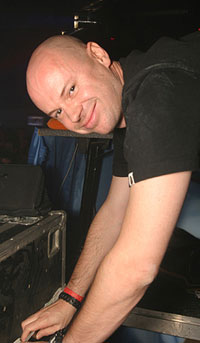
I'm sitting across from Dave Seaman in the office of Gaudi club. About 15 minutes left before his set. Time is tight. And I just sit and stare at him wide-eyed. Small, bald, with a touching childlike smile – the English version of Karlsson-on-the-Roof. Interviewing Dave Seaman is a real pleasure: not a gram of pretension, not a drop of irritation at my imperfect English – nothing but friendliness. The result – a pretty decent interview. But you be the judge.
ЛГ:
Hi, how are you?
DS: Great, thanks. Just tired – haven't slept in a while.
DS: Great, thanks. Just tired – haven't slept in a while.
ЛГ:
I get it, I don't remember the last time I slept either. How many times have you been to Moscow – third or fourth?
DS: As a DJ I'm playing here for the sixth time. And just visiting – I've lost count of how many times I've come.
DS: As a DJ I'm playing here for the sixth time. And just visiting – I've lost count of how many times I've come.
ЛГ:
So you already know your way around the city pretty well?
DS: Of course, I even dated a Russian girl for a year and a half.
So I'm a frequent guest in Moscow (laughs).
DS: Of course, I even dated a Russian girl for a year and a half.
So I'm a frequent guest in Moscow (laughs).
ЛГ:
Oh! I didn't know that. Are Russian clubs different from all the others?
DS: They are. I think the reasons for the difference are increasingly social. Your city has a lot of very, very rich people and a lot of very, very poor ones. And the Russian club scene is for those who have money.
DS: They are. I think the reasons for the difference are increasingly social. Your city has a lot of very, very rich people and a lot of very, very poor ones. And the Russian club scene is for those who have money.
ЛГ:
I think that's been a myth for a long time now, because our middle class is growing fast.
DS: Really? This is my first time here in two years, so you'd know better. But when I was here two years ago – I played at Slava, though maybe that's a special club…
DS: Really? This is my first time here in two years, so you'd know better. But when I was here two years ago – I played at Slava, though maybe that's a special club…
ЛГ:
And what's your favourite place in Moscow – just don't tell me anything about Red Square.
DS: I won't. I really like club 13 – my favourite place. And I also spent a lot of time at Papa John's – you probably know where that is (laughs). I like Gary, that's the reason. He's very friendly, very positive, cheerful, a good man, in short. (Gary Chaglasyan – owner of club 13, Papa John's and the company Organised Kaos, promoter of this party. – Ed.) I also love strolling through Gorky Park, and Red Square too…
DS: I won't. I really like club 13 – my favourite place. And I also spent a lot of time at Papa John's – you probably know where that is (laughs). I like Gary, that's the reason. He's very friendly, very positive, cheerful, a good man, in short. (Gary Chaglasyan – owner of club 13, Papa John's and the company Organised Kaos, promoter of this party. – Ed.) I also love strolling through Gorky Park, and Red Square too…
ЛГ:
Come on, I asked you not to!
DS: Oh, sorry (laughs again). Listen, actually what I like most about Russia is the warmth of the people. Although when you meet people in Moscow clubs, they all smile, they're happy to see you, but out on the streets – they're completely different.
DS: Oh, sorry (laughs again). Listen, actually what I like most about Russia is the warmth of the people. Although when you meet people in Moscow clubs, they all smile, they're happy to see you, but out on the streets – they're completely different.
ЛГ:
That's because it's cold on the streets.
DS: Ah, right (laughs again).
DS: Ah, right (laughs again).
ЛГ:
Now let's talk about music. You've been playing progressive house for about 10 years now?
DS: Have I, really? I don't know (laughs again).
DS: Have I, really? I don't know (laughs again).
ЛГ:
No, really, how many years have you been playing?
DS: I've been DJing for 24 years now (keeps laughing). I'm telling the truth (laughs hard). I started at birthday parties when I was really young, but that counts too, right? I started back when DJing wasn't yet what it is today. But I've been known as a DJ since 1992.
DS: I've been DJing for 24 years now (keeps laughing). I'm telling the truth (laughs hard). I started at birthday parties when I was really young, but that counts too, right? I started back when DJing wasn't yet what it is today. But I've been known as a DJ since 1992.
ЛГ:
And haven't you gotten sick of house over all this time?
DS: When someone does the same thing for as many years as I have, sometimes you get the urge to send it all to hell, and that's normal. No matter how good your profession is, how perfect it is, ask a footballer or a plumber – everyone has bad times now and then.
DS: When someone does the same thing for as many years as I have, sometimes you get the urge to send it all to hell, and that's normal. No matter how good your profession is, how perfect it is, ask a footballer or a plumber – everyone has bad times now and then.
ЛГ:
But you could switch house for another style at any moment without changing your profession as a DJ...
DS: Well, yes. But house is the roots. It seems to me that dance music existed even before the birth of Christ. Ancient Indians smoked, for instance, beat drums and danced. That was 3 thousand years ago. It's part of what's called being human. Dance is a natural process for a person. It can relax you no less, and sometimes even more, than alcohol or smoking. I like the tribal rhythm – and that's the foundation of house music. So how could it ever get boring? It's part of human nature. People love going to clubs and going wild on the dancefloor. If I get bored of anything, it's the fashion for whatever it may be.
DS: Well, yes. But house is the roots. It seems to me that dance music existed even before the birth of Christ. Ancient Indians smoked, for instance, beat drums and danced. That was 3 thousand years ago. It's part of what's called being human. Dance is a natural process for a person. It can relax you no less, and sometimes even more, than alcohol or smoking. I like the tribal rhythm – and that's the foundation of house music. So how could it ever get boring? It's part of human nature. People love going to clubs and going wild on the dancefloor. If I get bored of anything, it's the fashion for whatever it may be.
ЛГ:
What do you mean?
DS: I mean the fashion that the media usually impose. For some reason everyone needs trendy movements, trendy styles. This month it's drum'n'bass, next month progressive, the one after that electro-clash. That's what's boring.
DS: I mean the fashion that the media usually impose. For some reason everyone needs trendy movements, trendy styles. This month it's drum'n'bass, next month progressive, the one after that electro-clash. That's what's boring.
ЛГ:
And I've been getting bored of the four-to-the-floor kick lately, I'm sick of it.
DS: You know, there really has been little interesting done with the straight kick lately, but that's temporary. It's just a phase. Actually, you can lay so much over a straight kick, over that boom-boom-boom. Anything, you understand, an-y-thing! I think you're bored of the straight kick because right now it seems like everything that can be put over it has already been put there. And to surprise people you have to try really hard – that's what makes it more interesting. Broken rhythms are more interesting because there are more possibilities…
DS: You know, there really has been little interesting done with the straight kick lately, but that's temporary. It's just a phase. Actually, you can lay so much over a straight kick, over that boom-boom-boom. Anything, you understand, an-y-thing! I think you're bored of the straight kick because right now it seems like everything that can be put over it has already been put there. And to surprise people you have to try really hard – that's what makes it more interesting. Broken rhythms are more interesting because there are more possibilities…
ЛГ:
Last topic – Ibiza. Do you play there every year?
DS: Yes, I love that place. It's the world capital of the club movement. At least for three months a year.
DS: Yes, I love that place. It's the world capital of the club movement. At least for three months a year.
ЛГ:
But a lot of people think Ibiza is dead. I've never been there myself, I'm thinking of going in summer 2005. Convince me.
DS: You know what I'll tell you to that? Go, by all means. And to those who think Ibiza isn't what it used to be, I'll say this – it's you who aren't what you used to be!
DS: You know what I'll tell you to that? Go, by all means. And to those who think Ibiza isn't what it used to be, I'll say this – it's you who aren't what you used to be!
ЛГ:
Old, you mean?
DS: If they can't have a good time in Ibiza, they need to look in the mirror. Everyone to Ibiza – and don't listen to anybody!
DS: If they can't have a good time in Ibiza, they need to look in the mirror. Everyone to Ibiza – and don't listen to anybody!