Kompakt: on music and Moscow
Танцпол · 28.04.2008
By София Пушкарёва
On 19 April, in the building of the Khokhlovka Manufactory, live performances were given by such pillars of the electronic techno scene as Wolfgang Voigt, Joerg Burger and Thomas Fehlmann, as well as the New York hip-hop producer Om'mas Keith. In its scale this is one of the most interesting events of the year for connoisseurs of electronic music.

Before the event began, anyone who wished could come to a lecture organised by the Russian branch of the Red Bull Academy. The Red Bull Music Academy (RBMA) is rightly considered one of the most unique music projects in the world. For the tenth year running it has been gathering DJs, musicians, composers and simply people in love with music to its sessions. Every year, thirty representatives of the most diverse nationalities meet to take the RBMA course and study together over the course of two weeks. And the Academy's lecturers are legendary musicians and representatives of the largest labels. Besides teaching DJs and musicians, the RBMA organises lectures featuring stars of the world club scene, which anyone who wishes can attend.
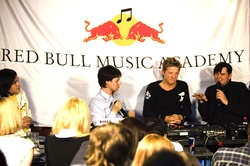
For the Moscow lecture the Academy invited the founders of the Kompakt label, Wolfgang Voigt (Wolfgang Voigt, Mike Ink, Studio1, Gas) and Joerg Burger (Joerg Burger, The Modernist, Triola), who talked about the development of techno music from Kraftwerk to minimal techno, about the creation of the label and its direct influence on that development. According to the guests, the idea behind creating the label was to find an authentic German sound, unlike black broken rhythms, unlike English punk, unlike American blues. Taking German pop culture, folk motifs and the so-called shaffel beat, used most often in polka, as their basis, the Kompakt musicians combined all this with contemporary musical directions and technologies. They managed to invent, as critics and journalists often write, the "Cologne sound", popular the world over and already having found a great many imitators.
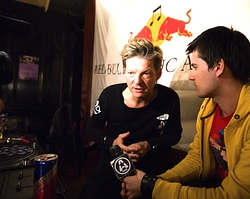
Joerg Burger: "When I started making music, I was first and foremost influenced by pop culture: new wave, punk, rock'n'roll and the like. I even worked with some pop musicians as a producer. In 1987 Wolfgang and I bought our first acid-house record, and this new sound completely absorbed us. At that time we were both writing music, but we were not good performers, so we constantly had to look for vocalists, and often relationships with these people did not work out. And suddenly we discovered the possibility of creating music without involving session musicians. This really captivated us, yet our roots always remained in pop culture; we were always interested in melodies, in harmonies, which are often absent in contemporary dance music. Wolfgang was interested in the German pop scene, which is not quite clear to me, because I always gravitated towards the English one. And so out of all this musical chaos we tried to create something of our own".
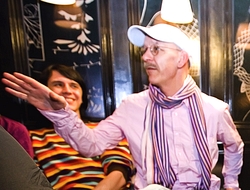
Wolfgang Voigt: "I was raised on German, English and American pop music, I listened to glam rock, jazz and so on. But it always seemed a shame to me that the best contemporary pop music is written abroad. Our country, proud of names such as Handel, Bach, Wagner, could not compete with the English musicians of the 20th century. My idea was, building on our national music, to invent new directions and currents which in the future would be called typically German. I wanted to draw young people to our German music scene, to bring contemporary German culture to a world level. All the more so as everyone knows that Germany has lived through many difficult and contradictory historical events, which in the 20th century pushed it into the background both economically and culturally. We began to experiment with sounds and rhythms and in the end made the music which is now released on Kompakt and which has reached the heights not only of the German charts but of many others beyond our country's borders".
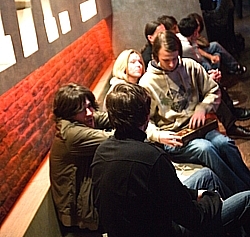
Wolfgang and Joerg also told those gathered about how the label operates, since the Kompakt management keeps everything under its control, from selecting the material to be released through to its distribution and its own music shop. Many were interested in how the label's owners select the tracks that will be released, and what criteria the music must possess for them to pay attention to it and release it alongside Michael Mayer, Modernist, Jurgen Paape, Gui Boratto, Thomas Fehlmann and many others.
Wolfgang Voigt: "We are always looking for new talents who fit the label's policy and the musical style in which we work, but they must without fail have some sort of special something, some new sound. We do not put out those musicians who merely try to copy the so-called "Cologne sound". For example, we release SCSI-9, and I really like their music, because they have their own inimitable sound, which resembles neither me, nor Modernist, nor The Orb. It is a new style, a new perspective, which on the whole fits in with the music that we
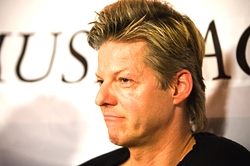
make. It is like one of the facets of a diamond. There is no single defined sound of the label; we release a great number of musicians from different countries, belonging to different cultural traditions. Even the people who have been releasing on Kompakt for many years sound different - for example, Jurgen Paape's music is nothing like Superpitcher's, and mine is nothing like Joerg Burger's. We always try to find something new. Music develops constantly. Right now a great many people are saying that everything is heading towards a blending of genres and technologies. And out of this chaos something new is born. I do not much like such tendencies. In general, it is hard to speak about the development of the musical process, because we do not know what scientists will invent in ten years. The changing of music depends directly on technology. There are two theories of musical development. Some researchers believe that music develops gradually from genre to genre, and each subsequent direction is based on the previous one. For example, the Rolling Stones were based on the blues of the 40s, punk on the Rolling Stones, techno on Kraftwerk. Others suppose that musical development is driven by the appearance of new technologies. We would not be able to write all these minimal-techno tracks now without the modern computer, synthesisers and virtual instruments. All of this consists of the achievements of the 20th century, and it is they that dictate where music should move".

After the lecture the musicians set off to the "Original" Culture Palace for a soundcheck, where they were rather surprised by the sound quality and by the absence of any technical assistants or any representatives of the organisation. Wolfgang and Joerg are rare guests in Moscow, and so they were surprised by many things that seem ordinary to Russians: for instance, the dust, the exhaust fumes, the multitude of people smoking. "It seems to me you do not think at all about your health or your future. It is as if you do not care whether you die today or in five years," Wolfgang marvelled. They were amazed by the insane traffic on the roads, the endless jams and the absence of pedestrian crossings where, in their opinion, there ought to be some. The musicians themselves live in Cologne and get around the city exclusively on foot, except in cases when they need to travel beyond its limits. They were also surprised by the absence of a vegetarian menu in many restaurants (Voigt is a strict vegetarian and eats neither meat nor chicken), the absence of special non-smoking rooms in some establishments (practically all of the Kompakt staff do not smoke, and smoking is strictly forbidden in the label's building), and, of course, the dirty streets.
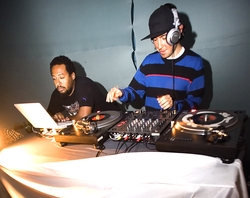
However, they were pleasantly delighted by the warm-hearted and open Russian people and the dozens of beautiful girls all around. Their impression of the trip to the capital could only be marred by a few technical glitches, but, as the musicians themselves noted, in such extreme sets lies the very concept of a "live" performance. After all, it is far more interesting to listen to a musician who does not copy a CD recording note for note, but who alters a well-known melody, sometimes even beyond recognition, to please the audience or to suit the technical capabilities of the stage. In any case, the Moscow public received the music of the German guests with great enthusiasm, despite the unexpected pauses in the middle of tracks and Wolfgang's cries of "Bring some more beer for me to continue". The musicians played both their own tracks, released under the name Burger&Voigt, and the tracks of their colleagues who release on Kompakt. Straight after them Thomas Fehlmann played his set - a musician who has been working with the label for many years, where he releases his solo albums and works together with the project The Orb. Fehlmann is known both for his ambient tracks and for his techno albums. He differs from his colleagues in that he still uses the shaffel beat, which in his tracks always sounds new and interesting.
Lovers of broken rhythms had the chance to visit the second dancefloor, where the well-known New York musician and producer Om'Mas Keith drew everyone gathered into the music of funk, jazz and hip-hop. The young Russian musicians - Andriesh, Mujuice, Roman Rosic/Belk and many others - played their live performances no worse than the German and American guests.