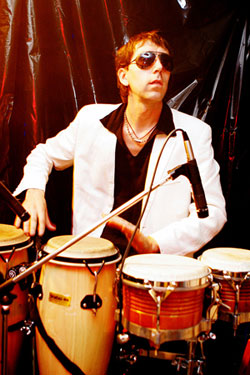
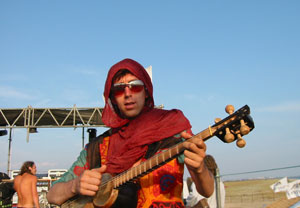
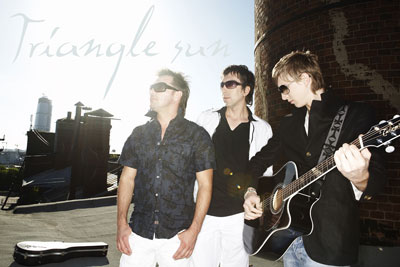
On Moscow's first radio station, M-radio, in 1992 you could hear the voice and sets of Igor Kosenko, better known as Garik Kosmonavt. Around the same time he was nominated among the top ten DJs of the capital, and it was thanks to this very man that the first morning after-parties began to take place here. A modest but talented promoter and musician, a member of such bands as Tetris, El Cosmo Group, Fomalhaut and Triangle Sun, the author of interesting and vivid albums, today he still works just as diligently in the field of creativity and art, combining in himself a musician from the popular lounge band Triangle Sun and the art director of the private club "Krysha Mira"...
Hi, Garik! Tell us, how did you end up in music?
It was a long, long time ago. My dad played several instruments – the accordion, the saxophone and the guitar – and led a dance orchestra that performed pop music at weddings and "corporate parties." One fine day he decided to abandon his hobby and went into the construction business. Thanks to his financial support, my younger brother and I were able to pursue what we loved – music. As a result, my younger brother became a DJ, and I became a musician and promoter.
And what's your younger brother's name?
My brother is Yura. He performs under the alias DJ Nils. He's a resident at Krysha Mira – he plays sunset sets, deep house, various dance stuff... in general, an all-rounder with good taste.
So your father helped you find your feet.
Partly – yes. As a child I was sent to accordion lessons, then to a choir, then to guitar. I already knew how to read music when my musical taste began to take shape. Cassettes of Depeche Mode, U2, The Cure, A-ha, Kraftwerk appeared on the shelves.
By the way, I put together my first band back in school. Back then we played country music, because our English teacher sang beautifully in exactly that style. The school bought our band a double bass, a banjo and drums, and we came up with a name for the band – "Cactus Flower." That was 1987–88.
So how did you arrive at the electronic sound?
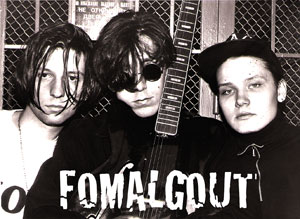
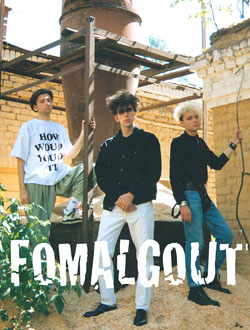
Later, in my student years, a group called Fomalhaut came into being. We played in the techno-pop style, imitating the sound of Depeche Mode. It was fashionable back then; we hung out together with the bands Tekhnologiya, Triplex and Arrival. The first line-up had three people: Misha Leontyev (Miguel), DJ Alik (now he's a DJ at the club Real McCoy) and me. Later Sasha, now known as DJ List, and Slava, now known as DJ Slava Finist, joined us. That's what our band was like in 1992.
How long did the band last?
Not as long as we'd have liked. We realized that supporting ourselves financially through music was rather hard, and the band broke up. But, so as not to stray far from our favorite pursuit, each of us went into DJing. At one time I too was among the top ten DJs in Moscow, but at that point I was more drawn to the promoting side of things... I started organizing parties, raves, after-parties, fashion shows and presentations.
Today the people I started out working with have come back into my life again. After 12 years, as if through a zodiacal cycle, we met once more – only now at Krysha Mira. Today I can look at my life as a spiral; I can already foresee what will happen in a few years, because I clearly see the cyclical nature of the events that have happened to me recently...
Today you're known as a member of the lounge band Triangle Sun. How did you meet Sasha Knyazev and Vadim Kapustin (members of the project – editor's note)?
It all began when the promoter Katerina Priklonskaya conceived the idea of holding the first lounge-music festival in Moscow. Her friends from Cafe del Mar suggested she do it. The festival itself was planned to be held in Moscow restaurants. By that point I was working as art director of several venues that interested her. We agreed on everything and launched the Russian Lounge Festival project. I was invited onto the jury, where I first heard Triangle Sun. I remember the DJ Spy.der came up to me and said that Triangle Sun's performance had really hooked him, and that they would be the winners.
Afterwards Katya suggested the guys perform at the restaurant "Yellow Sea," where I was art director, and that's where we met in person. I started playing percussion and guitar, and everything took off.
How popular and in demand is lounge music today?
Honestly, I don't know. I don't sell records, so it's hard for me to draw any conclusions. But when I come to Gorbushka and ask the electronic-music sellers what's in the greatest demand, almost all of them answer that it's lounge.
Are you invited to perform often?
It varies... Three or four concerts a month. Usually we're invited to perform at launches of new car models or expensive perfume or jewelry. These are events where people come for a welcome drink, to chat and listen to good music. And we like performing there, because our music is more for listening, it's for the ears, not the feet.
Could one say that music has become a craft for you?
Above all, we're driven by the desire to create something beautiful and convey it to people. Why do you think people listen to music? Because listening to music makes their soul feel lighter. So our activity could quite well be called missionary work.
Imagine you'd been born at the start of the 20th century and ended up among the experimental futurists – what kind of music would you create?
I'd probably create the blues...
And if we fast-forward a hundred years? What will we hear?
As for our project Triangle Sun – we won't be playing lounge all the time. We don't want to be constrained by contracts with various labels, like, for example, the band A-ha, who played soft lyrical music but said in interviews that they were hardcore rockers at heart. We, on the other hand, want to do only what we like. Our next album will drift a little toward funk and house; perhaps over time we'll become more danceable. It's hard for me to predict further. But in a hundred years, scientists will most likely work out which sound frequencies shift a person's mood one way or another, and the musicians themselves will be doing not music but mathematics, calculating the right sounds to affect the consciousness. (Although right now, to some extent, that's exactly how it all works.)
On the other hand, as José Padilla (José Padilla – compiler of the Café Del Mar collections – editor's note) said in a friendly conversation: "I judge the quality of music by one important principle: if I feel love in it, then it's good, quality, proper music, it hooks me. If there's no love in the music, it's an empty shell, a set of sounds, just noise."
How did it come about that you became the art director of the club Krysha Mira?
At Krysha there's no art director, there's an art council. We call it the Council of Elders. And I'm part of it because all my friends are there. Krysha Mira is a private place, I can't tell everything. The one thing I'll clarify is: Krysha Mira is not a club or a café. Krysha Mira is a family, and everything is built on that. All the work is built on simple, warm relationships within the team, and it doesn't matter what position a person holds – whether it's an Uzbek laborer unloading a truck of groceries, or a bartender, waiter, manager or owner. We have no barriers in communication. Each of us feels like a cog or a little washer in the mechanism of a shared cause.
Last week I saw the promoter and the owner of Krysha together hauling up to the top floor a bag stuffed with vinyl belonging to DJ Spider, who could no longer manage it on his own. You won't see such a touching sight in any other establishment.
And has Triangle Sun performed at Krysha Mira?
Yes, we've played a few times at sunset. At Krysha the sunsets are really beautiful in general. But not many people know about it, because the place is private and not everyone can get in. All week a vegetarian restaurant operates at Krysha; people come there to have dinner, listen to music and enjoy the sunsets.
What's the secret of Krysha's success? Do you have a clear work plan that you stick to?
Actually, we don't like planning – it's like playing from sheet music. Our forte is total improvisation! Since Krysha Mira uses no advertising at all, it's enough for us to make a decision a week in advance – people will come anyway. We bring in DJs and musicians not for publicity, the way everyone else does; we don't need that. We invite artists who are close to us in spirit, who play interesting, quality music. We inform our guests via SMS mailings or, when people come to the club, they see the schedule – that right now, say, a DJ from Ibiza is playing – but they don't come because of the person from Ibiza, they come to Krysha, because it's always honestly awesome there.
In general, our formula for success is very simple: comfortpeople + comfortmusic = comfortdance! We make sure that comfortable people, pleasant to be around, gather at our place. We keep an eye on the music that plays for us. All our DJs already have between 10 and 15 years of experience: Fish, Spy.der, Volodya, Pushkin, List, Kubikov...
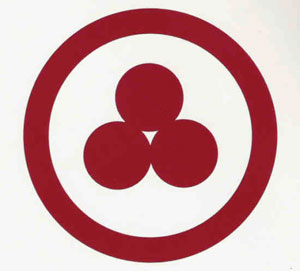
And why did you use it?
This sign is a symbol of Eternity and Unity, a symbol of the New Era, discovered by the scholar Nicholas Roerich. He found the sign of the three circles on temples and churches of various spiritual and religious denominations. Roerich understood that this sign carries within it a spiritual power that unites all religions; it's a sign of unity and peace. The sign on white cloth is the so-called "Banner of Peace." It was proclaimed that the "Banner of Peace" protects all cultural monuments and sites on the planet. I've even heard that during the Great Patriotic War this sign was hung on library and museum buildings, thereby marking that they must not be bombed – that this is the heritage of mankind.
At Krysha Mira we also use the Banner of Peace to remind ourselves that we're driven first and foremost by creativity and culture, and only after that by business, as an inseparable part of life that supports our aspiration to express ourselves. At Krysha not everything is so simple. In summer there are yoga and meditation classes. Right now, for instance, Krysha is hosting a lecture on the mysteries of the teachings of the Maya Indians, given by qualified scholars – researchers of this science. And our team is made up of real shamans, all into the right books... people of the future.
And have you come across clubs in other countries similar to Krysha Mira?
There was one such club... in New York. It was called Studio 54. I think Krysha resembles it.
Today many communities have formed that are ready to take in intelligent electronic music, ready to spend their leisure in interesting and worthwhile ways. But there are practically no places to do this. What do you think the difficulty is? And where can young people, hungry for knowledge and impressions, go?
To solve this problem in a global sense, you have to understand that any art space is set up with sponsors' money, and where huge billboards hang and useless information is forced on people, the purity of the perception of art suffers greatly. But today we're in a transitional period from sponsorship to patronage. Sponsors give in order to get a return; patrons give so that art may live. That's the difference, and it's a definite plus for the development of art spaces. I actually give lectures on this topic now at RMA (the State University of Management).
Otherwise, interesting venues keep popping up in Moscow, but they're usually for one-off events; among the permanently operating ones, besides Krysha, I can single out Gazgolder, Giusto, Propaganda and Solyanka.
And what will become of Krysha in a couple of years?
Hard to say. It's such a place – a tasty morsel. Perhaps some residential high-rise will be built on the site of the old factory. But it's not about the premises, it's about the team...