Auto-translated by 44100Hz.
Read the Russian original →
A Cool, Cool Death
Интервью · 15.07.2007
By Снежана Осипова
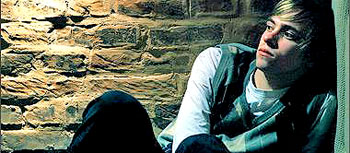
Roma Litvinov aka Mujuice is a man full of riddles and contradictions. Each of his new creations resembles a patterned fabric woven from different sounds. As if overheard by chance, Mujuice's tracks are always deeply sincere. They are tender and heartfelt, they seem to envelop you, making you renounce everything you belonged to before.
Recently, on the Pro-tez label, he released his second album, titled Cool Cool Death. About this happy event, as well as his vision of contemporary music, Mujuice told us in this interview.
Extra Enough!
Your new album is called Cool Cool Death. Where do those associations come from?
There are things that are rather difficult to talk about... There's a lot of sadness and irony in that title. It's utterly sincere. And although it's contradictory and ambivalent, there's no mockery in it.
Do you feel that you're doing something fundamentally new?
I think that's the wrong approach. So much has already happened in contemporary art that, from my point of view, there should be a kind of accumulation. That is, whereas avant-garde movements were largely formed and arose through limitations, isolation and setting themselves against something, I, on the contrary, am more drawn to lots and lots and lots of everything at once. So I think the new can emerge through an extreme concentration of everything old, out of a kind of epic chaos. At one time I was very preoccupied with the idea of formal innovation. I believed in it and thought about it a lot, but now it seems to me that it's utterly unimportant. You just have to try to do everything honestly, and formal novelty is the last thing that interests me.
Does your new work carry any idea?
I wrote this record as the music that I personally feel is missing right now, and the kind I'd want to listen to myself. It's precisely now that I was able to make it. If we're talking about the idea, it's reflected by words like "care", "support". This may sound strange, but I really did mean it. A record like this would help me, for instance. I wanted to help. My album is tender and harsh. Detached and compassionate. I was missing certain things that I felt in childhood, and much of that found expression in it.

Yes, your music feels very fragile, as if turned inside out, somehow defencelessly exposed... Are these your inner experiences?
Of course. I'm a person who takes nothing lightly.
Your new album was released on Anton Kubikov's label Pro-tez. Before you started working together, did you know each other?
We got to know each other relatively recently, even though we live in neighbouring buildings. He was selecting tracks for a vinyl release in Germany and offered to put out my record. I didn't think he'd take my track. But it turned out that Anton takes a broad view of things. He loves music, not form, not constructions. I really value and respect that, and it's probably the main thing we have in common. I regard that record as something of a feat on his part, since it isn't techno. It gives me great pleasure that someone can look into the essence of things rather than at the details and trappings.
So you're planning to keep working with the Pro-tez label? Maybe you already have some concrete creative plans for the future?
Yes, of course. Though right now I'm in a bit of a daze. I have absolutely no idea what to do next, but I think that's perfectly natural.
Are you pleased with your new record?
I don't know. The main thing is that I was utterly honest. On the one hand, you're never fully satisfied with what you do, but on the other hand, I probably made the thing that was needed. At least for myself. I couldn't get around it or avoid it. There's no calculation on my part, no special grounds, other than that I couldn't resolve it any other way.
What does microsampling mean to you? Why did you choose this particular style?
It's not right to call microsampling a style, it's more of a method. I like the technique itself. Since childhood I got "hooked" on it, and I'm still interested in working with exactly this kind of texture. Coldness and sterility aren't close to me. I love mistakes and accidents. Sampledelica is handwork, sometimes as fine as a jeweller's. It compensates for the "electronic-ness" of the music, makes it truly alive.
How does the process of creating your tracks work?
I walk around, drink wine, I feel very sad. That's all. Tracks aren't born in the head. Maybe in the heart, maybe in the liver or the stomach. I understand perfectly well that anyone who works in art has to realize that he's simply a medium and merely redirects flows of information and energy, in a sense correcting and supplementing them. These are irrational things. They can't be measured and don't lend themselves to dry definitions.

What do you think electronic music is lacking at the moment?
Electronic music lacks a certain inner freedom and a willingness to loosen formats and step outside the boundaries. It seems to me that if you're involved in contemporary art, you need to change some entrenched points of view.
And do you consider electronic music to be art?
I don't like the term "electronic music" at all. I think you shouldn't try to lock contemporary music into frameworks, to divide it up by styles.
If you were offered a chance to record for a foreign label, whom would you choose?
I think England is currently closest of all to a correct understanding of music. It would probably be some English label. I once dreamed of recording for Warp Records, but now that no longer concerns me.
Would you agree to have your music turned into a soundtrack for a box-office film?
I have a lot of grievances with box-office films, but I allow for the possibility that a box-office film can be good. For now, the directors I like — David Lynch, for example — are doing just fine with music without me.
Do you ever have the feeling that you hear music while watching certain events, a kind of soundtrack to reality?
Yes, I suppose that's how it always is... Music is precisely the soundtrack of our life, of the circumstances we all find ourselves in.
How do you feel about electronic music festivals, are you willing to take part in them?
Yes, I've played at various festivals. Soon I'll be playing at Afisha Picnic. Also this summer I've been invited to Kazantip. Honestly, it's hard so far to imagine what my performance there will look like, but in any case I have to give it a try. I can't say that I need the sea, the sun or people to feel at one with music. The greatest union with music I ever felt was as a child, swinging on a swing while listening to my player.
As a child, did you have any inkling of who you'd become in the future?
In early childhood my mother played the piano for me, and I tried to play too. Since I never studied music, I started inventing my own. Then there was a fascination with rock... And then I started doing what I do now. I experimented, searched. It's not that I wanted to do something in this direction — I simply felt that I couldn't not do it. There were moments when I skipped school just to come home and make music.
And why Mujuice specifically? And how did it come about that you started working with the label V135, on which your first album was released?
The name Mujuice appeared back in childhood, when I was only just starting out in electronic music. And I never changed it, even when making fundamentally different compositions. Sometimes this even caused problems, since I released projects of very different types under one and the same alias. With the first record it went like this: a friend passed my recordings on to the people at V135, and they, in turn, offered me a collaboration. I agreed.
Which nightclubs do you frequent most often?
I rarely go to clubs unless I'm playing at them. I find it hard to be in a club atmosphere. Though there are certainly places I like — Solyanka, Gazgolder or Shanti, for example. To be honest, I'd sooner take a walk around the city centre than go to a nightclub.

Many call IDM music the music of the future and even "alien" music.
For me the notion of "music of the future" doesn't exist. I believe music is timeless. For many years nothing in music has changed, and that suits me perfectly, even gladdens me. I like this state of affairs.
And do you believe in the existence of extraterrestrial civilizations?
How can you believe in something that cannot not exist? Yes, I suppose. And I also believe in energy, in its circulation and redistribution.
How do you picture the person who listens to your music?
I think building focus groups is not quite honest. I want to believe it's the kind of young people who aren't ashamed to be open to everything in this world, who feel free of prejudices. A person who listens to Prodigy in the morning and Schnittke in the evening. I believe in inner freedom. I like eclecticism. This word may have an unpleasant aftertaste for many, but it seems to me that eclecticism is precisely the most beautiful thing — it's freedom itself. And at the same time, the people who listen to my record should feel sad.
And do you feel sad?
Of course. I'm not too fond of this planet.
What tunes you to the right wavelength when you're being creative?
You can feel inspired, but nothing will come of it. The process of making music is a joining of very complex layers of energy and emotion. I wouldn't talk about inspiration in such formalized terms.
Is it important to you that those around you recognize your talent?
If I say "no", it would probably be a lie. What matters more to me is being a source of help or support for someone. Because there's a great deal of music that once saved and sustained me. I don't do it because I need some kind of bonuses. It's just that things are hard for me, and this is the only way — fortunately or unfortunately — to cope with such a state.
And do you feel in harmony with this world?
There are rare, random, absolute moments when I feel a connection between everything that's happening — a fragile but infinite beauty.
Mujuice on MySpace!