Kuniyuki Takahashi - Music News from Japan
Интервью · 05.07.2011
By headz.fm
Kuniyuki Takahashi can safely be called one of the most fascinating Japanese musicians of the last decade. Ask Larry Heard, Francois Kevorkian, Joe Claussell or Terre Thaemlitz about their favourite musicians from the Land of the Rising Sun, and Kuniyuki's name will most certainly come up in first place. Leading an almost reclusive life and rarely leaving his native Sapporo, the musician has only found worldwide fame in the last few years; his work took far too long to make its way to Europe and America, remaining, without a doubt, one of the best-kept Japanese musical secrets. But now it is here - seriously and for the long haul. Kuniyuki's music is very varied - at once cosmopolitan and very Japanese in spirit, danceable and yet soothingly calm, cosmic and yet entirely earthly. In his work the most diverse elements intertwine - African ethnic sounds, traditional Japanese instruments, the jazz tradition and club electronica. One could talk about his multifaceted work for as long as words hold out. On 9 July Kuniyuki Takahashi comes to Russia for the first time to perform in Moscow at the club Shanti, at the Headz.FM party - and ahead of this visit we could not resist putting a few questions to the Japanese master.
Yes, and even now there are still many problems in Japan; the victims of the earthquake in the affected regions cannot return to their normal lives, and their existence can only be called dreadful. It is hard for me to speak in absolute terms, but most likely, for Japan, the consequences of this most powerful earthquake, together with the damage from the accident at the Fukushima nuclear power station, have become the most terrible in the country's entire history. For both society and the economy the consequences will be enormous, and it is hard to say for now what those consequences will be. We need to keep an eye on what is happening around us - that is very important.
As for myself and my music, these events will surely show up in some form too, but I very much want the foundation of my work to be freedom. Of course, even before this there was much influence from socially significant subjects in music; there is a lot of music in the world in which these themes and aspirations find their reflection. And although this earthquake and its horrifying consequences have undoubtedly been the most powerful shock for me, I would like, as far as possible, to think not about these things but about the natural flow of the music itself, about that unique future which is opening up before us.
Setting aside the subject of music, though, I believe that we have no other choice but to eliminate the consequences of the nuclear accident and the earthquake through joint efforts, and to build our future.
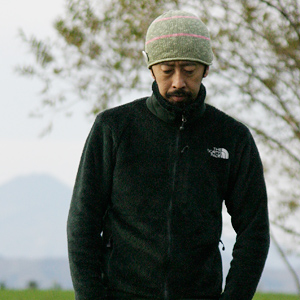
I was born and raised in Sapporo and I think that this place has, of course, influenced both me as a person and my work. Sapporo is in the north of Japan, and the nature here is similar to Europe's. It is not especially hot in summer; then again there is the sea, and rivers, lots of very beautiful places - I think that Sapporo and Hokkaido, thanks to their nature, offer many wonderful opportunities to listen to music while calmly enjoying it. Depending on the season the surrounding colours and hues change, and this makes your soul richer. I love my home very much, I like everything here.
I love my home very much, so choosing would be far from easy. But if I could choose a place to create, then let it be Africa. There is so much interesting music there, and I really love African rhythms.
Our live band is called the Kuniyuki Special Band, and it includes my old friends. In the line-up there is a guitarist, a percussionist, a drummer and myself - four of us play in all. We have a rule in the band - when we perform, you have to pay great attention to the mutual vibrations, and we try to convey precisely that atmosphere and feeling when we play live. Of course, we also treat the original of the piece being performed with attention, but above all, we try to convey our musical vision in the course of improvisation.
Whether it is electronica or the sounds of live instruments, I believe that everything is a component element of music. If these elements can complement one another, then the music will be beautiful. I think that music teaches us that it is rich in far too many possibilities.
No, I did not receive any special education.
In Sapporo there is a wonderful club called Precious Hall; I often played live there. I was very grateful to that place in many ways, and I made a track which I called "Precious Hall" and gave to the club's owner as a gift. Joe Claussell often came to Precious Hall, and it so happened that he heard this piece. Joe got in touch with me straight away and said he wanted to release my music. He said many warm words then: for me, of course, meeting him is a wonderful event, so I naturally agreed at once.
When Henrik came to Japan, he performed at parties held by Mule Musiq, and I performed together with him in several cities. In Sapporo we also played together, and when he was here we decided to make a track together. I think Henrik is simply an amazing musician, and in the process of creating music everything came very easily between us; many different ideas were born. It was a wonderful experience for me.
There are, of course, a great many such people, and it is extremely hard for me to choose someone. One of the people I respect most of all is Daniel Lanois, a producer from Canada. He has made music with all sorts of people, but among the famous ones he has worked with U2 and Brian Eno. All of his works contain a completely unique feeling.

I really love a group called Soft, they are from Kyoto, and it is precisely a band - they play live, they have a very special, organic and very psychedelic sound. I also cannot fail to mention my favourite musician Moochy (aka Juzu), he is very talented and sometimes we work together. In Japan there are quite a few young and very interesting musicians, so stay tuned for news!
Yes, I still buy vinyl. It is very hard to choose something, but recently I bought some wonderful things. Do you know the musician Isao Tomita? I really love the old synthesiser sound, and he, I think, was one of the first Japanese musicians to play the synthesiser. I really like his album "Clair De Lune" - an absolutely cosmic sound! I also bought an album by the English guitarist Allan Holdsworth, called "Sand"; he uses a unique guitar synthesiser, the "Synthaxe", in his music. I really like his music. And the third album is "Senzo", by the African jazz pianist Abdullah Ibrahim. Also a stunning record!
Right now I am working on my future projects, and it is too early to talk about it. I am also toiling away on my project Koss - that is a more techno- and ambient-oriented sound. I am also currently working together with Minilogue - an album may come out by the end of the year.
It is very exciting, because it will be my first time in Russia. I also love Russian music very much, and if I get the chance I would like to meet Russian musicians. As for my performance - it will be a live set, very danceable, but there will be a lot of improvisation in it - lately I have come to really love this kind of live performance format.
Headz.FM at the club Shanti
Kuniyuki Takahashi
(Mule Musiq, Japan) live
Studitsky, Rasskazov, Lay-far
