Auto-translated by 44100Hz.
Read the Russian original →
All Ages Surrender to Laurent Garnier
Интервью · 20.02.2005
By Alex Sputnik
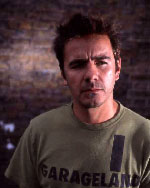
Laurent Garnier's new album "The Cloud Making Machine" reveals the musician from a completely different side, and fans familiar with his previous albums are left with reasonable questions. Perhaps this interview will help answer some of them.
Q:
What is this "Cloud Making Machine" of yours?
A: The two smokestacks you're supposed to look at the album cover through are parts of a factory located across from my house. Basically, it processes garbage. When children come to visit us, they're always curious about what that building is. It's not exactly pleasant to just tell a four-year-old, "that's a waste-processing plant," so instead we say, "that's a machine that makes clouds" — it sounds better. The plant chugs away around the clock, 24 hours a day. I live in a big loft attic-studio, and the first thing you see out the window is those two factory chimneys smoking without a break. At night I listen to a lot of music while trains pass by — I live in an industrial district. The orange glow of nighttime Paris lights up the factory clouds. This is what I see and hear every day and night, the way I sense the world around me.
A: The two smokestacks you're supposed to look at the album cover through are parts of a factory located across from my house. Basically, it processes garbage. When children come to visit us, they're always curious about what that building is. It's not exactly pleasant to just tell a four-year-old, "that's a waste-processing plant," so instead we say, "that's a machine that makes clouds" — it sounds better. The plant chugs away around the clock, 24 hours a day. I live in a big loft attic-studio, and the first thing you see out the window is those two factory chimneys smoking without a break. At night I listen to a lot of music while trains pass by — I live in an industrial district. The orange glow of nighttime Paris lights up the factory clouds. This is what I see and hear every day and night, the way I sense the world around me.
Q:
What does your album have in common with this remarkable factory?
A: It's a kind of fictional world. The album was conceived as a sort of narrative, almost like a film. It's my sense of the last four years I've lived through, with all their happy and sad moments, hope and questions. To make it clear for children — there's a machine that makes clouds. The clouds symbolize various things: Thunder, Rain. And when they disappear, the Sun immediately comes out. The clouds are responsible for all the changes and movements happening in the world around us. That's what my music is about.
A: It's a kind of fictional world. The album was conceived as a sort of narrative, almost like a film. It's my sense of the last four years I've lived through, with all their happy and sad moments, hope and questions. To make it clear for children — there's a machine that makes clouds. The clouds symbolize various things: Thunder, Rain. And when they disappear, the Sun immediately comes out. The clouds are responsible for all the changes and movements happening in the world around us. That's what my music is about.
Q:
How would you describe your music?
A: Personally, I'd like the album to look like a kind of patchwork, a patchwork quilt. I simply reworked music I'd previously written for documentaries or cartoons, plus my collaborative projects with various musicians. Well, of course there are also some completely new tracks. Lately I've been working on various projects and trying to find a single title for them. One morning I stepped out of the house and this garbage factory appeared before my eyes, as it does every day, of course. And suddenly I realized — there's the title! An industrial zone, all sorts of techno-industrial sounds — it's all created by the surroundings. A harsh place that promises us nothing good. At the same time, hopes and dreams, as well as fun, happen precisely in places like these…
A: Personally, I'd like the album to look like a kind of patchwork, a patchwork quilt. I simply reworked music I'd previously written for documentaries or cartoons, plus my collaborative projects with various musicians. Well, of course there are also some completely new tracks. Lately I've been working on various projects and trying to find a single title for them. One morning I stepped out of the house and this garbage factory appeared before my eyes, as it does every day, of course. And suddenly I realized — there's the title! An industrial zone, all sorts of techno-industrial sounds — it's all created by the surroundings. A harsh place that promises us nothing good. At the same time, hopes and dreams, as well as fun, happen precisely in places like these…
Q:
How do you think people see you after 10 years of your musical career?
A: Many people — this probably applies more to France — reduce it all to a common denominator: well, he's a great DJ, but as for being a musician — we're not so sure. Despite that, today many "rave children" consider my old tracks among the most important for club culture, classics! Compositions like Crispy Bacon, Wake Up, Acid Eiffel, Man With The Red Face, The Sound of the Big Baboo, Astral Dreams, Coloured City. I can still play all these tracks today — the dancefloor will beat in ecstasy! This music stays in people's memory. Even among those eighteen-year-old youngsters, for whom compositions from 8–9 years ago simply can't be familiar.
A: Many people — this probably applies more to France — reduce it all to a common denominator: well, he's a great DJ, but as for being a musician — we're not so sure. Despite that, today many "rave children" consider my old tracks among the most important for club culture, classics! Compositions like Crispy Bacon, Wake Up, Acid Eiffel, Man With The Red Face, The Sound of the Big Baboo, Astral Dreams, Coloured City. I can still play all these tracks today — the dancefloor will beat in ecstasy! This music stays in people's memory. Even among those eighteen-year-old youngsters, for whom compositions from 8–9 years ago simply can't be familiar.
Q:
The first half of the new album is fairly "downtempo." Won't your fans be disappointed?
A: Every album should tell a certain story. This isn't a collection of miniskirts. It's a tale, a reflection of a musician's life, a narrative from the beginning of the story to its conclusion. Lately I've been DJing less and going to concerts and exhibitions more. So, in my opinion, everything in my album is logical. In two years I'll turn forty — no wait, in a year and a half already… People who listened to my last two albums "30" and "Unreasonable Behaviour" will easily understand my new creation. It's just a normal evolution. Those who think Laurent Garnier is exclusively a techno musician and techno DJ are mistaken. Over 15 years I've played all sorts of things: Drum'n'Bass, and Deep House. When New Order is relevant — I play it, Sex Pistols or James Brown — too. Without new ideas and musicians, a new way of looking at things, we wouldn't have developed. There would be no Jeff Mills, no Carl Cox, no Sven Väth.
A: Every album should tell a certain story. This isn't a collection of miniskirts. It's a tale, a reflection of a musician's life, a narrative from the beginning of the story to its conclusion. Lately I've been DJing less and going to concerts and exhibitions more. So, in my opinion, everything in my album is logical. In two years I'll turn forty — no wait, in a year and a half already… People who listened to my last two albums "30" and "Unreasonable Behaviour" will easily understand my new creation. It's just a normal evolution. Those who think Laurent Garnier is exclusively a techno musician and techno DJ are mistaken. Over 15 years I've played all sorts of things: Drum'n'Bass, and Deep House. When New Order is relevant — I play it, Sex Pistols or James Brown — too. Without new ideas and musicians, a new way of looking at things, we wouldn't have developed. There would be no Jeff Mills, no Carl Cox, no Sven Väth.
Q:
Aren't you planning to release anything else new in the near future?
A: Yes, it'll be a compilation of remixes of my last album. It's meant precisely for those people who see me primarily as a techno artist. It'll be a fully dancefloor-oriented compilation. There will be just a heap of current tracks, every remixer will find something to their taste. Besides, we're announcing a contest over the Internet — whoever best remixes one of the tracks from the last album. The winner's remix will be released on 12-inch, and a video will be shot for it as well. It should be exciting!
A: Yes, it'll be a compilation of remixes of my last album. It's meant precisely for those people who see me primarily as a techno artist. It'll be a fully dancefloor-oriented compilation. There will be just a heap of current tracks, every remixer will find something to their taste. Besides, we're announcing a contest over the Internet — whoever best remixes one of the tracks from the last album. The winner's remix will be released on 12-inch, and a video will be shot for it as well. It should be exciting!
Q:
As is customary, in closing: how do you see the future of dance music?
A: Last Saturday afternoon I played for children, for the very little ones — from one to twelve years old. It was a "children's electronic matinee" as part of the festival "Lille — Cultural Capital of Europe." Parents, and anyone older, weren't allowed in — they stood outside the hall. Half the audience was under five. I played techno, house, disco and drum-n-bass. And Rock! I put on two Nirvana songs and something by Blur. The children just went wild dancing. And in the evening a big rave was held, 20 thousand people came, and it was a blast too. So I can state authoritatively: people will always have a need to dance, which means nothing has ended — everything is just beginning!
A: Last Saturday afternoon I played for children, for the very little ones — from one to twelve years old. It was a "children's electronic matinee" as part of the festival "Lille — Cultural Capital of Europe." Parents, and anyone older, weren't allowed in — they stood outside the hall. Half the audience was under five. I played techno, house, disco and drum-n-bass. And Rock! I put on two Nirvana songs and something by Blur. The children just went wild dancing. And in the evening a big rave was held, 20 thousand people came, and it was a blast too. So I can state authoritatively: people will always have a need to dance, which means nothing has ended — everything is just beginning!