Loudness Wars - The Battle for Loudness
Техника · 09.09.2009
By Максим - The Lizard - Милютенко
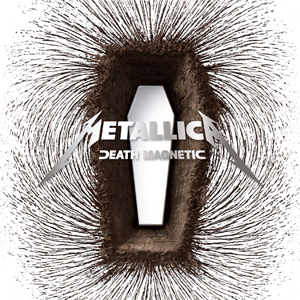
Fans of "Metallica" have demanded a remix of the band's latest album, Death Magnetic, on the grounds of its "over-compression" and "the presence of a large amount of distortion". They have banded together and want to press their demand through the courts — the number of such (American) citizens stood at 19,000 in January. They have been hastily joined by fans of the band Red Hot Chili Peppers (RHCP), who, albeit with considerable delay, are now demanding a remix of the album Californication.
What sounds like a joke is in fact the tip of the iceberg of a very pressing problem. A whole serious article on Wikipedia is devoted to it. Those who know English can read it here→...
This aspect of modern culture is called none other than the loudness wars — "the battle for loudness".
So what is this "loudness"? How do you picture it and how do you measure it? Simplifying a little, one could say that we sense this differing "loudness", for example, when a film is interrupted and a commercial break comes on TV. The adverts are louder! You keep having to reach for the remote and turn it down. Why? Because advertisers want their spots to "break through" the domestic environment overloaded with other sounds. That's why they push the capabilities of the media and the broadcast chain to the limit.
In what way? To understand this, we need to briefly explain what a compressor is in the world of sound engineering (not in the world of data archiving) — briefly indeed, for sound engineers study the science of how compressors work and how to use them for years. Film soundtracks, like music recordings, possess a certain dynamic range, that is, both quiet and louder passages. In films it is usually greater — when a boulder falls on Indiana Jones, it has to be much louder than the compliments Jones whispers in his heroine's ear. In advertising it's the opposite: dynamic range isn't needed, every word of (the announcer) Sergey Chonishvili has to reach the housewife's ear in a battle with the water gurgling from the tap and grandpa's shouts from the bedroom. In music, dynamic range depends on the genre, and we'll talk about that in a little more detail below. The device that reduces the dynamic range (that is, makes the quiet parts louder) is called a compressor. As a result, what is usually called the average loudness rises. Average loudness is measured in various ways, but the simplest and most intuitive method is to measure it with a device or plugin that analyses the so-called RMS (root mean square — one of the varieties of average loudness).
A little history — not as detailed as on Wikipedia, but enough to make the root of it "visible". So, initially (that is, from the 1960s) the question of the loudness of audio recordings interested only the broadcasters of electronic media, not the recording industry. Broadcasters, for whom too dynamic a signal is inconvenient, solved this problem themselves by installing a so-called FM processor — a compressor that processes each frequency band separately and prepares the signal for frequency modulation through the transmitter. That is, broadcasters compress the signal to compensate for the imperfections of the broadcast format. Over time, however, the record companies too began sending pop radio stations radio versions of songs mixed louder than usual — in order to stand out against the rest and thus boost sales. This was the start of the race for loudness in the music business.
For us this is a cue to start a new paragraph. The pioneers of "loud" music were the staff of the legendary Detroit label Motown in the late sixties. All commercial music back then existed only on vinyl and reached the radio airwaves only through a turntable as well (as a rule, radio, like jukeboxes, used 7-inch singles).
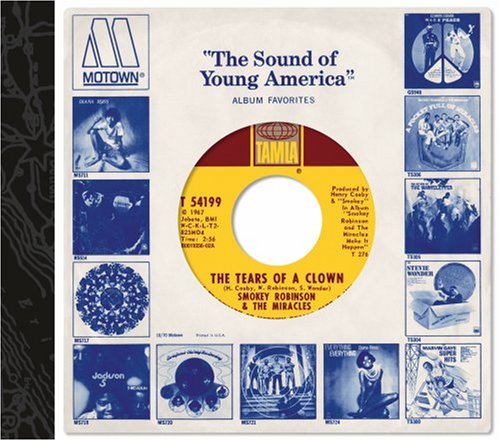
So the Motown people began to achieve maximum loudness by increasing the pressure on the cutting stylus when creating the master — the source for vinyl pressing. The greater the pressure, the deeper the groove on the blank (in English this is precisely what is called the "groove") — and the wider it is. Which means louder, too. The drawback of this technique is that it's easy to overdo it and cause a crack. It's also obvious that music abounding in frequent loudness peaks makes deep cutting more difficult. Motown's cutting engineers set the mixing engineers the task of reducing the "excess" dynamic range — tracks that were too "quiet" (that is, dynamic) were sent back for a remix. The next generation of Motown's lathe engineers already began to compress tracks themselves before cutting, using devices previously employed only in studio mixing. In essence, they invented what we today call mastering.
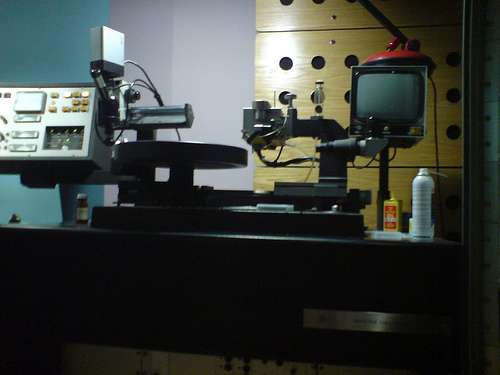
So what has changed since then? Club DJing appeared — that is, the playing of vinyl records in the (noisy!) conditions of a club. Club DJs ran into the fact that overly quiet tracks cause the needles to feed back — they have to adjust the input signal with the Gain knob, and if the DJ booth isn't isolated from the sound system in some way, the needles can "feed back". Naturally, this is connected with the imperfection of the vinyl format as such: to enjoy all its advantages, you need an almost perfect signal chain... The next trick was the invention, in the late 70s, of the maxi-single — a full-length "forty-five" that uses the whole length of a vinyl LP for a single track. As a result, the groove could be much wider, and therefore louder.

And then, of course, came "digital". Early digital media and devices also had their shortcomings. The 16-bit CD format allows only about 65,000 different loudness values, which isn't as many as it seems. For clarity, one can draw an analogy with colour reproduction on computer screens. Switch your monitor to 16-bit colour — the image becomes more discrete (the gradation of colour shades becomes more pronounced). The same thing happens with sound on a CD. On top of that, the earliest generations of home players in particular were so imperfect that they coped quite badly with reproducing quiet passages — a stepped change in loudness was noticeable. In fact, the full 16-bit depth is achieved only close to the maximum permissible signal level. This became yet another reason to increase compression during mixing and mastering — so that there would be no overly quiet passages in the recording. A new category of digital processing (plug-ins) appeared, called "maximisers" — compressors that limit the signal level more or less harshly. You can feel it — this is already a term from the very recent past. As a result of a successful marketing strategy by the makers of such processors, maximisers entered the home of every sound engineer. Convenient: with a maximiser we not only make optimal use of all the capabilities of the CD format but also create a more competitive (because loud) musical product.
This phenomenon (the battle for loudness) has penetrated deeper into our everyday life than it might seem at first glance. A genuine fashion for loudness was born. Even the makers of classical grand pianos didn't stay on the sidelines: if you compare the sound of an early-20th-century Steinway with that of a modern one, then... you guessed it: the modern one sounds louder, more aggressive. The same holds true for the film industry, where special effects (explosions and others) are today customarily pushed almost to the listeners' pain threshold.
Here we return to the recent albums by "Metallica" and RHCP. Incidentally, the producer of "Death Magnetic" is a star among rock producers — Rick Rubin. And the producer of Californication is also Rick Rubin!

In fairness, it should be noted that Mr Rubin is a Grammy winner for sound engineering, and he's also known as a home audiophile (owner of a $60,000 home hi-end system) with a taste for the most varied music, including jazz. Rubin has produced a whole series of albums acclaimed among professionals for their excellent mixing. In connection with this, some bloggers claim that Rubin deliberately chose the "harsh" sound to create a contrast with Metallica's "Black Album" — too poppy and soft in the opinion of many "metalheads". That is, he supposedly ruined the sound for artistic, conceptual reasons. To bring back the "heaviness".
But it's obvious that if even heavy metal fans are complaining about excessive loudness, "over-compression" and "over-limiting" (a limiter is essentially a compressor of a higher degree), then it's time to think seriously.

The full extent of the damage was revealed quite unexpectedly. Namely: the recordings of the aforementioned album ("Death Magnetic") were licensed for the game "Guitar Player", both in full and in parts. And that's when Metallica's fans were able to compare! Let's not deny ourselves this pleasure either:
Surprisingly, the difference is audible even when played on the tiny speakers of my Powerbook. Excessive compression does not make for pleasant sound. Simply put, distortion appears. The smooth wave of a sinusoidal signal tends towards a square shape, and looks less and less like natural sound. Over-compressed recordings can't be listened to loud — your ears get tired, and home equipment struggles to reproduce a square wave. As a result, the effect achieved by over-compression is (ironically enough) the opposite of what was intended: the listener will turn the volume knob to the left. That is, turn it down. It's also bad that many not-very-experienced folks abuse compression and limiting during mixing — as a result they start using it as a substitute for an actually good mix.
Can the same tendency — a pursuit of loudness intensifying over the years — be detected in electronic music? To check, I gathered 10 tracks by well-known heroes of the electronic genre. It turned out that quality recordings from the early 90s are in short supply in my record library. But I found a few. Here is the list of tracks I selected:
1993 Virtual Symmetry - See You
1994 Massive Attack - Karmacoma
1995 Banco De Gaia - Kincajou
2000 St_Germain - Sure Thing
2000 Kraftwerk - Expo2000
2006 Villalobos - Lazer@Present
2007 Apparat - Arcadia
2007 Underworld - Beautiful Burnout
2008 Gui Boratto - Annuciación
2008 Joris Voorn - Minor
Of course, these 10 examples don't claim to be a comprehensive study, and the format of an article wouldn't allow for it anyway. Besides, different mastering engineers have different ideas about "acceptable" maximum compression, loudness and so on, which is why even in the 21st century recordings are made that aren't compressed "barbarically". Let us also note that the "closer to the dance floor", the more logical the striving for a loud track becomes, and this too is especially noticeable on the later recordings. All the screenshots can be viewed here:
1
2
3
4
5
6
7
8
9
10
Despite the fact that at first glance the differences aren't so dramatic (we check the average loudness in the "RMS" column beneath the meter bars), the loudest tracks are those by Villalobos (a 2006 CD reissue of these earlier tracks) and Joris Voorn (2008), while the "quietest" are the works of Virtual Symmetry (1993 on Harthouse / Eye Q) and Banco de Gaia (1995). Indeed, in 1993 they didn't mix like this:
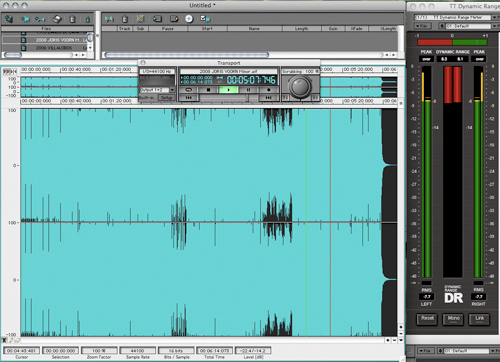
And in 2006 they didn't mix like this:
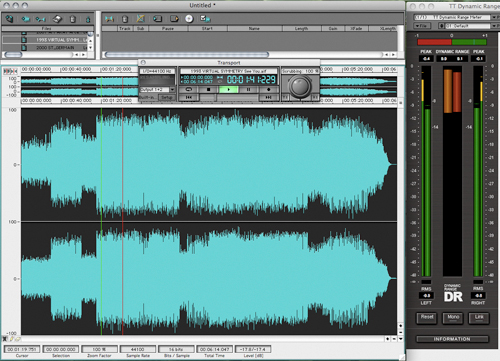
To appreciate the significance of a few decibels' difference in average loudness, let me remind you that 6 decibels means a twofold difference, 3 decibels a one-and-a-half-fold one. Thus, 1.5 decibels of difference means that one track is a quarter louder than the other.
The exception that proves the rule in my selection is the Gui Boratto example. I should note that all this musician's work is mastered by Robert Babicz — a well-known sound freak and a specialist respected in the mastering world. Just like me, Robert stands for restraint and a sense of proportion when limiting. The fact that the things he masters sound superb proves once again: a professional mastering studio has capabilities unavailable on a home PC. The tools that let you compress and limit a recording without a drastic loss of quality are expensive. That's why analogue mastering is worth its money.
Today's digital formats cope beautifully with quiet musical phrases. The signal-to-noise ratio problem is a thing of the past. Only vinyl still requires high loudness (which, incidentally, can only be achieved optimally at the master-cutting stage) and proper bass mastering. I'm even prepared to go so far as to assert: the quieter, the more euphonious.
So it turns out that originally the increase in the loudness of audio recordings was needed only to compensate for the shortcomings of storage media and broadcast chains, and was applied quite sparingly — analogue requires that certain limits be observed (in particular, too wide a groove on vinyl can cause the needle to jump out of it during playback). The advent of digital formats completely untied the hands of those who decided to use loudness to "elbow aside" their competitors. What was at first a necessity, applied wisely, over time turned into a device for boosting sales. This "trend" has today reached even the creative workshops of the musicians themselves.
We would do well to learn from lovers of classical and jazz music their careful attitude to music as such. Otherwise, soon there will be no difference in sound between the commercials on TV and our favourite recordings on the mp3 player.