Auto-translated by 44100Hz.
Read the Russian original →
MIGZ 2009: Vasily Shumov and the group "Centr"
Интервью · 24.06.2009
By Маргарита Аминева
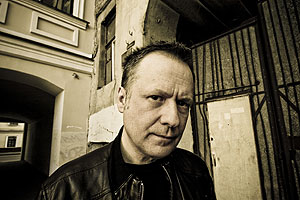
Vasily Shumov is the ideologue and permanent leader of the group "Centr", which was the first in the Soviet Union to start performing new-wave music and, thanks to bold experiments with electronics, later earned the honorary title of "the Russian Kraftwerk of the socialist era". On the eve of his performance as part of the international festival of contemporary music and media art MIGZ, Vasily answered 44100Hz's questions...
44100Hz: You do poetry. Where can one get acquainted with it? Would you quote something from the new material?
Vasily Shumov: You can get acquainted with my poetry on Centr's CDs. I don't make poems separately, without music. All the texts go into musical compositions. Here's a fragment from my latest drafts. The text is called "Do Vostrebovaniya" (Poste Restante).
The sovoks came into demand
A foretaste of anguish
The Sovok in demand
Is thieving and cruel
The Sovok in demand
Growls at the West and at the East
The sovoks in demand
Tear one another to pieces...
44100Hz: You were acquainted with, and keep up relations with, many legendary figures of the 80s. Whom would you single out among today's heroes - in art, literature, cinema?
V.Sh.: By my observation, in the modern world the concept of the "hero" has mutated. Heroes are now created in a manufactured way in the offices of producers and PR people, and are then spun up on TV and in other media. All sorts of winners of contests like "American Idol" or "who can eat the most sausages in a minute". Also "heroes" who financed themselves, like Paris Hilton, the offspring of the owner of the Hilton hotel empire. Such phenomena of manufactured "heroes" and "stars" now exist in practically every country, each with its own local colour. Art, literature, cinema - they too have mutated and are busy searching for capable financial "injectors", with all the ensuing conformism, transience and opportunism. To have your own voice now, you have to apply considerable effort, will and patience, and go through ordeals just to be heard at all. The authors who today have their own voice and are able to carry it to a wide listener are, in my view, the real heroes, worthy of every praise.
44100Hz: What do you think, then, about contemporary electronic musicians?
V.Sh.: I think contemporary electronic music has an identity problem. Perhaps it's because laptops and software like Fruity Loops have become available to everyone, and an enormous number of electronic projects have appeared. The electronic projects themselves often have several names, their line-ups constantly change, and they exist for just one or two concerts. So you get a massive stream of fairly identical electronica, out of which it's very hard to single anyone out. That's why my heroes remain the pioneers of pop-electronics of the 70s, like Kraftwerk, then in the 80s: Human League, New Order, Depeche Mode, in the 90s: Daft Punk, Squarepusher, Faithless, Robert Miles, Underworld. Now, in 2009, many of these acts are going strong, but because of the huge number of new, nameless electronic musicians with laptops, it's become much harder these days to single anyone out. On my iPod, for example, I have several MP3 electronica tracks that I like. But I have no idea who performs them, when, where, or by whom they were recorded. That is, it's impossible, or very difficult, to identify the performers.
44100Hz: Does a musical underground exist in Russia now?
V.Sh.: An underground like there was in the USSR in the 1980s - of course, no. There are quite a few interesting projects that aren't shown on TV or FM radio. They don't yet have a way to reach a large audience because of their non-format, non-pop nature. And what kind of musical product TV and radio are stuffed with - you know perfectly well yourself. This isn't only in Russia. In Los Angeles, for example, since the 90s there hasn't been - and still isn't - a single major FM radio station that would specialise in electronic music.
44100Hz: By the way, what is your relationship with America? Why did you spend so many years there?
V.Sh.: I can't say anything bad about America. I'm amazed at the way anti-American sentiment is being cultivated in our society, yet another attempt to construct an image of America as the enemy. America is the birthplace of rock'n'roll, the internet, personal computers, audio-video software. In America I recorded many albums, studied new media and media art, and graduated from an art institute. Many of the technologies I use in my work are created precisely in the USA.
44100Hz: Where does your video work find an outlet, besides concerts?
V.Sh.: Exhibitions, presentations, master classes, the internet.
www.myspace.com/keltonsdarkcorner→
www.myspace.com/videoartists→
www.myspace.com/keltonsdarkcorner→
www.myspace.com/videoartists→
44100Hz: Which direction in art appeals to you most? What attracts you in it?
V.Sh.: Everything that's called media art, techno art, video art, computer art. Forms of art that use new audio-video and computer technologies. These directions open up new possibilities and genuinely new styles and concepts in art. This, it seems to me, is precisely today's relevant contemporary art.
44100Hz: What, for you, is the difference between MIGZ and other domestic festivals?
V.Sh.: MIGZ is one of the few festivals I know of with a clear new-media aesthetic. Besides the concert performances, MIGZ hosts lectures, seminars and master classes.
44100Hz: What, in your opinion, is the most important scientific and technical invention of recent years?
V.Sh.: Rather than an invention as such, it's that various new networked-communication technologies have become available to millions of internet users. Audio, video, chats, file-sharing, Skype and other means of communication have brought people much closer in terms of interaction, access and the exchange of information on a personal level. That's wonderful.
June 26, 35MM (CUBE)
Vasily Shumov and the group "Centr"
www.myspace.com/shumov→