Monegros Desert 2008
Танцпол · 23.07.2008
By Денис Мысенко
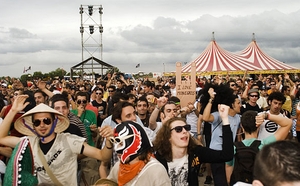
As is well known, every self-respecting European country holds a multitude of festivals with varying musical policies over the summer. Sultry Spain, still full of genuine joy over its recent victory at the Euro Cup, is no exception. On 12 July, a little after the famous Sonar, simultaneously with the traditional San Fermin bull run in Pamplona, in the desert 150 kilometres from Zaragoza, Juan Arnau and his team organised the 14th Monegros Desert festival. Few, perhaps, would have paid attention to this event — after all, it's inconvenient to get to, the desert lies far from both Madrid and Barcelona — but the promoters put together such an interesting line-up that forty thousand people, weather notwithstanding, came to dance on the sun-scorched sand.
Despite the attempt to diversify the festival's musical policy — the line-up featured hip-hop masters Cypress Hill, dubstep flagships Skream and Benga, the godfathers of trance Infected Mushroom, the pop-electro star Miss Kittin, and the ever-drum&bass musician Aphrodite — the dominance of techno at the event's grounds was nonetheless felt distinctly and indisputably. Dave Clarke, DJ Rush, Derrick May, Sven Vath, Richie Hawtin, Ellen Allien, Laurent Garnier, Chris Liebing and Technasia — these are just a few of the names that convey the scale of the techno coverage at Monegros Desert 2008.
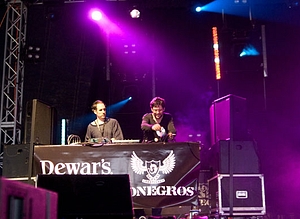
The festival was organised across five dance floors, presented by both well-known alcohol and tobacco brands and by players from the music world: a marquee from the Spanish beer San Miguel, a mini dance floor from Bacardi rum, a huge open-air area from the Barcelona club Row14, the only "solid" indoor space from the Red Bull Music Academy, one more open-air floor from Sennheiser, and — the exception — the "unowned" White Label, belonging to no one. Each of the dance floors had its own musical policy: Row14 leaned mainly towards minimal techno; Sennheiser — hard techno and the like; the Red Bull Music Academy — a mixed bag, from 2step to drum&bass; San Miguel — the most popular music (Cypress Hill and Miss Kittin performed precisely here); Bacardi and White Label — good techno and deep house. There were no problems with the line-up, apart from the Frenchman Garnier's set being delayed by several hours. The rest of the artists performed precisely on schedule.
It can't be said that for all 22 hours of the event an atmosphere of universal joy and euphoria reigned across the grounds. Some time after Monegros Desert 2008 opened, heavy rain poured down over the north of Spain, and some of the dance floors were open-air. As a result the night turned out rather damp and cold, and thousands of people were simply not prepared for it — most had come in nothing but t-shirts. On the other hand, this had a very positive effect on sales of Monegros-branded t-shirts and towels: all night long there were long queues at the stall, the goods being snapped up by the armful. Only the warm morning sun brought back the feeling of Spanish summer.
The festival grounds had their own currency — monegrinos, which made it possible to speed up service at the bars and also to rule out petty theft by the bartenders. And, of course, to dodge paying taxes — after all, no one can write you a till receipt when using "dodgy" decorative coins. The lighting equipment barely scraped a three out of five; these were more like the simplest installations in the spirit of "at least something". The sound, on the other hand, didn't let anyone down, which at events like this is perhaps far more important — a five is entirely deserved. The organisers equipped the grounds with the usual plastic toilets, drinking-water taps, mini first-aid stations, and cloakrooms (clearly superfluous). There were enough bars, but the range in them turned out to be meagre. Only about a dozen items in all, the simplest cocktails made with the sponsors' drinks, but the prices were quite budget-friendly — 6–7 euros a drink. As for food, there were only sandwiches and a semblance of pizza, about six dishes in all, but for some reason only ever one or two items from the menu were actually available. To the organisational shortcomings one can also add small negative touches with the buses — the passengers weren't given the fruit and drinks they'd been promised, and in some buses, despite the ban, tobacco smokescreens were set up for the entire journey. The press and the artists were provided with a separate little zone with bars, toilets and sofas. But since a downpour had come the day before, most of this zone stood empty — no one wanted to sit on wet sofas.
The main difference from similar events held in Russia is that the majority of attendees arrived in their own cars. The buses, including services from France and Italy, delivered perhaps a twentieth of the crowd. With rare exceptions, the audience was made up of young people aged between 18 and 28. Not a single conflict or fight was observed over the entire festival — people had come in a good mood.

As for the musical side of the festival, all the artists performed with distinction. Richie Hawtin mixed unusually fast for himself, ending his energetic set with a rare 1987 acid-house record, Mory Kante — Ye Ke Ye Ke (Afro Acid Remix). The German Sven Vath played an uncharacteristically light, melodic set. BPitch Control's owner Ellen Allien delighted the crowd with a wonderful selection of minimal techno, at times not danceable at all. Miss Kittin and The Hacker drew perhaps the most grown-up part of the audience to their show, but their live sets clearly still lack energy and dynamism — a vocalist standing in one spot most of the time doesn't much impress the audience. Derrick May's set came across as a little chaotic and motley after Hawtin's very steady and technical performance. The Spaniard Oscar Mulero opened the Row14 dance floor well — a full 4 hours of work by the classic method, off vinyl records, while many guests had brought only a PC. Cypress Hill performed well, but their very presence in the line-up is questionable — the hip-hop scene and the techno scene share little audience overlap after all, and it's unlikely some young rapper would travel far from home to a techno festival for the sake of one short show. The Spaniard Luis Lles, who lives nearby, played all sorts of music on his cosy little Red Bull Music Academy dance floor, from 2step to reggae, without even mixing the tracks. Cristian Varela, who closed the festival, clearly lacked euphoria and grandeur. And although at such events the crowd usually demands more of the party, the festival ended an hour earlier than had been announced.