Auto-translated by 44100Hz.
Read the Russian original →
The New Tekhnika of Grown-Up Youth
Интервью · 14.10.2007
By Снежана Осипова
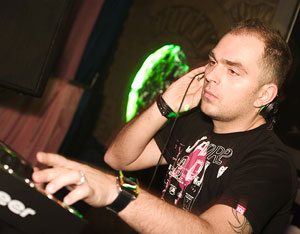
This man made himself, and he isn't afraid to talk about what he likes and what he doesn't, even when it runs against public opinion. He can safely be called a veteran of club culture. Grad's rich track record includes not only the thousands of hours spent behind the decks, his work on radio and residencies at "Garazh" and "XIII", but also the realisation of his dream — the creation of the new club "Tekhnika Molodezhi". DJ Grad told us about its unique format...
Let's talk about your club Tekhnika Molodezhi.
Let's — I spend a great deal of time there.
You once said a place similar to Tekhnika was supposed to appear, but something didn't work out. Tell us in more detail.
On the site of the Open café a club was supposed to appear, run by Alexey Zubov. I planned to bring something of my own into it. Not just music, not just DJs, but a place like in the film "Back to the Future", when the hero returns to the eighties. Because the 80s are a stratum that's very popular and in demand right now. Just take any old clip from MTV to see how people dressed back then, what they listened to, what it was all like. That's the music I was raised on, together with the 80s generation.
When was this?
Four years ago. It seems to me any disc jockey who works in clubs has a dream of opening his own place. It's very pleasant if you open your own place the way you want, and not the way your founder or board of directors wants. Exactly as you see it. From start to finish. At Tekhnika Molodezhi my views coincided with Tash's (a member of the Comedy Club project), probably because we're the same age. In the end it turned out to be not just a retro club, but a place where that merry era is greatly cherished and presented not in a pushy way, but lightly and interestingly.
The whole story actually began at a festival in Turkey. The Comedy festivals aren't just a week of relentless drinking, as many think — they're genuinely a fully organised holiday, both for the people who go there to relax and for those who work there. I went there as a disc jockey, and it was right there, you could say, that fate tied me to this project.
But the most interesting thing is that when I first came into the Comedy Club office, which is now on Lesnaya Street, I got a real shock. It turned out that more than ten years earlier I had lived in that very office! Because my uncle, a theatre and film actor, rented a room there. And when I came to Moscow from Norilsk, I stayed with him at that exact address. When I walked into the guys' office, they didn't believe me. Really, what a coincidence... it's mystical.
The whole story actually began at a festival in Turkey. The Comedy festivals aren't just a week of relentless drinking, as many think — they're genuinely a fully organised holiday, both for the people who go there to relax and for those who work there. I went there as a disc jockey, and it was right there, you could say, that fate tied me to this project.
But the most interesting thing is that when I first came into the Comedy Club office, which is now on Lesnaya Street, I got a real shock. It turned out that more than ten years earlier I had lived in that very office! Because my uncle, a theatre and film actor, rented a room there. And when I came to Moscow from Norilsk, I stayed with him at that exact address. When I walked into the guys' office, they didn't believe me. Really, what a coincidence... it's mystical.
What concept did you decide to stick to when opening the new club?
Often people take on too much. Besides, they immediately make a lot of mistakes. The first — they say the word "glamour". You have to be aware of how well you can live up to that word. If you're well versed in house music, in glamour, you can do it as a professional. If you're versed in something else, techno for example, you can make a cool techno club. Often the promoters themselves don't know what they're getting into, and they pump cash out of the club by any means. Our situation is different, we were aware of what we're capable of. And we're capable of bringing people joy around the clock. Seven days a week. And that's really how it is. Because we have a great team of creative young people, not hung up on anything, and for whom there are no limits, no ceiling to stop at. And at the same time there's specialisation. We don't compete with anyone, our style is unique, and we don't turn it into kitsch. Everything just happens by itself, because the stratum of the musical culture of the 70s, 80s and even 90s is very large. These are people who remember their first discos. That sort of thing is never forgotten... all the rhythms that get played here, by the way, are in demand in modern music. In house, for example, or r'n'b.
Our concept is very friendly. Besides the dance floor there's also a cinema and a library here. Here anyone can feel like an artist and draw someone's portrait while waiting for their order. There's a games room with a Sony PlayStation 3 console, and every new game that comes out appears at our place straight away. In other words, you can come here at three in the morning on a weekday and find something to do, that's all. I position myself from the client's point of view, and I'm always interested here. I can come to eat, drink, watch football, play a new computer game, there's internet here — well, what more do I need? And besides all that, on Friday and Saturday there are fun parties here. On Thursdays we do a barbecue. And it doesn't claim to be a super party. I believe the word party commits you to a great deal. Everything has to be perfect — lighting, decorations, music specially selected for the party. We just make the tastiest barbecue. Me and Tashik, from the heart, for free.
The effect of friendliness and warmth... I, at least, have never seen anything like it anywhere else.
I think you'll be blown away by what we can do!
Our concept is very friendly. Besides the dance floor there's also a cinema and a library here. Here anyone can feel like an artist and draw someone's portrait while waiting for their order. There's a games room with a Sony PlayStation 3 console, and every new game that comes out appears at our place straight away. In other words, you can come here at three in the morning on a weekday and find something to do, that's all. I position myself from the client's point of view, and I'm always interested here. I can come to eat, drink, watch football, play a new computer game, there's internet here — well, what more do I need? And besides all that, on Friday and Saturday there are fun parties here. On Thursdays we do a barbecue. And it doesn't claim to be a super party. I believe the word party commits you to a great deal. Everything has to be perfect — lighting, decorations, music specially selected for the party. We just make the tastiest barbecue. Me and Tashik, from the heart, for free.
The effect of friendliness and warmth... I, at least, have never seen anything like it anywhere else.
I think you'll be blown away by what we can do!
And what position do you officially hold at Tekhnika Molodezhi?
I'm the art director.
Who developed the club's design?
Personally I only took part in setting up the light and sound. The design here was created by a special creative group brought in from Tibet. For example, we wanted the entrance to the club to look like the entrance to a Tokyo airport. Everything here is very different, each room is unique. This classic room we're sitting in is actually marked out like a basketball court. It's a genuinely crazy club. For example, our comics wall changes every six months, we keep drawing new and new pictures.
Can you recall the most memorable party at Tekhnika?
It's still too early, we opened in June. I remember, when the club first appeared, I was pleasantly struck that people sang the 80s songs by heart. They remembered them. At one party everyone was in shock when a slow number came on on the dance floor. But there's always an upside to this — in a club where slow numbers play, it's easy to get to know someone. To fast music it's hard for people to approach one another, strike up a conversation, an acquaintance. You have to be very sure of yourself to dare to do it. And here that's 50% of the success. You can calmly walk up to a girl and invite her to a slow dance. And no one finds it jarring. But there's a very fine line between good music of that era and vulgarity. At our place people dance to Depeche Mode, Pet Shop Boys, Kool and the Gang. R'n'b doesn't play here, here people dance to jazz, funk, disco and real hip-hop. I'm for an alternative to what's out there in the club industry now, music included.
Is it easy to get past face control at Tekhnika?
When people ask me: "How do I get in?", I always answer: "Be yourselves". If you approach the club radiating positivity, the face-control guy senses it. Even if you've never been to this club, and they start asking you some questions — there's nothing scary about that, the main thing is to feel confident. Everything is done to make those inside, and you too once you're through, comfortable. At our entrance there's a man whom almost everyone knows. The best face-control guy in Moscow. I guarantee it!
And where are you most comfortable performing?
In clubs, oddly enough. In the club Gorod, for example. I always enjoy playing there, the people there know music and understand it. That's really true, even though I was a little nervous about my first performance there, but it turned out very heartfelt.
Tell us about the time when the after-parties at Garazh were at the peak of their popularity.
It all started because people, after Jazz Café, just couldn't sleep in the mornings.
One time I came to Garazh, and a tired and exhausted Oleg Ojo asked me to play a little. From that day my career at Garazh began. Honestly, there's a certain element of fanaticism in how I work. Sometimes my personal life suffers because of it. When the club XIII existed I slept there and only left to change my clothes. When Garazh existed, I ran the after-parties, sometimes turning down tours and offers, of which there were already many at that point. If you do one thing, then do it professionally and giving it your all.
One time I came to Garazh, and a tired and exhausted Oleg Ojo asked me to play a little. From that day my career at Garazh began. Honestly, there's a certain element of fanaticism in how I work. Sometimes my personal life suffers because of it. When the club XIII existed I slept there and only left to change my clothes. When Garazh existed, I ran the after-parties, sometimes turning down tours and offers, of which there were already many at that point. If you do one thing, then do it professionally and giving it your all.
And which places would you recommend going to?
In summer I see no point in being indoors, so I love all the summer terraces there are in Moscow. This year the place "Kak na Kanarakh" was popular. A summery, almost beach-style holiday out in the open air, light and non-committal — there was no loud music there, it was simply comfortable. In general, if some good DJ comes to town, I gladly go to any club, be it Dyagilev, Gorod, Neo, Mio or some open-air venue. For me it's the event itself that matters, not the place where it's held. In Russia, at least.
Are you no longer planning to run after-parties in Moscow?
No, why — I'm planning to do unique after-parties at Tekhnika. First-wave DJs will play. There'll be no tedium — it'll be what after-parties in Moscow started out as.
Who are these first-wave DJs?
I'll be delighted to invite Nikka, Ojo, Djangl, Bell — everyone who used to play house.
Do you remember the moment when you felt your popularity?
Most likely it happened somehow gradually. Probably when I sent out my technical rider and all its points were fully met. When people started to listen to me. For me respect matters more than fame. Fame is more a matter of touring — being recognised and so on. Thank God, it's worked out for me that my tours are booked far in advance, and I'm grateful to people for that. But when a girl asks me to sign her chest, I feel like some kind of pop idol. Recently another such case happened in Chelyabinsk. I even asked her about four times, are you sure it's me who's supposed to write it, and she answered — yes, you specifically. They sent me a photo recently.
Yes, I saw it on your LiveJournal. And, by the way, have you been keeping a diary on the internet for long?
Pimenov made me do it at one point, since he's our guide to all things new and high-tech. I hesitated for a very long time over whether to do it or not. But when I started it and got my first hundred friends, I realised people read what I write. At this point there are more than a thousand of them!
Do I have a chance of making it onto your friends feed?
You know, it worked out that from the very start I friended the maximum possible number of people. And then it turned out no more was possible. It upsets me too — people write, why aren't you adding me to your friends feed, and I try to do it and I can't.
In general, at a certain point I crossed the thousand mark, and I'm glad that with all the people who read me on LiveJournal I can have a good chat online on various topics — about music, nature, the weather. I think writing anything personal on the internet is silly; the net doesn't exist for that.
In general, at a certain point I crossed the thousand mark, and I'm glad that with all the people who read me on LiveJournal I can have a good chat online on various topics — about music, nature, the weather. I think writing anything personal on the internet is silly; the net doesn't exist for that.
And do you think there's some equivalent of radio 106.8 now — maybe Megapolis FM?
No. If ten more stations like Megapolis were to open now, they'd all be à la 106.8 or Stantsiya 2000. Because there's a benchmark that we had and that we build on. Right now I work at D FM, and that's exactly where I put my thoughts and ideas.
Who helped you take shape as a musician?
The first music videos, probably. I was simply stunned when I saw the Jackson 5 clip "Can You Feel It", Kraftwerk, DM. Oleg Ojo was certainly a big influence. Fonar and all my fellow DJs at Stantsiya 106.8 command a good deal of respect; I came to feel myself a musician thanks to Agent Smith...
At one time you were named one of the sexiest DJs... It was Ptuch magazine. How did you react?
Well, I was pleasantly shocked. I think my music is too sexy!
And which of today's female DJs would you name the sexiest?
None of them. Although I have a very good attitude to them all. I like Western female DJs. I adore Tanya Vulcano... I think she's not only a stunning girl but a DJ who makes a very strong impression on me. I also like Smokin' Jo and Lottie.
And what does a girl have to be like to appeal to you? Can you become smitten with a girl you saw on the dance floor?
I can, but I don't want to. I have no taboos, but I do have moral principles. I like all sorts of girls. When I play, I play for all the girls, and first and foremost for the girls. Blondes, brunettes — doesn't matter. Tall, short — doesn't matter. Slim — yes. There has to be charisma, charm. Besides, on the dance floor you very often can't tell what kind of person she is.
And what's going on in your personal life right now?
Everything's good with me.
Are you planning to record a record any time soon?
Yes, at the moment I've finished work on a remix of "Slow" for Bobina. Soon I'll be starting to release my regular mixes. I'm also preparing new tracks.
Where do you usually buy your records?
On the internet. I collaborate with a great many house producers who make tracks themselves, with record labels. Sometimes a track is recorded in the evening, and the next morning it's in my inbox. Whereas I used to spend time travelling to England, going round all 16 vinyl shops, buying it by the big crate, now that moment has, unfortunately, vanished. But I enjoyed it very much, and I'm grateful to fate that I caught the time when you could still go to London for records too.
Lots of books and guides to club culture have appeared now, memoirs of former clubbers and DJs. How do you feel about that kind of literature? Do you want to write a book yourself?
In my opinion all these books are very similar, but I'd gladly write one too. It wouldn't be fiction, but rather documentary-journalistic. I'm also going to take on a TV project. I won't say what kind yet, but when it comes out, it'll really be something that isn't yet on our television. I have a great many plans. I'm just in no hurry. Everything in its own time.