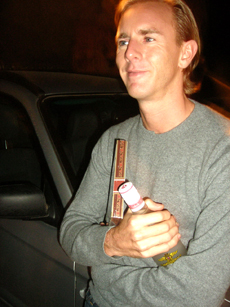
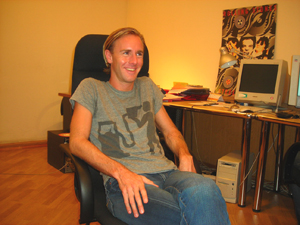
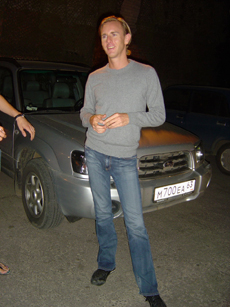
Richie Hawtin (born June 4, 1970, in Banbury, Oxfordshire, England) is a Canadian electronic musician and disc jockey who tours various countries around the world. He is an important component of the second wave of Detroit techno in the early 90s. Hawtin is better known for his memorable work as Plastikman, an alias he continued to use in the mid-2000s. In May 1990, together with his like-minded friend John Acquaviva, he founded the record label Plus 8, whose work continues to this day. And in 1998 he launched the label Minus, intended for his own projects.
The driving force of the second wave of Detroit techno has two free days a month in his schedule. But even those instantly get filled up. Hawtin's arrival in Samara came as a big surprise. Igor Ignatyev, a journalist for the website www.club-guide.ru, managed to talk with the musician and quiz him about life in Berlin, techno and travelling.
You've probably guessed my first question...
No, not at all — how would I? =)
What's the purpose of your visit?
A-a-ah, well, I just dropped by to see friends, and also to practise my Russian.
Really? And how's the studying going?
Nowhere; my Russian is still terrible.
Well, can you say at least something?
N'et... I honestly try to learn it, but Russian is too alien a language for me. All the more so since I'm learning German right now, and two languages at once is a bit hard.
You've been living in Germany for three years already and still haven't learned German?
No. It's much better now, of course, than it was when I arrived in Hitler's homeland. They've already managed to teach me at school. During the first year I didn't take lessons, since I wasn't sure I'd stay here, though now I know for certain that I'll be living in Germany.
And why Germany specifically?
For me, Berlin is one of the most interesting cities in the world. If you truly understand electronic music, then Berlin is your city. There are a lot of great cities, but I want to be where there are lots of parties, record companies and so on. They constantly push electronic music forward. And it's very important to be in the thick of musical life, among talented creative people.
What can you say about Berlin's nightlife? Small clubs, big raves...
Actually, there aren't all that many big raves in Berlin. But there are a great many small clubs, where people come towards morning to see the night out. In fact, in Berlin you can go to a club any day of the week. But it's best to head there on Thursday and listen to music until sometime around Monday morning. It's tremendously inspiring!
And how often do you play in Berlin?
I play 4–5 times a year.
Not often...
Yeah, I don't like to play in the same place many times, I prefer to take part in special parties. Sometimes my sets are a surprise for the audience — for instance, last time my performance wasn't planned, and I played for 18 hours.
Cool! Listen, you were born in England, lived in Canada, worked in America, and now you've moved to Germany. I see you like to roam around the world.
Yes, I've been travelling for 15 years now, since 1987. It's in my blood by now. Yes, I like being at home, but I also love it when everything around me changes. I like meeting new people, finding myself in new places. All of it means that I'm living, changing and learning. Actually, it seems to me I've been travelling my whole life. Maybe not every day, but I'd happily live in Asia, China or Japan, for example. One day I'll even end up in Siberia!
What, do you have concrete plans already?
No, for now my plans are studio work, in Berlin. After that I'm thinking of going to Tokyo or Shanghai. I'll live there for 3–4 months, do some recording.
And what's the wildest place on your map?
Cambodia. I've also been to Easter Island. It's between South America and Australia. It's one of the most remote archipelagos in the world. It's very hard to get there, and development there is at the foundation stage entirely. Now that's a truly wild place.
So how did you get there?
By plane. But it wasn't so simple; I made several connections and only then landed in a place where no one was waiting for me. I was with my brother. We met a family who invited us to stay in their home, where we spent seven days.
All right, you change yourself, everything around you changes too... but how does the music change?
Techno, like any other electronic music, has to change. It needs to progress, to move forward, and that's exactly why I try to change my life more often. If I remain a constant, I won't grow, won't discover new tricks, and my music won't change. And if my music doesn't change, I'll perish! That's precisely why techno has to change.
But back when you were working in America, techno barely changed, didn't it?
It changed, but slowly. At some stage it stopped developing, and that's exactly why I moved. I moved in order to get inspired somehow. The music I play now differs from what it was 5–10 years ago. I'd call it a continuation.
You started with techno. 15 years later you still play techno, but...
…techno encompasses all directions. It's everything that is futuristic. It can be house, minimal, anything at all, even something like trip-hop. The main thing is that all these directions contain the philosophy of techno. Personally, I play roughly the same thing, sometimes it resembles house, sometimes funk or even some kind of Latin, it doesn't matter. But in all of it there's the idea of change and moving forward. That is the philosophy of techno.
As far as I know, there was a period when you played IDM.
Well yes... but I never really thought of what I do as IDM specifically. Techno was called IDM. It's intelligent dance music. The same techno, but not only for the dance floor. Some people need to divide music into styles. But most of the music we love and play contains the ideas of techno. It can be both for dancing and for home listening, but all of it is futuristic. Good IDM is futuristic, good house is futuristic.
Is "futuristicness" the main criterion for judging music for you?
For me — yes. Good music is futuristic, it's the music of the future. I think this criterion has to be taken into account when talking about good electronic music. That's exactly where the difficulty lies. There's a great deal of similar music, but it's precisely this characteristic that you should pay the main attention to.
And what is real techno for you?
Some say that real techno is Kraftwerk or Derrick May or Kevin Saunderson, but when all this music appeared, it was diverse and futuristic!
That's clear enough. I think every musician dreams of performing at the Olympic Games. And what did it mean for you?
I never dreamed of playing at the Olympic Games. When they called me the first time, I thought it was some kind of joke. I answered something like "okay, call back tomorrow". And they called back! Naturally, I was surprised. You know, the Olympic Games are the kind of thing you can't turn down. For me it was rather hard, because I had to work with the show's director and a choreographer. I had to do what I was told, not what I wanted myself. All of it was new to me.
Which country did you root for at the games themselves?
For Germany, of course.
Why, not for America, for example?
And why should I root for America?
Well, you lived there, worked there...
Well, yes, Detroit is very important to me. But I don't believe in America. I don't believe in the way people live there. They couldn't care less that civilisation exists beyond the borders of the USA. They don't give a damn about Russia, France and so on. They're insular, they only care about the affairs of their own town.
The same with music?
Yes, absolutely. Radio and the big labels are endowed with so much power that they're able to control people's musical desires. That's exactly why hip-hop is very popular there, because there's big money behind it. The overwhelming majority of the music popular in America is made right there.
As for the start of your musical career: I know your father was into music. Wasn't he a professional musician?
No, my father isn't a musician. He's an oddball who's obsessed with electronics, computers, and is very heavily into music. When I was still a child, he listened to things like Kraftwerk and Pink Floyd. So there was music playing constantly in our house. It's very easy for me to picture him sitting at his collection, constantly listening to music, assembling a radio or something else. As for me, I never thought I'd become a musician. I'm simply a product of my circumstances.
In general, it really looks as if you're carrying on your father's life and passions.
No, not really, I'm not carrying on his life. It's just that I was inspired by my dad's passions. It was he who introduced me to computer games, and later — to computers. And later still I realised I'd grown attached to these machines. Over time, I discovered that with their help I could create music. Actually, at first I was into films, cinematography. That's what I wanted to do originally; later I realised that with those same computers you could do all sorts of tricks with music. And that's what I settled on.
Yeah... what would you do without computers?
I'd probably be into films, working in that field.
And do you have professional training?
Yes, I studied video at university, but then I had to leave, because it was hard to study because of touring.
And do you play video games now?
Not very often. I love them too much, so when I start playing something, I check out of life for two weeks. My favourite game is GTA; in general, I like long games that aren't so easy to finish.
About a year ago you took up VJing...
Yes, my friend and I made a few original things. Now the visuals and the sounds come to us simultaneously. But these aren't your simple little flash clips.
Is this your next step?
Yes, I think I'll come up with something along these lines in the coming years. I'm constantly testing different things in my studio, and not in vain, I think. But I'll never become just a VJ. That doesn't interest me. I'm interested in combining visuals and sound in one person. I'd like to find a technology that would let me fully control sound, sensitivity and so on. Perhaps this technology will make it possible to influence reality. But I don't want to work with reality. I'm more interested in what lies beyond it, in what doesn't exist. That's exactly what allows people to break away from ordinary life. All of it seems very complicated, but nevertheless one can't help dreaming of it. Right now this is my goal. After all, we have to have some goal before us, otherwise we grow old. Those who stop developing and dreaming grow old. So you must never abandon your dreams.