Robots from the Cocoon
World Wide · 18.09.2007
By Александр Баулин

Frankfurt is famous not only for its trade fairs, skyscrapers and airport, but also for the most expensive club on the planet — Cocoon, run without interruption by the pioneer of German techno Sven Väth (and that's exactly how his German surname, Sven Väth, should properly be pronounced). Over the years of its existence, the club has become one of the most magnetic places in Germany for techno lovers from all over the world. That said, the era of globalisation and the dominance of brands hasn't passed it by either. Today we say Cocoon and mean not only the club on the eastern edge of Frankfurt, but also a record label, a booking agency and, of course, the annual summer party series on Ibiza and travelling events at the world's best venues.
Sven Vath - Mind Games
A brief historical excursion is best begun with events that took place 10 years before Cocoon opened. In the summer of 1988 Sven, together with Michael Munzing and Matthias Martinsohn, buys the prestigious club Vogue. After a complete refit and a grand opening in early October, the club, named "Omen", under Väth's direction begins to champion the then-fashionable "acid sound".
In 1990 musical tastes grow heavier, and now techno dominates the club; Omen becomes a kind of crossing-point for international currents in club culture, and Sven is the central figure in that process.
In April 1996 his own series of club parties comes to life — Cocoon. The first event takes place in Frankfurt, the second in Munich, and the last at an art festival in Copenhagen. Later, however, for organisational reasons, the series was put on hold.

The time comes when Sven has to bid farewell to an important part of his life: on the 18th of October 1998 the legendary club Omen closed its doors to the public forever. This led to a gaping void in the city's nightlife that was never adequately filled. But Sven, with his characteristic logic that "an end at the same time means a new beginning, nothing should stand still", resolves at all costs to preserve a venue in Frankfurt for developing and promoting the current and avant-garde directions of electronic music, and techno especially. To that end, every second Friday of the month he begins holding Cocoon parties in a shopping-complex building called Ufo.
In 1999 Cocoon grows into Cocoon Clubbing — a mobile promo group throwing parties in Germany's best-known techno clubs (Stammheim/Kassel, Tribehouse/Neuss and Prag/Stuttgart). But that's still not all. The party sets off on its first journey to Ibiza, to the famous club Amnesia, where the first four events go so successfully that they become an unfailing feature of the summer — every Monday from June to September. Already the following year, Sven's idea of combining electronic music with other art forms found its finest embodiment precisely on Ibiza. The blend of music, visual effects and the island's stunningly beautiful views enveloped visitors in the brightest cocoon of emotions, remembered for a lifetime.
Cocoon Amnesia Ibiza
Under the impression of the atmosphere at his own parties and driven by a desire to keep his fans' memories of that summer in their pristine vividness, Sven decides to release his first official CD album, "Sven Vath In The Mix - The Sound Of The First Season". It comes into the world in November 2000, exactly 5 months after the opening of his own label, Cocoon Recordings.
All this, however, could not satisfy the ambitious Sven, who, by the way, in that same 1999 became Germany's official cultural representative for the Goethe-Institut. With the arrival of the new millennium he begins work on rebuilding his venue with the aim of opening within it a club that would match his tastes and ideas 100%.
Planning out the space took nearly two years, during which numerous consultations were held (besides Sven, his old business partner from the Omen days — Matthias Martenson — took part in them) with the design agency 3deluxe, with the aim of achieving a coherent concept that would organically combine architectural, graphic and multimedia elements. In sum, in 2004 the Cocoon club finally opens its doors before a public that had waited long. Its area came to 2,664 square metres, and its approximate capacity — 1,200 people. The venue consisted of three bars, two restaurants and a dancefloor.
The "Micro" zone is a restaurant with modern European and Asian cuisine, combined with a space where cultural events are often held, and where the line-up of performing DJs changes from day to day. This zone was specially designed for the comfortable listening of music different from that played in the main hall. Here, as night falls, the lounge is gradually displaced by ever more danceable rhythms. What makes this zone unique is the use in its interior of hundreds of fibreglass tubes hanging from the ceiling, onto which multicoloured images are projected, creating a whimsical visual ornament to match the music being played.
Next to the Micro zone is the Silk restaurant. The main feature of its interior is the large leather sofas set amid sumptuous décor kept in light-pink tones. Dining here is meant to be done lying down, or at least half-reclining. Semi-transparent mesh curtains divide the restaurant into eight niches. According to the designers from 3deluxe, all these solutions elevate the simple act of eating to the level of an aristocratic ceremony reminiscent of ancient feasts. The VIP zone deserves a separate mention, surrounded by a virtual aquarium with charming creatures swimming in it. If you want to spend the evening here, make sure to reserve a table in advance, as the number of seats is limited, and try not to be late — dinner is served at eight in the evening. And so as not to interfere with enjoying the taste of the dishes, smoking is forbidden inside the restaurant.
At the very centre of the club lies its heart — the main dancefloor. Here is the most imagination-stirring architectural feature — a white "membrane wall" surrounding the dancefloor by 360°. This wall is also used as a screen — by projecting various video onto its textured surface, one can change the state and atmosphere on the dancefloor in keeping with the music the DJ is playing. For those who wish to rest without moving away from the dancefloor, around the membrane wall there are thirteen cocoons with soft upholstery inside, three of which can be reserved in advance as private micro-rooms. Above the hall there is another VIP zone with two half-open cocoons and a separate bar. Nearby is also the Inbetween Lounge — the perfect place to sit and chat with friends while sipping cocktails from the nearest bar.
With its unique interior Cocoon seems to say to its visitors: "I am the very place where you can feel the full richness of the nuances and intricacies of modern electronic music".
The club's sound system was specially designed, assembled and installed by the New York firm Integral Sound. Its power is 220 kilowatts. "That's not as much as you think. It's all done so as to take in the music as comfortably as possible," Sven stated in one of his interviews.
At night, the club most often resounds with techno and tech-house from Sven Väth and Richie Hawtin along with DJ Hell, who are the residents. Carl Cox and Laurent Garnier regularly come to the club with their sets, helping the owner continue his policy of developing techno music. Live band performances are also not uncommon at the club — for example, on the 1st of November the old-timers Underworld will perform on its stage. On Saturdays preference is given to house, personified by such names as Swayzak and Ian Pooley. In the club's other zones, preference is given to jazz, soul, funk and r'n'b.
As already mentioned at the very start, Cocoon is on the eastern edge of the city, so the most convenient way to get there is by taxi; the entrance fee averages 15 euros, but the prices for cocktails at the bars "bite". In a word, it's best to be prepared for the fact that a night spent at the club will most likely make your wallet thinner. True, this doesn't stop the club's regulars at all. How much they leave within its walls can be judged only from the fact that when word came this spring of a burglary at Sven's flat, then, besides expensive watches and securities, the club's daily takings — a six-figure sum in euros — were stolen.
Stephan Bodzin Live at Cocoon Frankfurt
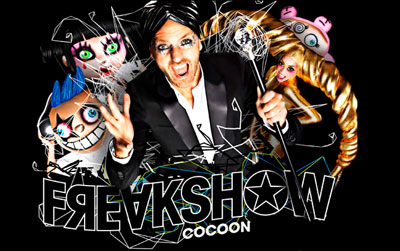
But today you can catch Cocoon parties not only in Frankfurt. Although the club is fussy in choosing its residencies, parties under its aegis take place in Madrid, Rotterdam and on Ibiza. And the Cocoon parties on Ibiza are famous not only for their line-up, where in the literal sense one star sits on another and drives a third along (Ricardo Villalobos, Luciano, Loco Dice, Roman Flügel, Tobi Neumann, not counting Richie Hawtin and Sven Väth), but also for the unforgettable freak show in which colossally sized robots and other characters leap out of cocoons and dance along with everyone in the hall. A blank spot on the map until recently was London. But first in March, and then in July 2006, Cocoon appeared there too — at the club The End. And this, by all appearances, is still far from the end!