Auto-translated by 44100Hz.
Read the Russian original →
Sun and Neon Light
Интервью · 14.06.2008
By Татьяна Андрианова
On the eve of the Russian release of the album The Sun and The Neon Light, the German musicians Arno Kammermeier and Walter Merziger (Booka Shade) shared with us their thoughts on music, on Russia and, of course, on themselves. In Russia the new Booka Shade album will be released by Get Physical's official representative - the Moscow label Algorythmik→ and will go on sale on 15 June.
Booka Shade - the Sun & The Neon Light EPK
44100Hz: You travel a lot and have already been to Russia more than once. Do you think the Moscow public differs in any way from the European one?
Вальтер Мерцигер:
Naturally, people in Eastern Europe differ greatly from people in, say, Southern Europe. Some are more emotional than others, but one way or another the audience always finds a way to express its feelings - whether through frenzied dancing or ecstatic shouting. We really enjoy performing in Bucharest, Budapest, Kyiv, Moscow... people always know the words of the songs, they sing along!
Arno Kammermeier: By the way, music by and large is a universal language, so it doesn't matter at all where you perform - in Canada, South America or Australia - people come to our concerts to have a good time: they dance, have fun, and besides, the lyrics of our songs are very easy to remember, so people always sing along with us.
Arno Kammermeier: By the way, music by and large is a universal language, so it doesn't matter at all where you perform - in Canada, South America or Australia - people come to our concerts to have a good time: they dance, have fun, and besides, the lyrics of our songs are very easy to remember, so people always sing along with us.
44100Hz: How did the name of your group come about?
Вальтер Мерцигер:
I found out by chance that in Russia "buka" is what they call little sad boys, is that right? When we were coming up with the group's name, we didn't know that. Arno and I were just reading some magazine, saw the word booka there, then saw the word shade, decided to combine them - and out came Booka Shade. There's no meaning in it at all - it just sounds good. Doesn't it?
44100Hz: Tell us how you met and started making music?

Арно Каммермайер:
It's such a long story... but I'll tell it briefly (laughs). We were at school, and we were about 14, I suppose - that's when we realised we wanted to do music. And not just anyhow, but to write our own music, to perform on stage in front of crowds of male and female fans. In short, we set up a small studio in Walter's parents' house and started recording. As a result we put out a pile of really cool records. Back then we made first-rate pop, but then we fairly quickly became disillusioned with what goes on in the music industry, and went back underground - took up what we'd started with - techno. Today we feel completely free and can do whatever we please. We have our own record label, so there's no need to think about being dependent on anyone. It's simply fantastic!
44100Hz: At the start of your career you played synth-pop and pop, even a bit of rock, and now you write completely different music. Why? Perhaps it's connected with the influence of certain artists on your work?
Вальтер Мерцигер:
Naturally, we were strongly influenced by the music of the 80s - we grew up in that time... Depeche Mode and The Cure, for example. Honestly, they recorded their best songs precisely in the 80s. As for contemporary artists, I don't even know, so much influences us... Well, probably Sigur Ros - wonderful guys from Iceland. Or Björk - she's from there too, by the way.
Arno Kammermeier: We also love film soundtracks very much, and the classics.
Walter Merziger: Yes, yes, exactly. And after all, we aren't DJs, when it comes down to it, to listen to everything indiscriminately; we're musicians - so we love to experiment with sound, even though we work in the dance direction. At parties the music often lacks melodies - sometimes DJs get carried away with faceless minimal techno, and nothing good comes of it. We try to put that situation right somehow.
Arno Kammermeier: We also love film soundtracks very much, and the classics.
Walter Merziger: Yes, yes, exactly. And after all, we aren't DJs, when it comes down to it, to listen to everything indiscriminately; we're musicians - so we love to experiment with sound, even though we work in the dance direction. At parties the music often lacks melodies - sometimes DJs get carried away with faceless minimal techno, and nothing good comes of it. We try to put that situation right somehow.
44100Hz: And you do it brilliantly. Now tell us about your new album The Sun and The Neon Light. This record differs radically from your other works.
Арно Каммермайер:
We had a grand touring trip all over the world, and we recorded the album while travelling. Then, when we got back to the studio, we realised that we had so many impressions from those endless concerts that all of it absolutely had to be expressed in music. On tour we always had a laptop with us, so we wrote music in the hotels. We worked on the basic ideas.
Walter Merziger: Here, for example, you're listening to the track Comacabana - and it was actually written in Copacabana, in a hotel! The sun was shining outside the window, but the composition came out gloomy, which shows what kind of mood I was in then. Or here, for example, the track Charlotte - it's very positive. We recorded it after a dazzling concert, in a great mood. When you have a lot of joyful emotions, you write exactly that kind of track. That's why the album has such different compositions.
Walter Merziger: Here, for example, you're listening to the track Comacabana - and it was actually written in Copacabana, in a hotel! The sun was shining outside the window, but the composition came out gloomy, which shows what kind of mood I was in then. Or here, for example, the track Charlotte - it's very positive. We recorded it after a dazzling concert, in a great mood. When you have a lot of joyful emotions, you write exactly that kind of track. That's why the album has such different compositions.
44100Hz: As for the sound of this record, did you use any special instruments in the recording?
Вальтер Мерцигер:
Yes! The stylophone, a very old instrument - they were popular in the 60s. They were used in shooting sci-fi and other films. It's quite tiny and you can play it just by running a special stylus across a special little screen. It's all very simple, but what a sound! And also the accordion. That very accordion from Samim's dance hit Heater! I'm not lying. We were travelling and found this instrument. We used it in recording the album too, in the track You Don't Know What You Mean To Me (J's Lullaby) - a lullaby to my little son. In the song Outskirts we initially used a synthetic sound, but then we realised we needed to record it all with a string orchestra.
44100Hz: And who drew the cover for the album?
Арно Каммермайер:
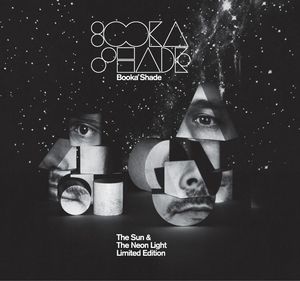
We've always taken the visual side of the Booka Shade project seriously. The cover was created by the wonderful artist Hort - we really like his style. He also drew the artwork for our very first album; we've worked with him constantly ever since. For The Sun and The Neon Light he came up with a brilliant idea - the reflections of our faces on the three-dimensional letters of the group's name. We were delighted!
44100Hz: Your career is a long path from simple fun to the production of a high-quality and commercially successful product. Could you have imagined that everything would develop exactly this way?
Арно Каммермайер:
Yes, when we started, for instance, running the Get Physical label in 2002, it was something like a hobby for all of us. We put out the music we liked. And now that hobby has become a genuine business, a huge company employing a lot of people. And we're happy. We have a great team. After all, when you're on tour all the time, you need someone to be in the office keeping an eye on the work, on how the preparation for putting out records is going - not only your own, but those of other artists on the label too - they're excellent musicians who entrusted their work to us.
44100Hz: Perhaps the last question. Your new album is not just an experiment, but also a kind of return to your roots?
Арно Каммермайер:
Exactly! We've always loved electronic music, but we wanted to try ourselves at something new. Acoustic music had attracted our attention for a long time, and we decided that we could make a mix of acoustics and electronics, combine them. That, by the way, is where the album's name comes from.
Walter Merziger: For the last fifteen months all we did was talk about the album. But we couldn't go on self-copying any longer. To record another Movements record, just under a different name - there was no point in that at all.
Arno Kammermeier: And besides, surprising people is a really great thing.
Walter Merziger: For the last fifteen months all we did was talk about the album. But we couldn't go on self-copying any longer. To record another Movements record, just under a different name - there was no point in that at all.
Arno Kammermeier: And besides, surprising people is a really great thing.