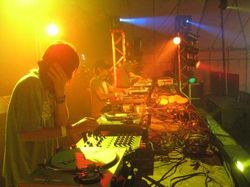
A few days ago in the centre of Stockholm, at the club Operaterassen, one of Sweden's main techno figures, Adam Beyer, threw an interesting party, Swedish Silver, at which he gathered practically all the national heroes of the scene – Cari Lekebusch, his first comrade-in-arms Joel Mull, Alexi Delano who had moved to the USA, Agaric who had cleared off to Berlin, and the relatively young artists Nihad Tule and Hardcell. The line-up was missing only the name Jesper Dahlbäck to cover the entire national scene. Swedish techno long ago became a brand in its own right – buyers all over the world come to record shops in search of this unique sound.
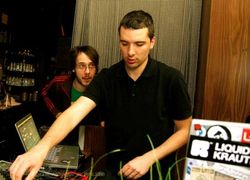
At this event we managed to catch one of the artists – Patrik Skoog (Headroom / Agaric), who had flown into Stockholm for just one night and kindly agreed to answer a few questions. Patrik is a musician with more than 100 releases behind him (mostly 12"s) and tours all over the world, but he has nevertheless remained a modest Swedish guy. During the interview Patrik kept shifting his feet, changing his pose and adjusting his glasses.
44100Hz: Hi, Patrik! Tell us, why did you decide to move to Berlin?
Agaric:
I moved to Berlin at the beginning of last year. I'd already been dropping by for two years, and I really liked the city. A very cheap city right in the centre of Europe. I'm from the south of Sweden myself, where nothing happens – I almost never played there, and just didn't do anything, really. In Berlin, though, something is always happening; it's a city where it's interesting to live. In Frankfurt, for example, there's a completely different climate, different people – I prefer Berlin.
44100Hz: In your opinion, what are the biggest differences between the Swedish and German techno scenes? Where do you prefer to play?
A:
I like performing both in Sweden and in Germany, but I still play in my homeland less often. The thing is, in Sweden it's very hard to do promoting – clubs close very early, there are lots of other problems. I know people who caught fire with some new club ideas and projects, but after a while they gave up – they simply got tired. The last couple of years the situation in Stockholm is a little better, but still. In Germany, as in Holland, nightlife is firmly rooted in national traditions. Parties have been held for many years, and creative people feel absolutely no pressure at all, even if they take on the boldest and most avant-garde experiments.
44100Hz: Do you think the alcohol monopoly in Sweden affects nightlife, in particular techno parties?
A:
Yes, of course. I think that in the end teenagers try to stock up in advance on as much alcohol as possible, and parties come down to attempts to get as drunk as possible as fast as possible. Then the nightclubs close early, and very drunk teenagers are forced out onto the street, where they start fighting each other. I consider the effect of the monopoly to be negative overall.
44100Hz: In two days you're playing in Tokyo, at the club Unit. The Japanese say that along with you they're bringing DJ Shonky over from Europe, because you recommended him as one of your favourite artists. Is that true? And what's so special about DJ Shonky?
A:
The guys asked me to recommend someone I'm sure of. DJ Shonky is a Berlin DJ, he plays great.
44100Hz: We know that you've travelled the planet a lot on tour. What are your favourite clubs?
A:
I really like Berghain in Berlin. And I also really like Watergate. Two very different places. I love going there whenever I get the chance. I love playing in Hungary, regardless of the venue – I like their approach to organizing parties. On the whole, I prefer performing in small clubs that aren't too fancy – so that all the attention is on the music.
44100Hz: And what about Esque in Stockholm?
A:
Yes, yes, I like Esque.
44100Hz: As far as we know, this summer you make your debut in Ibiza – you're playing at Adam Beyer's party at Privilege. Is that true? And have you been to Ibiza as an ordinary visitor? What are your expectations about the upcoming trip?
A:
Yes, it'll be my first journey to the white island. Unfortunately, I'll only manage to stay for three days, but I'll try to spend them as effectively as possible. I'm very happy about this tour. I'd like to go there more often. I'm inspired by recordings of sets from Ibiza, and I can't wait to see it all with my own eyes.
44100Hz: A couple of years ago you switched to a lighter, deeper side of techno. You also chose a new alias – Agaric. What prompted you to do this?
A:
I always had several parallel projects with different names. The moment came when I felt I wanted to do something different. It seemed to me I'd already had my fill of the heavy sound. I became more open to everything new, started experimenting more.
44100Hz: Please tell us about the ideas behind your label We Are? We know that you don't write the track titles and artists' names on the records, and there's no sleeve design either. Is this an attempt to shift the emphasis entirely onto the content of the release? On the other hand – 10-inch multicoloured records look quite interesting…
A:
I'm very glad you liked our 10-inch releases! I think it's important to put out beautiful records. I have a lot of records, and I adore their aesthetic. I adore record sleeves. Not like CDs. Now there's online sales too, where the customer gets only an mp3 – no accompanying design at all. I consider CDs completely useless, because they have neither the aesthetic of vinyl nor the practicality of an mp3. And I didn't write the names so that the listener could enjoy the music without wondering who wrote it. My label has been dormant for 6 months now – that's connected to my move. I closed my company in Sweden, and I need to register everything anew here. At the end of this month there'll be the first release after the break. A 12-inch record with names and design. So the project with the coloured nameless records is, you could say, closed. But it was very pleasant to work on it.
44100Hz: Whom do you consider the leaders of the electronic scene, or its breakthrough, at the present moment? Whose tracks make you smile or marvel?
A:
This past year I've taken special pleasure in the work of the Romanians – like Raresh and Rhadoo. A warm Eastern European breeze in music! I also like the work of the Dutch.
44100Hz: Tell us more about your live project Agaric. As we understand it, you use this name for your live performances, and your real name, Patrik Skoog, for DJ sets? What equipment do you use for your live sets?
A:
I use a MIDI controller, a laptop and certain zones of my brain, as well as Ableton Live. I end up with roughly 50/50 – DJ sets and live performances, and in both cases I use the name Agaric. Except that I'd use my real name if it were a Drumcode party.
44100Hz: Do you use the equalizer on the mixing console or in Ableton Live?
A:
I use two filters on each of the channels in Ableton, controlling them with a MIDI controller.
44100Hz: And when did you buy your last vinyl record?
A:
I bought my last record three days ago. I buy records a couple of times a month – I spend all my money on them. But at the same time I think that modern technology gives DJs new possibilities. It's hard for many artists to give up the vinyl they're so used to. I can't force people to lean toward innovation, but I myself play my live sets better and better.
44100Hz: If you analyze the DJ-equipment market today, you can clearly see a shift of emphasis toward computer-based DJ solutions. Even the Japanese Vestax, who for many years produced gear for the most seasoned vinyl monsters, recently announced a digital DJ console going on sale. Perhaps in about 10 years all DJs will travel exclusively with laptops?
A:
Yes, I'm sure that's how it'll be. In fact, even now all my mates play from laptops. And labels have started having problems – it's hard to sell releases even at break-even level. In the pop industry vinyl sales are growing, because many fans consider buying a record the best way to show their love for an artist. In the dance music sphere, though, sales are at their record-low level. I'd like to at least maintain that level.
44100Hz: The vinyl market was fairly simple and centralized – a small number of big distributors, a small number of big online shops. The internet market will be much more decentralized, oversaturated with a multitude of labels – after all, now anyone can open their own online label in 5 minutes. Do you think it'll become harder for popular artists to preserve their big names in such an information "storm"?
A:
I think good music will always find its way to people. Yes, it'll probably become harder. In the future there'll be subscriptions to labels instead of individual label sales. You subscribe – and you get the label's releases all month. There'll probably be a multitude of small independent labels. Actually, right now things aren't happening the way I expected, so it's hard to predict what the state of affairs will be even two years from now.
44100Hz: There already exist technologies that allow music to be synthesized in real time, based on the parameters of the human body – pulse, temperature and so on. Probably, in the future there'll be devices that automatically create music to match the mood of their listener. At the same time, the market has more and more technology for automatically mixing two compositions – a task that was traditionally solved by DJs. Don't you think that these and other tendencies could put DJing as a profession under threat?
A:
It's hard to predict, of course, but it seems to me there's some special feeling in a club that comes from the fact that the sounds you hear are the result of a living person's work.
44100Hz: What are your associations with Russia?
A:
I was in your country just two months ago – I played at Gazgolder Gallery. So my associations are connected with that trip. Very friendly people, a great time. Acquaintances of mine played there too.
44100Hz: Your hobbies and interests beyond music?
A:
Oh, tough question. Everything I do is somehow connected with music. When I lived in Sweden, I played in various bands, played the guitar. That could have become my hobby. But as it is – I listen to music, go to places with music and hang out with musicians.
44100Hz: And the last question – your favourite film, off the top of your head?