On 3 October, at the Arma17 venue, the superhero of the Munich provocateur label International Deejay Gigolo Records will perform - the devilishly seductive DJ Hell. With the looks of a playboy, the manners of a gentleman and the demands of a sybarite, Mr Helmut Geier knows like no one else how to take everything from the night, especially if it's a Gigolo Night.
Over more than 10 years of club preaching, the former punk musician and footballer from Bavaria Helmut Geier has turned into a true gigolo - a shameless dealer in audio-intimacy and electro-revelations. His work is eccentric eclecticism and a critical reproach to all the opponents of the techno scene. As the founder of the most authoritative label Gigolo Records, DJ Hell treats dance music as a phenomenon in which the main thing is deliberately careless chic, moderate elitism and a bit of justified vanity. Part snob, but to a greater extent a great experimenter, DJ Hell resuscitated electroclash, making it the main dogma of the new sound.
Without giving up his position as one of the most in-demand Euro-DJs, Helmut Geier continues to take part in the planet's festival life, performing every year at the Love Parade and Tribal Gatherings. Occasional performances in Tokyo, London and Berlin tease the crowd with a select and resonant metaphysics. On 3 October Moscow too will learn how musical gigolos spend their nights! Alongside DJ Hell, the residents of International Deejay Gigolo Records will perform at the Arma17 venue - the unconventional and melodic Seelenluft, who once released the single "Manila" with the vocals of a 12-year-old boy; and also the modeller-builder Richard Bartz, who uses synthesizers of his own making in his performances.
44100Hz's correspondent Gordana Manaevskaya managed to have a chat with the DJ before his performance in Moscow:
DJ Hell:
I think it's important to watch the people dancing in front of me, but it doesn't always work out. My passion is to make people dance, to let their bodies feel the hypnotic sense of rhythm. Music can make you think or dance, cry or laugh. Music can be used as therapy. I'm a DJ because it's my life. When I write music or play in a club, that is me. It's my DNA.
44100Hz: Describe your relationship with music.
DJ Hell:
On my album "Geteert und Gefedert" there's a track called "Im Mutterleib". In it I used the sounds of not-yet-born life - a child in its mother's womb hears these sounds and feels comfortable. And in general, as long as I can remember, music has always been present in my life; at first it was the dance music of the 60s and 70s that my mother bought. Later on I listened to the radio around the clock and started buying records myself.
44100Hz: When did you realize you wanted to be a DJ?
DJ Hell:
Honestly, I don't remember when I started calling myself a DJ, producer or performer; music was always in my head, long before I first got into a studio and recorded something.
44100Hz: Tell us how you became famous and in demand?
DJ Hell:
I've never worried about the fact that not everyone would understand my music and my way of thinking. I've always done only what I wanted, and that, it must be said, is rather hard in the modern music world. And nevertheless, having played for about 30 years in clubs around the world, I'm still inspired to write new music. Every day a huge amount of different music appears on our planet, so the hunt for interesting tracks and artists is a never-ending story. There was a time when I travelled four times a year to London or Chicago for new records, back when they weren't so accessible yet, and of course there was no mp3. But over that time I amassed an excellent collection of Detroit and New York house and old-school techno.
44100Hz: You mix several musical styles: punk, electro, house and hip-hop. But still, which music had the greatest influence on you?
DJ Hell:
House and techno are probably the most open and innovative genres. If you look at my creative path, the 80s were the most important period of my life. Back then punk music had only just become "new wave", then a lot of German electronica appeared, then came the turn of hip-hop, house and techno. I already loved all these styles back then, and I'm very glad I had the luck to be a DJ at that time.
44100Hz: More and more DJs and producers appear every day. In your opinion, how does composing electronic music now compare with the way it was before? What has been lost in the current musical generation?
DJ Hell:
What upsets me most is that quality control has disappeared. Anyone can upload their music to Myspace or distribute it in some other way, calling themselves a musician in the process. On the other hand, a great many new technologies and ideas have appeared in the music industry. Take 2007, for instance - it was a really boring year for music history, but look around now. Simply tons of new artists and releases, something new appears every day. And everyone in the world can hear this music. Another positive point: with the arrival of mp3, all music lovers got a great opportunity to have all their favourite music always at hand. Life has completely changed. In short, I vote for Barack Obama!
44100Hz: From Munich to New York, from there to Berlin and back to Munich again... Does such a rich life inspire you?
DJ Hell:
I lived in Berlin for more than two years, and this city gave me the freedom I'd always been looking for. Berlin is the city of the word "now", and it welcomes everyone. And the nightlife here is the best in the world.
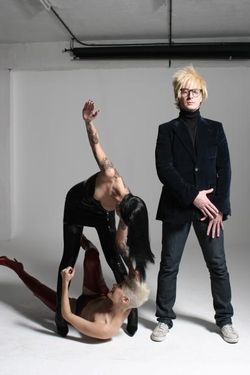
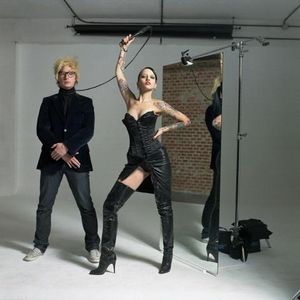
44100Hz: New York, by all appearances, also left an impression; say a couple of words about your Warhol-style photo shoot?
DJ Hell:
Andy was a champion among people. He managed to run the world his own way. He was an absolute genius and a breaker of rules. He knew how to play, manipulate and control people. Berlin needs a Factory too, and I'll be Andy War-hell!
3 October 2008
Moscow, Arma 17
Gigolo Night party