Ladytron
Лондон
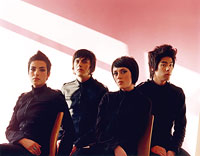
They took their name from a Roxy Music song, wear outfits made for some early 70s sci-fi film, and reference more than three decades of music, while playing organically brewed synth-pop in the lo-fi genre. The Liverpool quartet Ladytron represents either musical dreamers or a glimpse into an alternative reality where the world embraced a radically different melodic line. The thought of them conjures both beliefs.
Releasing their debut album '604', Ladytron dug their first big tunnel into U.S. territory. Thus, they cemented the success that came after last year’s EP 'Commodore Rock'. The band is led by Daniel Hunt. The group's swift electronic melodies evoke the creativity of Human League filtered through the automation of Devo and projected through a pocket calculator by Kraftwerk. This is quite enough for you to label the group’s style as retro-futuristic nostalgia for the best days of robot pop – the concept of Ladytron is definitely not defined.
"We carry this concept within us," laughs Hunt. "That is, we have no problem with it. The only thing that concerns us is to avoid being perceived as prioritizing style over content." He insisted that the band made no return to any era. Their sound, as Daniel explains, is simply the result of their nearly exclusive use of keyboards and synthesizers in writing and performing their compositions. "Our music is based more on the sounds we get from our instruments than on any desire to revive the past," he says. "We consider ourselves a modern band." Ladytron owes its existence largely to its founder and composer Hunt. "I tell people I played in a band called Ladytron even before the band actually formed," he said. In reality, the collective was formed after Hunt and his old friend Reuben Wu met in Liverpool with Helen Marnie and Mira Aroyo in 1998, completing the lineup. They recorded their first single - the ballad 'He Took Her To a Movie' for just £50 and gained almost constant companionship from their fans. Of course, some misunderstandings happened to them at that time, but it's not Ladytron's fault. They came up with special outfits - a sturdy black uniform that matched the natural black hair color of all quartet members. The idea for such design came from the 1971 film 'The Andromeda Strain'. The title of the album refers us to a computer error code in that film - the variation '601', meaning 'unable to analyze'. "We thought it was funny," Hunt said regarding the costumes. "We even thought we had become some cartoonish ensemble since we were practically fooling around with something like that." The name 'Commodore Rock' is a nod to Rob Hubbard, a person famous in certain circles for composing 8-bit music for 80s computer games on the Commodore 64. In fact, Ladytron owes its style to both the modern electronic pop group Broadcast and any synthesizer collective from the 80s. Despite Daniel's statement that on '604' music from the 60s influenced no less than music from the 80s, he said that his compatriots Broadcast reflected almost precisely such a passionate cinematic groove on their last year's album 'The Noise Made By People', which he originally wanted to supply to Ladytron’s music. "We made a conscious decision to move away from that sound because I thought: they already did it," said Hunt about the group Broadcast. Instead, the record '604' showcases a more urgent branch of electro-pop, most vividly represented in the latest single 'The Way That I Found You' (a genuine example of modern new wave) and the techno-funk track 'Mu-Tron'. As Hunt emphasized, music comes first. "This is the band I've always dreamed of," he said.
