Fabrique Girl
Чтиво · 14.07.2008
By 44100Hz
The Fabrique club hosted an off-site class for students of the «Management in the Restaurant Business and Club Industry» faculty of GUU – RMA. It was led by the club's art director Ekaterina Belyakova. Below are the most interesting excerpts from her talk.

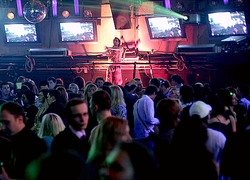
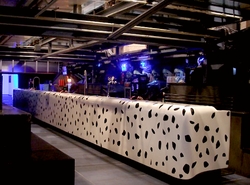
Since 2003 the club has changed little in purely outward terms. As back then, it operates on two levels – the upper one, where the catwalk is located, a restaurant area with separate private rooms, a small bar and a summer terrace, which in winter is converted into an ice rink with skate rental. And the lower one – with the dance floor, a lounge area and, again, a bar (though we've now upgraded the lower level, making it more comfortable – instead of a row of sofas we've placed convenient booth-niches designed for groups, plus made some changes to the design). As back then, the club can hold 1,500–2,000 visitors at once. As in 2003, it operates twice a week – Friday and Saturday from nine in the evening to seven in the morning. Entry is mostly free; we charge a fee – from 500 to 1,000 rubles – only on the days of major parties, which, though they've become fewer lately, still go off with a bang and always to great acclaim. Our main revenue comes from the restaurant and bars, which run on a deposit system. You can't sit down at a table without paying 3,000 to 4,000 rubles into the till: that money is then credited toward your order from the menu. In addition, Fabrique maintains relations with our regular partners – tobacco and alcohol brands, whose roster, compared with five years ago, has also not undergone significant changes. Bacardi, Martini, Miller, British American Tobacco: their products are sold in Fabrique on exclusive terms and, under the terms of the contracts, we have no right to trade in alcohol and cigarettes produced by competing companies.
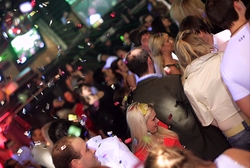
That said, one cannot claim that Fabrique has remained the same as it was in the first years of its existence. Because over this time the main thing about the club has changed. The music policy changed, and accordingly the ideology of the club, which now positions itself as a large dance venue playing disco and vocal house in all its manifestations, and where there is no place for musical experiments, as there used to be earlier, when we played trance, and electro, and tech-house."
Then, however, what apparently had to happen, happened. Those of our visitors who had come to Fabrique practically from the first day of its existence grew up and stopped coming to us; only a handful of those people remain now. For many other clubs this would have meant the beginning of the end. All the more so since before our eyes we had the examples of the fairly numerous projects of those same Gorobiy and Lazarevic, always operating by one and the same scheme: invest – recoup – earn – close – move to a new location to launch a new project. However, in Fabrique's case this didn't happen. And chiefly because a new audience came to replace the old one. I won't undertake to characterize it clearly – it's too varied, in age, in occupation and even in level of wealth, though there are, of course, no people below a solid "middle" level among them.
Very young people and men in their forties to fifties, clerks and, as they say, middle-management managers, employees of foreign companies working in Russia – all of this is our current audience. What unites these people? Hard to determine. Maybe an interest in fashionable dance music or in some specific show programs, or maybe not at all. I'd even say that most of them don't care what music plays in the club, which DJ plays; the main thing is that, coming here, they hear the same as last Friday and Saturday – seasoned, light house music. There are no jarring lurches into trance and progressive that would grate on this crowd's ears, and they come to us again and again. They come not to dance, but simply to drink, eat, socialize: this is also borne out by the alcohol sales figures – lately every weekend we go through 50 liters of whisky alone. Those visitors who do pay attention to the music prefer not something radical and cutting-edge, but perfectly middling, purely commercial house.
Meanwhile, all those Western DJs, whose one or two hits we hear on the radio or see on TV, bring with them to Moscow the most newfangled baggage of records with the energy of that Western music – quite hard and rhythmic. So what happens in the end? The crowd expects those very "two hits" from them, but they often break off into other music unfamiliar to the local audience. Imagine a situation like this: you invite, say, Gaudino, he plays his famous tracks, then starts experimenting, and people don't "get into" his music, the dance floor shuffles about, everyone's waiting for standard light house. And you can't very well tell him: "You know, Alex, play something a bit simpler, because people don't understand." That's why we're very selective about the choice of music and the booking of Western stars!

That said, there are other problems in working with DJs too. The main one has to do with the fact that many Russian clubs simply blow up the market by offering foreigners the kind of money they'd never earn back home. The average fee for a DJ's performance, even a star one, in the West is 10–15 thousand dollars. And here someone offers him forty. And that's far from the limit. "Rai" once paid one DJ 50 thousand conventional units. Naturally, other celebrities, getting wind of this, take their bearings from precisely this figure, and are in no hurry to come to Russia for less money.
A fairly common mistake club promoters make in working with DJs is also that they often resort to the mediation of booking offices, which simply cheat them. Working directly with DJs' agents, whose contact details are easy to find on their websites, is far more attractive. And most likely you'll get them at perfectly reasonable prices, albeit not under the MOS brand. I remember that in 2004–2005 Fabrique was literally flooded with offers to host Ministry of Sound parties, citing ownership of the brand's rights. But why do we need that? After all, a DJ can come and play entirely on his own."
This is explained first of all by the fact that the audience such establishments are aimed at is inherently very, very narrow, so there simply isn't enough of it for the clubs that keep opening one after another. Moreover, the partygoer these days isn't the same as in the late 90s to early 2000s: the trend is that whereas club regulars used to change two or three places a night, now, having arrived at one, they usually stay there until morning. To surprise this spoiled crowd with something, to make it change its habitual place of deployment, seems almost impossible. At the same time, Moscow acutely lacks affordable clubs for representatives of the middle class. They almost never drop into glamorous venues: it's expensive there, the crowd is far too specific, next to it you feel out of your element, and you might not get past face control. And there's not really anywhere else to go.
It's rather strange, but despite the very high demand for affordable clubs, club-restaurants, club-cafes, this market niche, despite its more-than-obvious prospects, is filling up very slowly. There are places like Pancho Villa, Real McCoy, Che – with their own energy; there's Fabrique, as a "club-club"; but there's also "Zona," which admits practically anyone able to pay 500 rubles, and considering that vodka in this establishment costs 100 rubles a serving, such an entry price doesn't seem sky-high at all. All these venues are doing quite well economically and have no trouble with guests. The problem, as I've already said, lies elsewhere: in the fact that there are still few such clubs. If only someone would go and open a huge affordable venue with a paid entrance, aimed at people aged 25 to 35!
Based on all of the above, allow me to give you one piece of advice. If you ever decide to open your own club, the word "glamour" may serve as your aspiration to a certain lifestyle, a certain level of wealth and so on. But there shouldn't be thousands of glamorous clubs! It's a dead-end pursuit for those who understand nothing about it. Leave it to the pros! Better open an affordable venue for 500, or even 1,500 guests. With a minimal show program. With fashionable but not brainy music. With inexpensive alcohol. And don't choose the center. I'm sure that a club in, say, Altufyevo or Butovo will bring you far greater income. There are hundreds of young people there with nowhere to go. You'll see, it'll take off!"