Heiko Laux Brings Kanzleramt to Moscow
Интервью · 19.11.2008
By 44100Hz
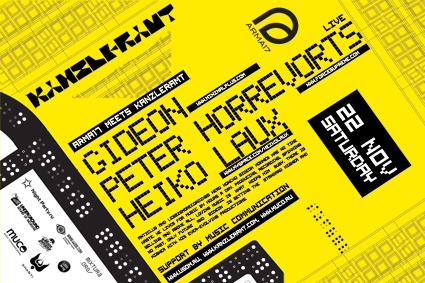
Berlin's Kanzleramt has for more than ten years been regarded as one of Germany's most respectable techno labels. The techno boom that swept across Europe and continues to this day is in large part the work of Heiko Laux and his protégés. On 22 November, Kanzleramt is bringing a whole landing party to Moscow, consisting of the label's founder Heiko Laux (DJ set), the young Dutchman Peter Horrevorts (who will give a live performance), and the label's new star by the name of Gideon, who will also take to the turntables. It is to the release of his new album Need No Permission that this visit of distinguished guests to the capital is timed. The event is organised by the club Arma 17 and the Moscow publishing and promotion company Music Communication. Gideon Hommes, or simply Gideon, is a true jack-of-all-trades. A musician, DJ, club promoter and label manager, in each of these activities he reveals some new side of his many-faceted personality and achieves success at it. He first made his mark in the techno world thanks to the Anticlub parties he threw in his native Eindhoven, and by the mid-2000s he became known as a musician too. On top of this, Gideon founded the label Lessismorecordings, which quickly grew into a sprawling record company. Gideon is a devotee of modern techno. The sound he champions both in his own compositions and in his DJ sets is a powerful, confident beat, sharp bass lines, syncopated percussion and minor-key melodic sequences.
Gideon's compatriot Peter Horrevorts, before the start of his musical career, was engaged in drawing and sculpture, and quickly excelled at building rough sound constructions out of synthetic ingredients. At first Peter dabbled in old-school techno with a progressive flavour, releasing records under various pseudonyms on the labels X-Trax, Sublogic Corporation and Tsunami Special Blend, and in 2006 he signed a contract with Kanzleramt, where he began releasing under his own name. For the Dutchman, the move to the illustrious label coincided with his finding his own musical concept. He crossed vintage deep-techno with ragged, itching electro bass lines in the spirit of Alter Ego. The new sound turned out to be not only fresh but also very dynamic. Recognition from his peers wasn't long in coming: Peter's tracks appeared in the playlists and official mixes of such stars as Dave Clarke and Danny Tenaglia, and the composition Birth (Remix) was included in a mix by DJ Skurge, released by arguably the most respectable techno label on the planet — Detroit's Underground Resistance.
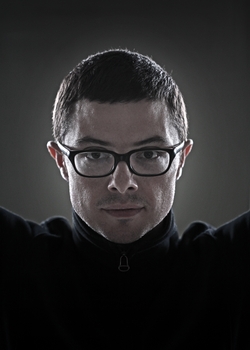
As for the owner and ideologue of Kanzleramt, Heiko Laux, he can be called a true musical maniac. The German has around a dozen projects to his name, and the total number of his records has passed fifty. Laux is a genuine star: everywhere he goes, from New York to Tokyo, success awaits him. His compositions come out on the commercial Yoshitoshi under the patronage of the house duo Deep Dish, on the underground techno label Synewave owned by Damon Wild, and on the legendary Berlin label Tresor. Heiko has been to Moscow more than once — once he performed solo, then he brought his project Offshore Funk, and this time he'll appear in the role of DJ. It's impossible to predict how his set will sound, but it's sure to contain plenty of tracks by his protégés on Kanzleramt Records.
On the eve of his arrival in Moscow, Heiko agreed to answer a few questions for 44100Hz.
It was probably in the mid-eighties, when I first heard Tangerine Dream. Then there was Nitzer Ebb — they had electronic drums and a sea of energy, but I was really carried away when I heard Farley Jackmaster Funk & Jesse Saunders' "Love Can't Turn Around" in a club not far from my home town.
Oh yes! Detroit musicians have always inspired me. If we're talking about what left the greatest imprint on the sound of the Kanzleramt label, then first and foremost it's Detroit.
Releasing CDs is really just another way of distributing the tracks the artists have recorded. After all, it's the label's job to deliver the music to listeners by every possible route. The more formats, the better this material sells — people who don't have turntables at home love music no less. And what matters to me is the music itself, not the medium.
To be honest, I long ago gave up trying to deliberately record something special. If I go into the studio with such thoughts, everything comes out exactly the opposite. It's impossible to predict either what will come out of a recording session, let alone how the record will then sell. So I just go with the flow.

Kanzleramt has always been a platform for putting out the music that I like and that at the same time doesn't fit the format of other labels. So in this case stars simply don't suit us; I'd sooner release something unexpected from a completely unknown artist than tie the label to any big names.
I ought to apologise to the musicians for abandoning that platform, but I simply had to concentrate on one label in order to run it well.

Nothing is forgotten and nothing is lost. The equipment doesn't go anywhere — even now you can still record music on the old "hardware". And the fact that many people still do so says a lot. I myself like both: I use computers and old synthesizers alike.
Maybe a new name will appear, but club music will be just fine. I haven't heard of a single musical genre ever dying.
The thing is that small towns play by the rules, while in big ones chaos develops and they slip out of control. They live their own life; narrowly specialised scenes emerge there, where their own particular processes develop. I grew up in a small town and at some point hit the ceiling there. And if you want to grow further, a metropolis like Berlin is just what you need.
At home it's mostly jazz and fusion, in the car I might even put on opera, and in the studio, of course, all these "thumpers".
Questions by Nick Zavriev
