Life After "Diaghilev"
Чтиво · 29.05.2008
By Петр Брантов
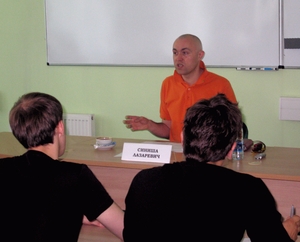
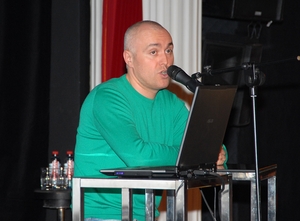
At the State University of Management, a lecture was given by the legendary club promoter Sinisa Lazarevic (projects: Circus Club, "Teatralnaya Kvartira", "Shambala" DJ Bar, "Zima", "Leto", "Osen", "Diaghilev") for students specialising in "Management in the Music Industry" and "Management in the Restaurant Business and Club Industry". During the class the talk was about developing club concepts, the principles of selecting staff, attracting sponsors and other aspects of promotional work. Below are the most interesting excerpts from Mr Lazarevic's lecture.
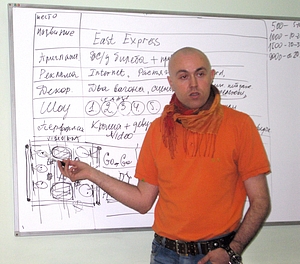
As for me personally, I settled on my target audience 20 years ago, and since then my colleagues and I have never once been unfaithful to it. To put it briefly, we're oriented towards rich people, people capable of shaping public opinion and influencing it. Accordingly, the defining elements of our style have always been and remain beauty, luxury and comfort. Here, though, I should make a reservation: by beauty I mean not some mind-blowing interiors — at "Diaghilev", for instance, they were pompous but absolutely fake. When I speak of beauty, I mean first and foremost the presence in the club of a large number of beautiful girls. If there are beautiful girls in the club, there will be rich, influential men too. There'll be "Rolls-Royces and Bentleys" at the entrance. And what are "Rolls-Royces and Bentleys"? They're your free advertising. These cars at your doorstep literally scream: "It's fashionable to come here, it's prestigious to come here, the best people of Moscow gather here!". And so the word spreads, the "grapevine" starts working. Believe me, no television spots or billboards can compare with such advertising! But let's get back to beauty. By my count, there are now half a million girls aged between 18 and 23 living in Moscow. Well, let's say even half of them aren't beauties. But the other 250 thousand are waiting for our invitations. The scope of work is enormous. Institutes, universities, academies — our promoters are constantly there with one single goal: to meet new girls, befriend them and invite them to our parties. Remember, beautiful girls are the key to success!".
A few more tips on working with guests directly during the party. Guests must under no circumstances be "mixed". When arranging the seating, you must make sure that bankers and oligarchs sit next to their own kind, and that access to the VIP places for the, shall we say, simpler guests is completely excluded. Of course, this rule is one-directional: if a banker or an oligarch suddenly takes it into his head to merge with the people on the dance floor, or to invite a girl he's taken a fancy to into his box, he must under no circumstances be prevented. I would also advise "zoning" the seating of guests depending on which drinks they've ordered: those drinking vodka will most likely find it more pleasant to sit next to and chat with lovers of that very drink than with those who prefer champagne.
Now for the most important thing — the atmosphere you must create for your guests. It is you, and not the artists, showmen and so on and so forth that you've invited. Trust my experience: within an hour and a half of the party ending, none of the guests will remember which singers entertained them that night, or whether they were entertained at all. But how they were greeted, seated, and how and about what they were spoken to, and, finally, how they were served — that they'll remember for a very long time. If the reception pleases them, if it seems sincere to them, they'll want to come back to you again and again; if not — well, here everything's clear enough as it is. In connection with this, one more piece of advice: a promoter must be able to find points of contact, topics of conversation with each of the guests. At the same time, he must realise that the guests in his establishment are the main ones, more important than he himself. At least the guests themselves like to think so. Guests — whoever they may be, oligarchs or middle managers — aren't interested in talking to the promoter about himself; they're more interested in talking about themselves. Give them that opportunity, and you'll come out the winner, including in a purely commercial sense. But remember, don't try to become anyone's "birth mother", don't go too far. After all, they can talk to their mum whenever they want, but with you only when you yourself give them the opportunity. A promoter can't turn into someone's "personal party buddy"; he works for all the guests and must be good for each of them. 2–3 minutes of conversation with one, another, a third. The tone — friendly. The topics — the most general ones: houses, apartments, cars, holiday packages, fashionable clothes. And under no circumstances anything personal, nothing that "tears at the soul". Otherwise you turn from a promoter into a friend, but you're not a friend in the full sense of the word, you "befriend" these people for money. It's a job. And you don't need any other kind of relationship at work.
How do you tell whether you're living up to your guests' expectations? What should you do if, despite all your efforts, guests leave the party long before it ends? The answer is simple: the promoters need to discuss every past party among themselves. In addition, an understanding of what you're doing wrong can come from surveying the waiters who serve the guests and have the chance to overhear their conversations with one another. Having analysed the situation on the basis of these sources, all that remains is to try to correct the existing shortcomings in the shortest possible time. That is, before the next party begins".
As for the requirements that club promoters themselves must meet, here, in my view, creativity of thinking, sociability and the ability to negotiate with people are very important. Say you're planning a cowboy-themed party — then the promoters must convince a certain number of guests in advance that they need to dress up as cowboys. Doing this may not be easy, but it's absolutely necessary, otherwise what kind of "cowboy style" would it be? But if you manage to talk 20 or 30 people into it, then the rest of the invitees, on learning of it, will most likely rush to hunt down the necessary costumes themselves. In general, the members of a good promo group don't limit themselves to working out party concepts in the most general terms, relying on performers for the details. They plan the party themselves, get into every little detail, come up with everything from the idea of the invitation's design to the elements decorating the various club zones. And then they see to the strict precision with which their ideas are brought to life. Only in this way can a club style be born, can a certain zest appear that's unique to your establishment and sets it apart from all the rest".
Let me give two examples. One of the sponsors of "Diaghilev" was the vodka brand "Russian Standard". When holding their parties, we never limited ourselves to placing direct advertising on banners, lightboxes and so on. One of our finds in this respect was placing the "Russian Standard" logo on gilded cushions laid out in the guest boxes. The same goes for a party thrown on the money of one of the largest champagne producers. Here direct advertising was replaced by the ceremonial carrying out into the hall of ice buckets with this drink, accompanied by fireworks and fanfares — this ceremony was repeated more than ten times over the course of a single night.
A few words on how to put together a sponsorship proposal. First of all, it shouldn't be too long. One page is enough; beyond that no one will read anything anyway. The second point: the address to the sponsor should be personal, that is, it should begin with a greeting to the person on whom the decision depends. In this way you'll demonstrate respect for your potential partner and the seriousness of your own intentions. Third: never send a sponsorship proposal by post; such documents must be handed over only in person. Fourth: the creative staff developing the party concept must without fail coordinate it with the club's commercial director. After all, it's he who will have to draw up the sponsorship proposal, and if you can't convince him of the rightness of your concept, then how will he be able to convince the sponsor of it? Finally, the last thing to keep in mind: if you're opening your first club, then the sponsorship contracts for organising parties — at least the largest and most significant ones — need to be concluded before the project is even launched. The sponsors certainly won't come to you themselves. In general, proposals from their side will start coming in no earlier than once you're well known on the market. For that you need to acquire a reputation as a successful promoter who has managed to realise at least two or three interesting club projects".